Door failures alone account for 42% of all elevator service calls. When combined with leveling issues, communication failures, and deferred maintenance, the result is costly emergency repairs, passenger entrapments, and compliance violations. Under ASME A17.1, the safety code for elevators and escalators, building owners are ultimately responsible for maintaining a Maintenance Control Program for every elevator in their building.
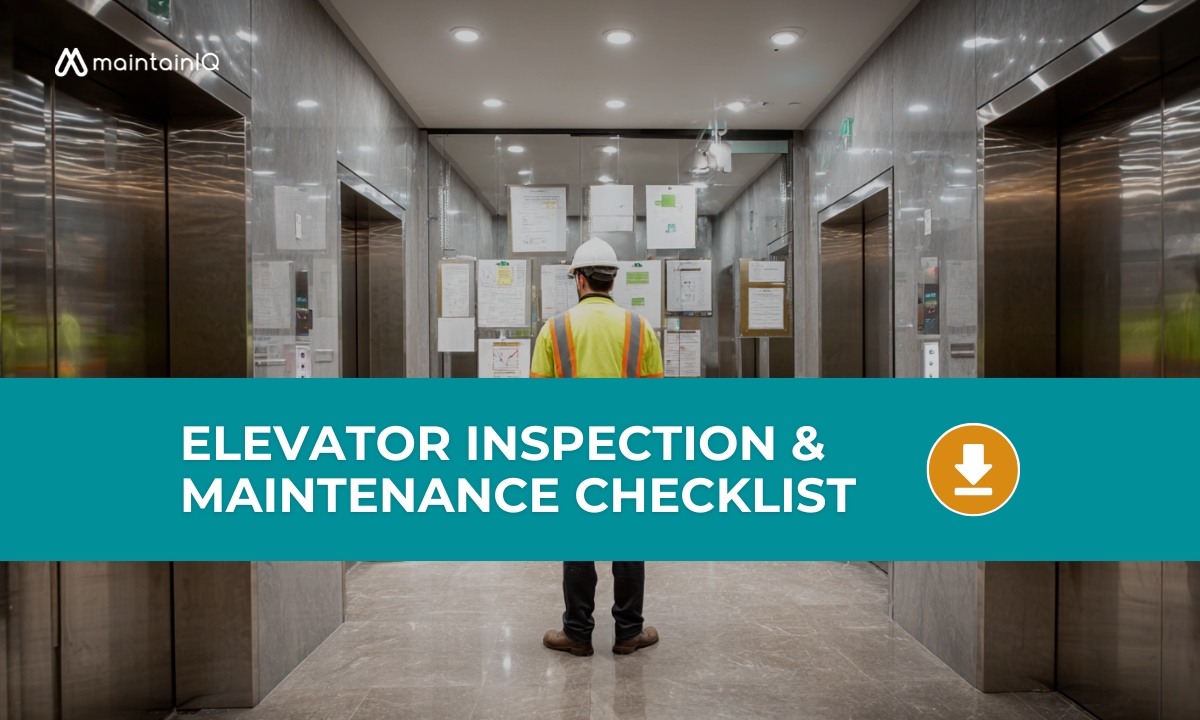
That’s why we’ve created this Elevator Inspection & Maintenance Checklist — covering weekly visual inspections, monthly safety checks, quarterly technician maintenance, annual certified inspections, and the documentation building owners need to stay compliant.
Digitize and automate this checklist with MaintainIQ, your all-in-one maintenance management platform.
What’s Inside This Checklist
- Weekly Visual Inspection (Building Staff): Ride quality observation, button and indicator testing, door operation, emergency phone, alarm bell, car interior condition, and inspection certificate verification.
- Monthly Inspection (Staff/Manager): Landing door condition, track cleaning, fire recall test (Phase I), pit inspection, machine room checks, fire extinguisher, and ADA compliance verification.
- Quarterly Maintenance (Licensed Technician): Door operator adjustment, lubrication, hoist rope inspection, leveling accuracy, interlock testing, hydraulic system check, safety device testing, guide rail inspection, and electrical connections.
- Annual Certified Inspection: Category 1 safety test per ASME A17.1, firefighters’ emergency operation test, emergency power verification, machine and brake inspection, code data plate, and 5-year full-load test reminder.
- Documentation & Compliance: Maintenance Control Program (ASME A17.1 Section 8.6), service logs, inspection certificates, callback tracking, incident documentation, and ADA records.
Why Elevator Maintenance Matters
- Safety: Elevators make 18 billion passenger trips per year in the U.S. Properly maintained safety devices, door systems, and emergency communication protect every rider.
- Compliance: ASME A17.1 requires a Maintenance Control Program for every elevator. State inspectors check for current certificates, service records, and code compliance. Missing records are a common violation.
- Liability: Building owners — not elevator contractors — bear ultimate responsibility for elevator safety. Documented maintenance records are your defense in the event of an incident or claim.
- Equipment Life: A well-maintained elevator lasts 20–30 years. Neglected systems require premature replacement at a cost of $100,000 to $500,000+ depending on the building.
- Tenant Satisfaction: Frequent breakdowns, entrapments, and out-of-service elevators drive tenant complaints and affect building value. Preventive maintenance keeps elevators reliable.
How to Use This Checklist
- Assign the weekly page to building engineering or security staff for routine checks.
- Use the monthly page during your facility manager walkthrough.
- Hand the quarterly page to your elevator service contractor as a verification tool.
- Keep the annual inspection page in your compliance binder alongside the state certificate.
- Or go digital with MaintainIQ — automate reminders, assign tasks, and maintain a complete audit trail.
Go Digital with MaintainIQ
A paper checklist is a great start. Digitizing your elevator maintenance with MaintainIQ takes it further — automated reminders, mobile logging, real-time tracking, and centralized records for audits and inspections. Whether you manage one building or a portfolio, MaintainIQ ensures consistency, compliance, and peace of mind.