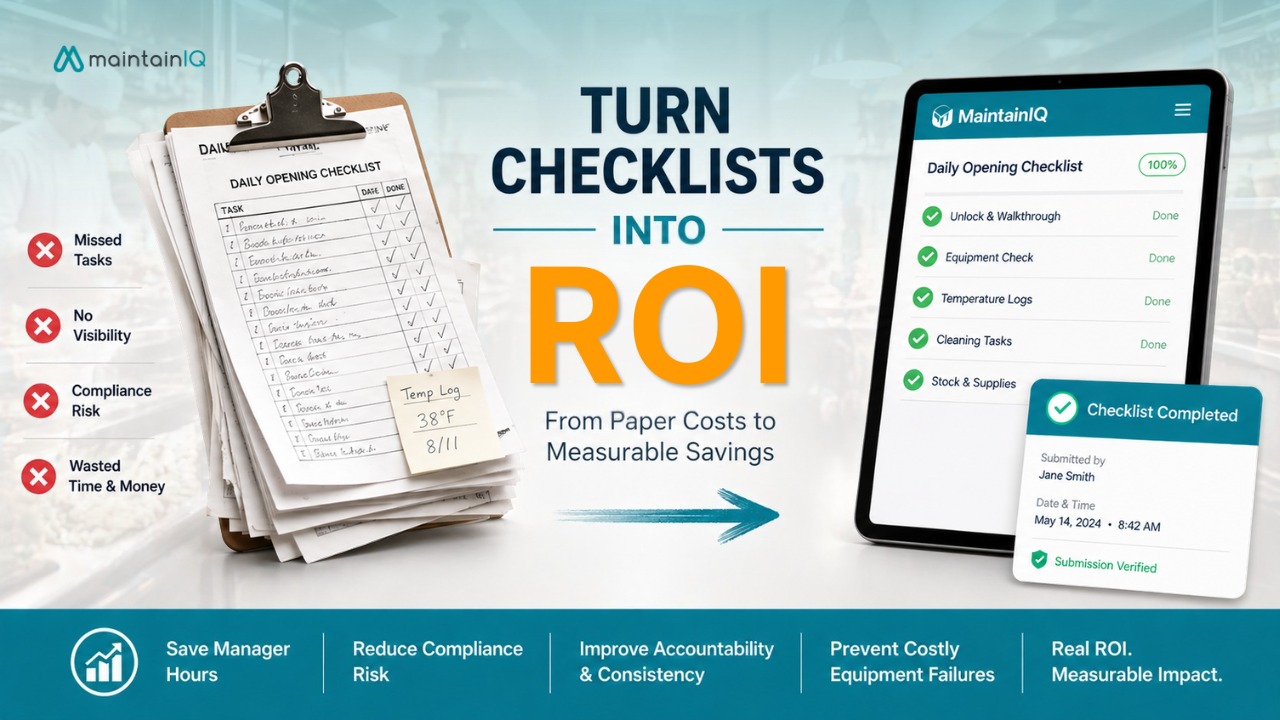
Most multi-location operators know that paper checklists are outdated. What they underestimate is how much those clipboards, binders, and printed forms are actually costing them — in manager hours, compliance risk, operational waste, and problems that go undetected until they’re expensive.
Digital checklists aren’t a technology upgrade for their own sake. They’re a financial decision. And like any financial decision, it should be evaluated on what it costs, what it saves, and how long it takes to pay for itself.
This guide breaks down the ROI of switching from paper to digital checklists across the five areas where the costs are real but rarely measured: labor time, compliance exposure, accountability gaps, multi-location inconsistency, and equipment failures caused by missed tasks. By the end, you’ll have concrete numbers to apply to your own operation.
Table of Contents
The Hidden Costs of Paper Checklists
Paper checklists feel free. They cost a few cents to print. But the real costs aren’t in the paper — they’re in the time, risk, and information loss the paper system creates.
Manager Time on Administrative Tasks
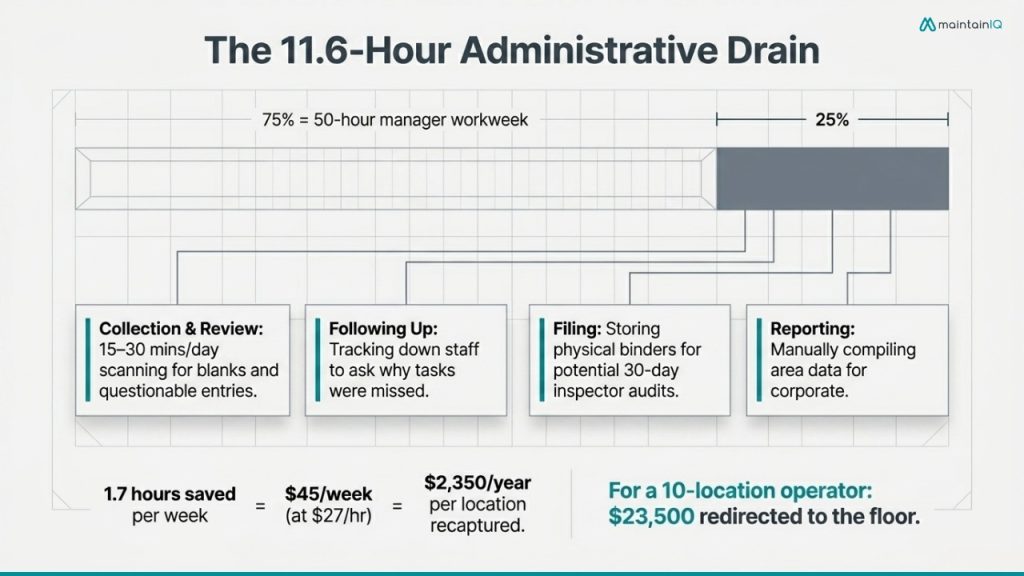
Time studies show that managers spend roughly 25% of their work week — about 11.6 hours — on administrative tasks, including collecting completed checklists, reviewing them for gaps, filing documentation, and following up on items that weren’t done. For restaurant managers who commonly work 50–60 hour weeks, that’s a significant chunk of every day spent on paperwork rather than managing the floor, coaching staff, or improving the guest experience.
With paper checklists specifically, the administrative burden includes:
Collecting and reviewing completed forms. At closing, the manager gathers the day’s checklists from various stations — opening, mid-shift, closing, temperature logs, and cleaning logs. They scan for blanks, questionable entries, and missed tasks. This takes 15–30 minutes per day, depending on the number of checklists in use.
Following up on incomplete items. Paper tells you what wasn’t done. It doesn’t tell you why, and it doesn’t notify the responsible person. The manager has to track down the employee, ask what happened, and decide on corrective action — all from memory or a handwritten note.
Filing and retrieval. Checklists must be stored for inspector access. A health inspector may ask for the past 30 days of temperature logs. Finding, organizing, and presenting paper records from a binder or filing cabinet takes time — and if records are missing, damaged, or illegible, there’s no backup.
Reporting to the corporate or ownership. For multi-location operators, area managers compile checklist data from individual stores into summary reports. This is entirely manual with paper — someone has to physically visit, collect, or call each location to understand completion rates.
Digital checklists eliminate or dramatically reduce each of these tasks. Completion data is logged in real time, visible from a dashboard, and stored automatically. There’s nothing to collect, file, or compile.
The Compliance Cost of Incomplete Records
Paper checklists create a documentation gap that operators often don’t recognize until it becomes a problem.
During visits, health inspectors demand complete, legible, and available records for temperatures, cleaning, and corrective actions. Missing, incomplete, or suspiciously consistent paper entries are treated as evidence of non-compliance.
Health inspection fines for food safety violations start around $200 for minor infractions and exceed $500 for serious issues. Repeat violations carry steeper penalties, and pattern violations can trigger mandatory re-inspections, permit suspension, or temporary closure. The hidden costs of failing a health inspection extend further — a low public grade drives customers away, and recovery takes months.
More than 60% of health inspection failures have been linked to non-compliance with sanitation and food handling protocols — exactly the tasks that checklists are supposed to track. When the checklist system itself is unreliable, the compliance infrastructure collapses.
Digital checklists produce time-stamped, employee-attributed records that cannot be backdated or fabricated. ensuring documentation is complete and credible on demand of the inspector.
Pencil-Whipping: The Accountability Problem Paper Can’t Solve
“Pencil-whipping” — filling out a checklist without actually performing the tasks — is an open secret in foodservice operations. Paper makes it easy. A team member checks every box at the end of the shift, writes down “safe” temperatures from memory, and signs the form. The manager sees a completed checklist and assumes the work was done.
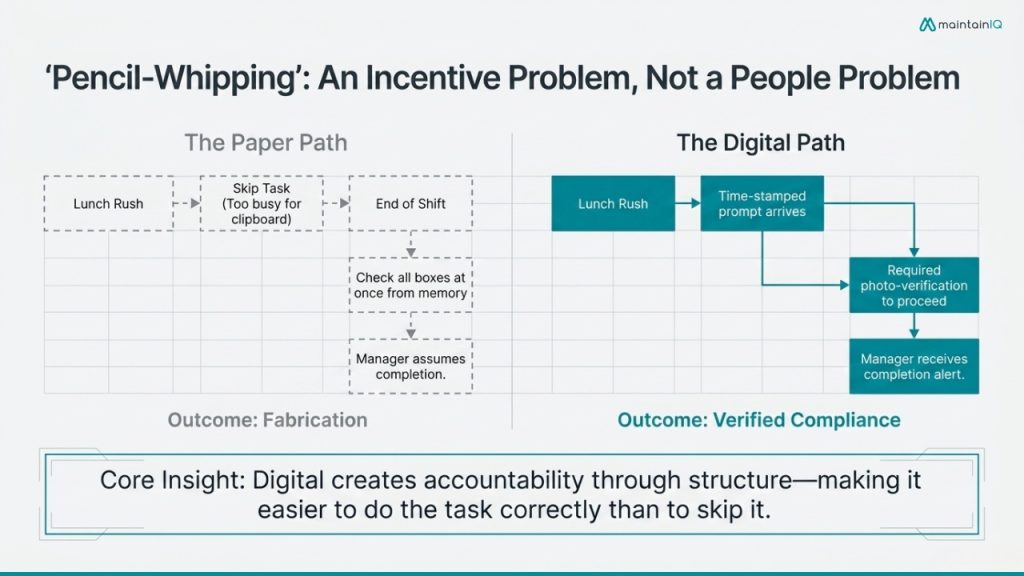
The problem isn’t dishonest staff. It’s a system that makes fabrication easier than compliance. When a cook is deep in a lunch rush, pausing to pull out a clipboard, find a pen, and log a temperature reading feels like a distraction. Doing it later — or not at all — has no immediate consequence on paper.
Digital checklists change the incentive structure. Tasks are time-stamped when completed. Temperature readings can require photo verification. If a checklist isn’t started by a certain time, the system sends a reminder. If it isn’t completed, the manager receives an alert. The system creates accountability not through surveillance, but through structure — making it easier to do the task correctly than to skip it.
Calculating the ROI: Five Areas Where Digital Pays for Itself
1. Manager Labor Savings
This is the most immediately measurable return. Take the daily time your managers spend on checklist-related administrative work and multiply it across locations and weeks.
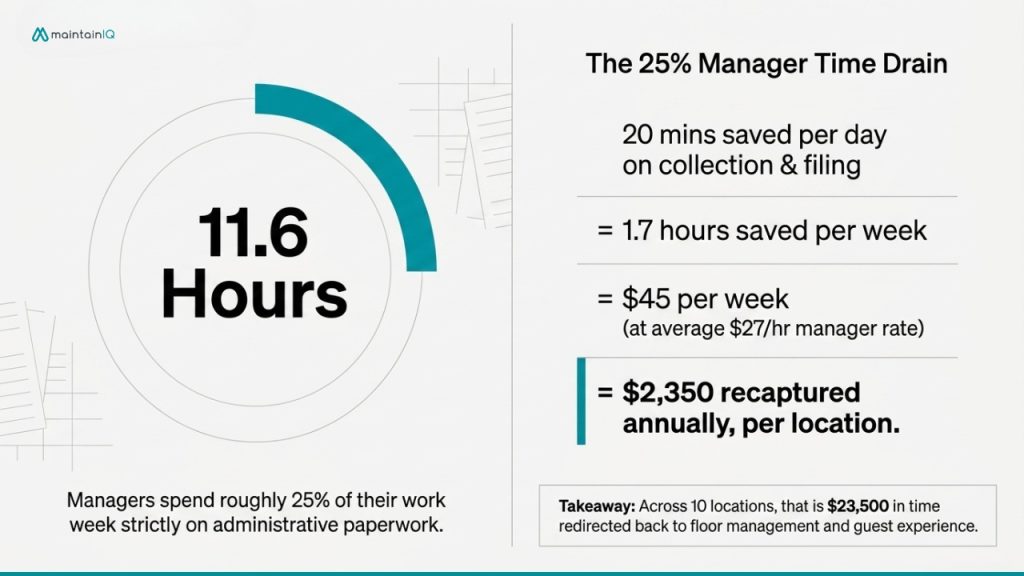
Conservative estimate: If a manager saves 20 minutes per day on checklist collection, review, and filing, that’s roughly 1.7 hours per week. At an average restaurant manager salary of around $27 per hour (based on Bureau of Labor Statistics data for food service managers), that’s approximately $45 per week, or about $2,350 per year per location.
For a 10-location operation, that is $23,500 in recaptured time; for 25 locations, it is nearly $59,000. This time is redirected to floor management, staff coaching, and guest experience.
2. Avoided Compliance Penalties
This return is harder to predict per-location but carries the highest per-incident impact.
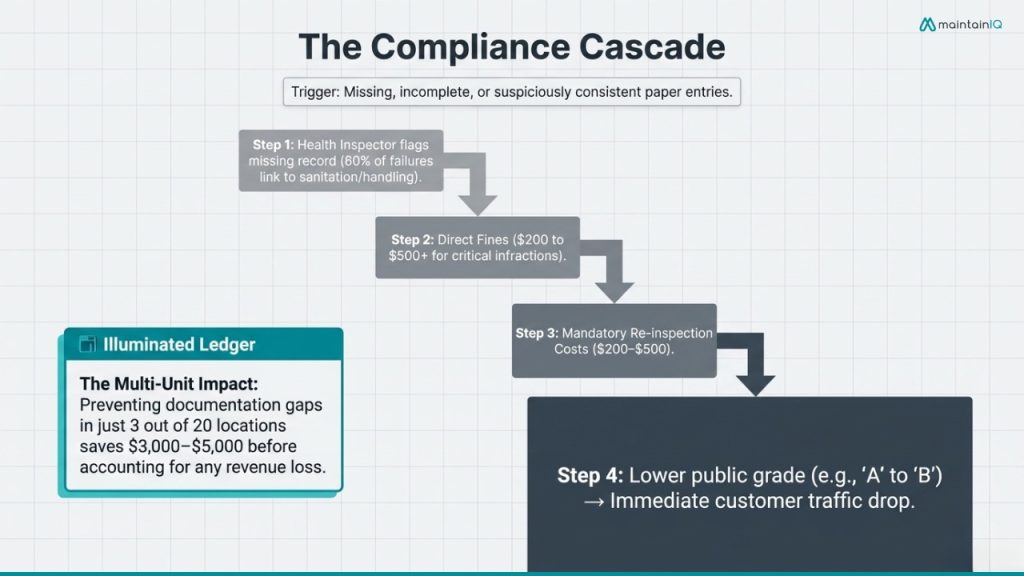
A single failed health inspection with a critical violation can cost $500 or more in fines, plus the cost of a mandatory re-inspection ($200–$500 in many jurisdictions), plus the revenue impact of a lower public grade. For operations in letter-grade jurisdictions like New York City or Los Angeles County, a drop from an “A” to a “B” visibly displayed on the door reduces customer traffic.
If digital checklists prevent even one critical violation per year across your operation — by ensuring temperature logs are complete, cleaning tasks are actually performed, and corrective actions are documented — the system has likely paid for itself.
For multi-location operators, preventing documentation gaps in just 3 of 20 locations can save $3,000–$5,000 in direct costs before accounting for revenue loss.
3. Reduced Equipment Failures from Missed Preventive Tasks
Checklists often include equipment-related items — check cooler temperatures, inspect door gaskets, verify dishwasher rinse temp, and clean condenser coils. When these tasks get pencil-whipped on paper, the equipment issues go undetected until something fails.
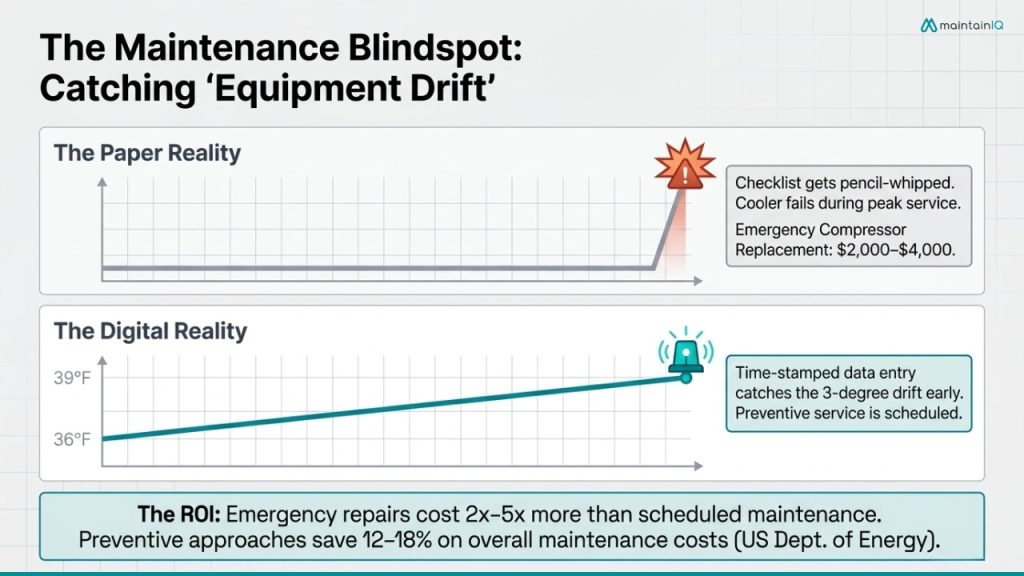
Emergency restaurant equipment repairs cost two to five times more than scheduled maintenance. A walk-in cooler compressor replacement runs $2,000–$4,000 as an emergency call. Scheduled condenser coil cleanings that prevent compressor overwork cost a fraction of that. According to the U.S. Department of Energy, preventive maintenance saves 12–18% on overall maintenance costs compared to reactive approaches.
Digital checklists using photo documentation or specific data entry catch “equipment drift” early. When a checklist consistently shows a cooler running at 39°F instead of 36°F, that trend is visible in digital reports — and it triggers a preventive maintenance response before the compressor fails during peak service.
4. Multi-Location Consistency and Visibility
For single-location operators, the ROI case is primarily time savings and compliance. For multi-location operators, there’s a compounding return: operational consistency.
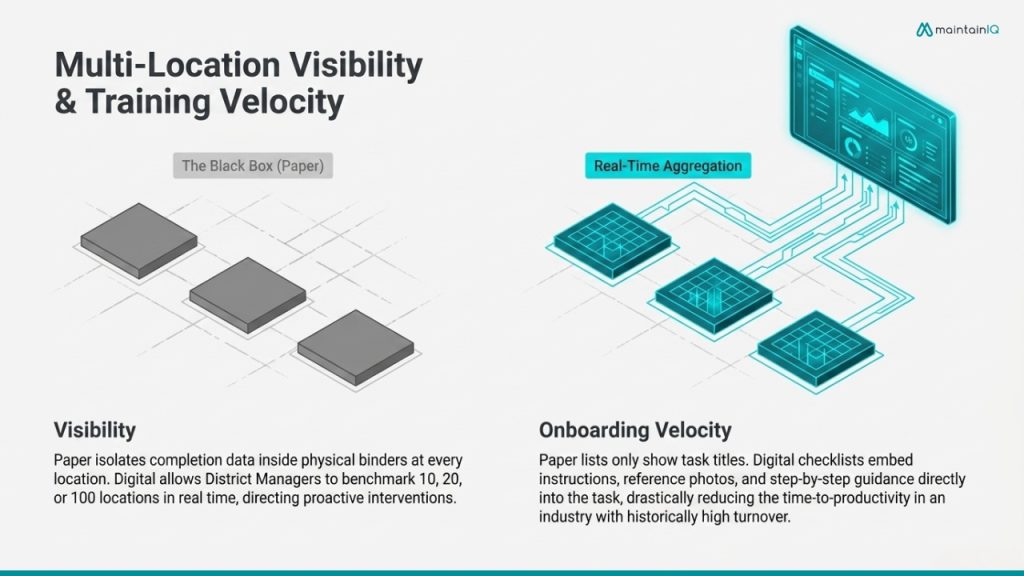
With paper checklists, every location is a black box. You don’t know whether Store #7 completed its food safety checklist today unless someone drives there and checks the binder, compare completion rates across locations and can’t identify which location consistently misses its mid-shift cleaning check or which manager’s team has the most incomplete logs.
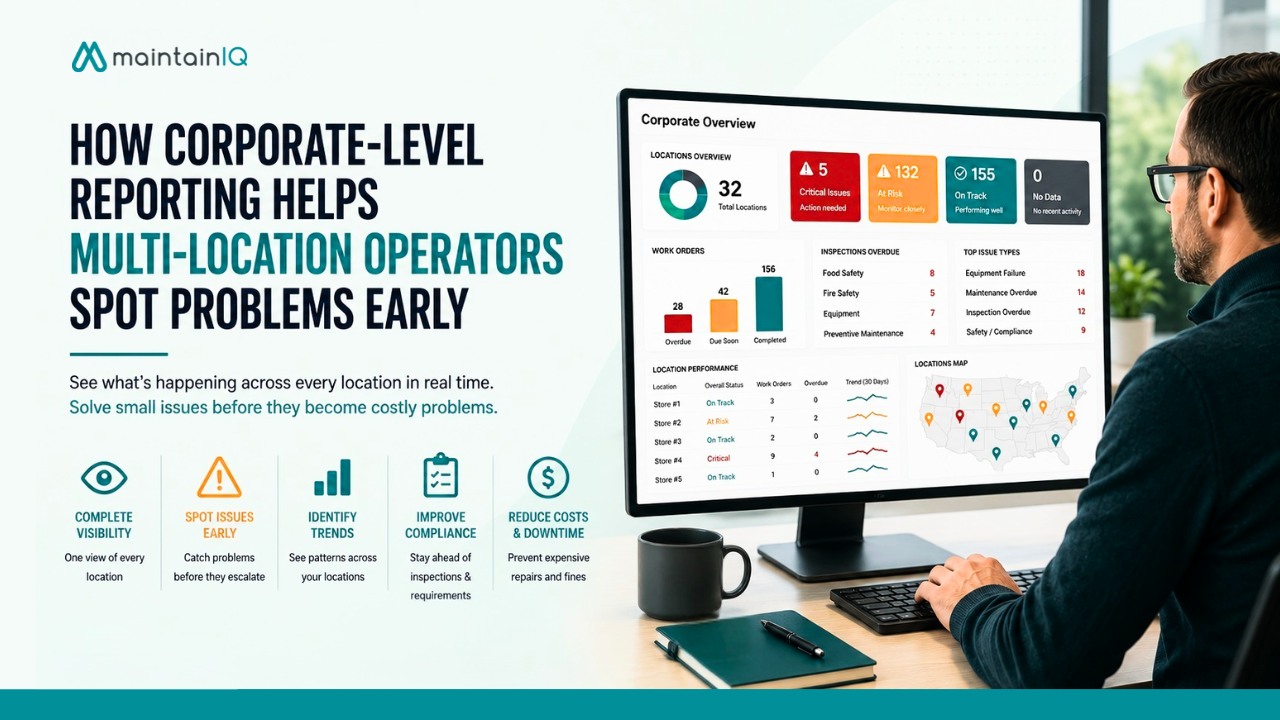
Digital checklists with corporate-level reporting turn every location into a visible, measurable operation. District managers see real-time completion data across all their stores. Corporate can benchmark locations against each other and direct training, staffing, or corrective action where it’s needed most.
The ROI stems from prevented problems: catching a location that would have failed an inspection or identifying a cleaning protocol being skipped. These are costs never incurred because visibility allowed for proactive intervention.
5. Training and Onboarding Efficiency
Paper checklists assume the person completing them already knows what to do. There’s a title for each task and a checkbox. That’s it. A new hire looking at “sanitize prep surfaces” doesn’t know the correct sanitizer concentration, the required contact time, or the approved method.
Digital checklists can embed instructions, reference photos, and step-by-step guidance directly into the task. This turns the checklist from a tracking tool into a training tool — reducing the time it takes for new employees to become independently productive.
Average restaurant employee turnover in the U.S. remains high — the Bureau of Labor Statistics consistently reports the accommodation and food services sector among the highest turnover industries, reducing the time for new hires to become productive is vital. If digital checklists reduce the time to productivity by even a few days per new hire, the labor savings across a year of typical turnover are substantial.
Building Your Own ROI Case
Every operation is different, but you can build a rough ROI estimate with these inputs:
Step 1 — Measure your current time cost. Track how many minutes per day each manager spends collecting, reviewing, filing, and reporting on paper checklists. Multiply by hourly rate, days open per year, and number of locations.
Step 2 — Count your compliance exposure. How many locations received health inspection citations in the past year that could have been prevented by complete, real-time documentation? What were the direct costs (fines, re-inspections) and estimated indirect costs (reduced traffic from a lower grade)?
Step 3 — Estimate your maintenance exposure. How many emergency equipment repairs occurred in the past year? How many of those were on equipment covered by a checklist task (cooler temps, gasket checks, filter changes) that may have been pencil-whipped? What did each emergency repair cost versus what the preventive task would have cost?
Step 4 — Factor in your software cost. MaintainIQ is $79 per month or $799 per year. For a single location, you need the annual time savings and risk reduction to exceed that amount, which, based on the calculations above, most operations achieve within the first one to two months.
Step 5 — Assess the intangible returns. Reduced manager stress. Faster onboarding. Inspector confidence in your documentation. Consistent brand standards across locations. These don’t show up in a spreadsheet, but they compound over time.
What the Transition Actually Looks Like
Switching from paper to digital isn’t a multi-month technology project. For most operations, it takes days, not weeks.
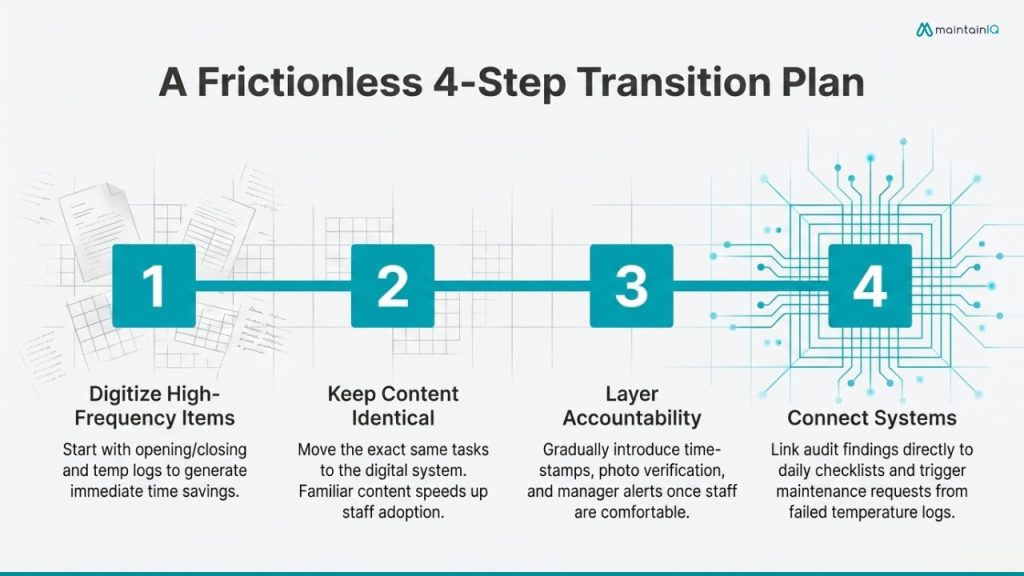
Start with your highest-frequency checklists. Opening and closing checklists, food safety line checks, and temperature logs are used every day and generate the most paper. Digitize these first. You’ll see immediate time savings and accountability improvements.
Keep the task content the same initially. Don’t redesign your checklists during the transition. Move the exact same tasks into the digital system. Staff will adapt faster when the content is familiar — only the format changes.
Add accountability features gradually. Once your team is comfortable with the digital format, layer in time-stamped completion requirements, photo verification for critical tasks, and automatic manager alerts for overdue checklists. These features are what drive the ROI — but introducing them all on day one can create resistance.
Connect checklists to your broader system. The full value of digital checklists emerges when they’re connected to temperature monitoring, work order management, internal audits, and preventive maintenance scheduling. A checklist item that flags a warm cooler should trigger a maintenance request. An audit finding should link to the daily checklist that should have caught it. This integration is what turns a checklist app into an operational management system.
Conclusion
Paper checklists cost more than the paper they’re printed on. They cost manager time — hours per week spent collecting, reviewing, filing, and chasing incomplete work. They cost compliance risk — missing or fabricated records that turn clean inspections into citations. They cost equipment longevity — preventive tasks that were checked off but never performed. And for multi-location operators, they cost visibility — the inability to know, in real time, whether every location is executing the standards the business depends on.
Digital checklists don’t just eliminate paper. They eliminate the gaps that paper creates — in time, accountability, documentation, and cross-location consistency. The ROI isn’t theoretical. It’s measurable in manager hours recaptured, violations avoided, equipment failures prevented, and operating standards maintained across every location, every shift.
The cost of the software is known. The cost of staying on paper is hidden — but it’s there in every missed task, every failed inspection, and every emergency repair that was preventable.
Book a 20-minute demo to see how MaintainIQ replaces paper checklists across every location.