How Digital Temperature Monitoring Prevents Food Safety Violations
Blind spots in your temperature logs could be triggering violations you don’t even know about. Digital temperature monitoring shows what manual checks miss.
Key takeaways
- Hold cold TCS food at 41°F or below and hot food at 135°F or above, the two FDA Food Code limits inspectors check on every visit.
- Cool cooked food from 135°F to 70°F within 2 hours, then to 41°F within the next 4 hours, and log the temperature at both stages.
- Paper logs fail through batch logging, overnight gaps and no alerts, so they show what staff remembered rather than what happened.
- A cooler that creeps a little warmer every afternoon is an early sign of a failing part, so book the repair before it becomes a violation.
On this page
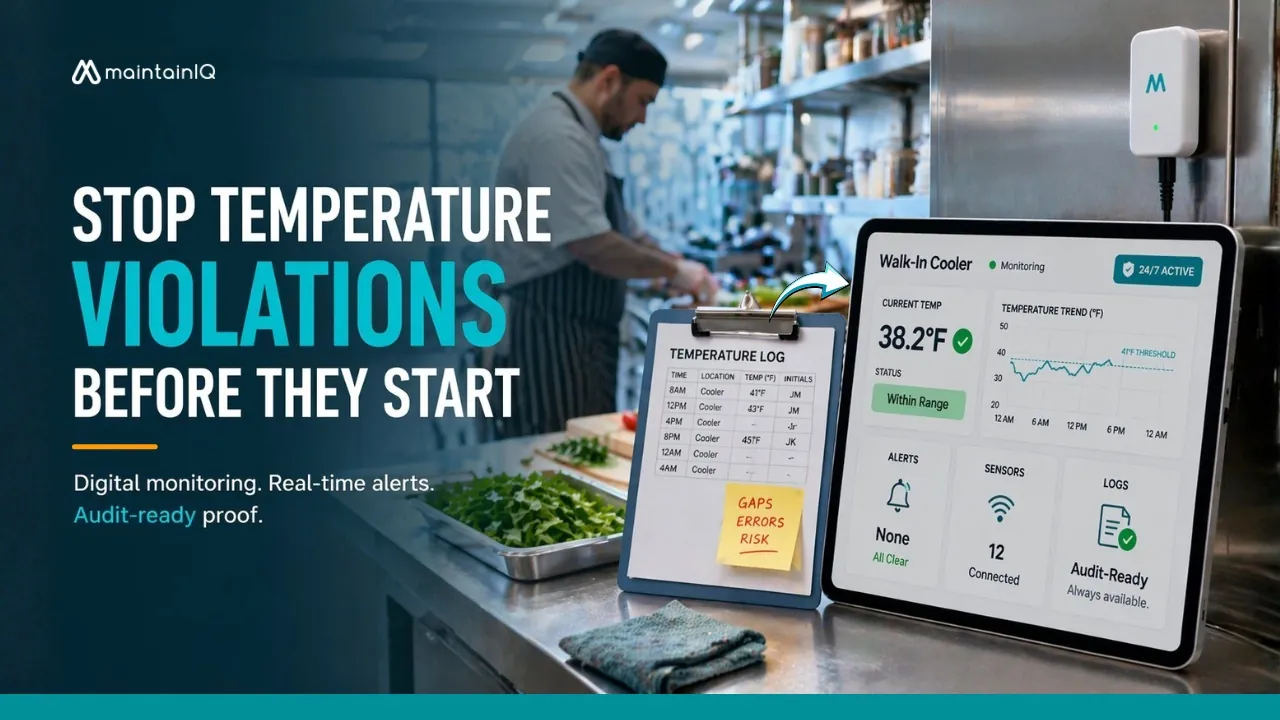
Digital temperature monitoring prevents food safety violations in two ways. It catches a cooler or hot-holding unit that drifts out of range while there is still time to fix it, and it saves every reading with a time stamp, so you can prove to an inspector that the checks happened. Paper logs can’t do either, because they only show what someone wrote down, often after the fact.
The rules themselves are simple: cold food at 41°F or below, hot food at 135°F or above. The hard part is holding those numbers on every shift and having the records to show it. Improper holding temperatures are one of the main risk factors behind foodborne illness, so inspectors check them on every visit. If you’re still relying on manual spot checks, you’re leaving compliance, and your customers’ health, to chance.
Below you’ll find the exact numbers inspectors check, the five temperature violations that come up most often, where paper logs fall short, and what digital monitoring changes.
The FDA Temperature Requirements Every Operator Must Know
Before you can prevent a violation, you need to know the exact numbers inspectors are checking.
The FDA Food Code requires you to hold cold TCS foods (Time/Temperature Control for Safety) at 41°F (5°C) or below and hot TCS foods at 135°F (57°C) or above. The range in between is the temperature danger zone, where bacteria such as Salmonella, E. coli and Listeria multiply fastest. You may also see the USDA FSIS danger zone of 40°F to 140°F. That is consumer guidance for home kitchens; restaurants are inspected against the Food Code numbers.
Cooking minimums are non-negotiable. Poultry and stuffed foods need 165°F, ground beef and pork need 155°F for 17 seconds, and whole cuts of beef and pork, seafood and eggs cooked for immediate service need 145°F for 15 seconds. Food you reheat for hot holding must reach 165°F for 15 seconds, within 2 hours.
Cooling requirements are just as strict. Cooked TCS foods must drop from 135°F to 70°F within two hours, then from 70°F to 41°F within four more hours, six hours total. Refrigerated deliveries should arrive at 41°F or below, and frozen items should be frozen solid at receiving.
Here are the same numbers in one place:
| What you’re checking | FDA Food Code limit |
|---|---|
| Cold holding | 41°F (5°C) or below |
| Hot holding | 135°F (57°C) or above |
| Cooling cooked food | 135°F to 70°F within 2 hours, then to 41°F within the next 4 hours |
| Reheating for hot holding | 165°F for 15 seconds, within 2 hours |
| Poultry and stuffed foods | 165°F |
| Ground beef and pork | 155°F for 17 seconds |
| Whole cuts of beef and pork, seafood, eggs for immediate service | 145°F for 15 seconds |
| Refrigerated deliveries | 41°F or below at receiving for most TCS food (frozen food arrives frozen solid) |
One note on ground meat: the USDA’s consumer chart lists ground beef at 160°F. The 155°F for 17 seconds in the table is the FDA Food Code rule that applies to restaurants.
These numbers are not suggestions. They are the standard health inspectors measure you against on every visit.
The 5 Most Common Temperature Violations That Fail Inspections
Knowing the FDA requirements is one thing. Understanding exactly where operators fail inspections is another. These five temperature violations show up on inspection reports again and again, and each one puts your food license at risk.
1. Walk-In Cooler Running Above 41°F
When a health inspector checks your walk-in cooler and it reads above 41°F, every TCS item inside is flagged as potentially compromised. Food held above 41°F is a critical violation.
This rarely happens overnight. Equipment drift, failing door gaskets, and overloaded shelves restricting airflow push cold holding temperature up gradually. Staff don’t catch it because they’re not monitoring continuously, so the inspector is the one who finds it.
2. Hot Holding Line Below 135°F
Hot holding failures are just as damaging on an inspection report, and they’re a common critical violation. Your hot holding temperature must stay at 135°F or above.
Steam tables not turned up high enough and food sitting without heat checks during a busy service are the gaps inspectors target. They’ll use their own calibrated thermometer, so your readings won’t override theirs. You can’t manage what you don’t measure regularly.
3. Food Left in the Danger Zone During Prep
Prep work happens under constant time pressure, and that’s where temperature control most often breaks down. You pull proteins and dairy from the cooler, set them on the counter, and get buried in tickets. Two hours later, those items are sitting deep in the temperature danger zone.
Without scheduled temp checks, there’s no record of when items left refrigeration or how long they’ve been exposed. You’re operating blind, and that’s exactly what inspectors document.
4. Improper Cooling After Cooking
TCS food temperature control requires cooked items to drop from 135°F to 70°F within two hours, then to 41°F within four more. When that timeline breaks, bacteria multiply fast.
Large batches, slow cooling, and missing logs are common issues inspectors look for. Log the temperature when the food comes off the heat, at the 2-hour mark and again when it reaches 41°F, so you can show both stages were met.
5. No Temperature Documentation Available
Even if your team holds every temperature within range, an inspector who finds no documentation will treat the situation as if no monitoring occurred at all.
Paper logs that are missing, incomplete, or clearly filled in after the fact don’t prove compliance. They undermine it. Inspectors are trained to spot batch-filled logs where every entry shows the same handwriting, same ink, and suspiciously round numbers. That pattern signals fabrication, and it converts a clean inspection into a documented critical violation.
Most of these violations are not about careless staff. They are about having no system that catches problems while they are happening.
Why Paper Temperature Logs Fail
Paper temperature logs remain the default in many foodservice operations, but they carry a fundamental flaw: they record what staff remember, not what actually happened.
The FDA’s retail food risk factor studies found that restaurants with a well-developed food safety management system (FSMS) had fewer out-of-compliance food safety practices than those without one, and improper holding temperature is one of the risk factors those studies track. A stack of paper logs on its own can’t deliver that.
Batch logging is the classic problem. Staff complete entire logs from memory at the end of a shift, writing “safe” numbers that inspectors immediately recognize as fabricated.
Overnight gaps are just as dangerous. Equipment failures between shifts go undetected for hours because nobody is physically present to check.
And paper has no alert capability. It documents the past, never the present. A paper log tells you what the temperature was. It cannot tell you what it is right now or warn you when it drifts.
Paper logs create a false sense of compliance: the records look complete, but nobody was actually watching the temperatures when it mattered.
How Digital Temperature Monitoring Solves Each Violation
Here is how paper logs and digital records compare on the problems above:
| Paper logs | Digital temperature records | |
|---|---|---|
| Visibility | Snapshot checks, often filled in from memory | Readings saved as they are taken, at the times you set (or around the clock with sensors) |
| Response | Problems found after the fact, often as spoiled product | An out-of-range reading prompts a fix right away |
| Data integrity | Open to pencil-whipping and batch filling | Each reading has a time stamp and the name of the person who took it |
| Maintenance | Break-fix emergency repairs | A unit that keeps reading high gets a repair before it fails |
Digital temperature monitoring addresses each common violation by replacing memory and clipboards with records you can trust. It comes in two forms, and many operators use both:
- Wireless sensors sit inside coolers, freezers and hot-holding units and record temperatures around the clock, including overnight.
- Scheduled digital temp checks prompt staff to take readings with a probe and a phone or tablet at set times, and save each reading with a name and a time stamp.
| Wireless sensors | Scheduled digital temp checks | |
|---|---|---|
| What it measures | The temperature inside a cooler, freezer or holding unit | The food itself, plus equipment, using a probe |
| How often | Around the clock | At the times you set, such as every hour or by a due time |
| What the record shows | The unit, the reading and the time | The reading, the time and who took it |
| Best at catching | Overnight equipment failures | Cooking, cooling, receiving and line check problems |
Here’s how each gap gets closed:
Continuous Equipment Monitoring
Sensor-based systems track your cooler and freezer temps 24/7, not just when staff remember to check.
If your walk-in creeps above 41°F at 2 AM, the system flags it immediately, giving you time to act before the morning manager discovers spoiled inventory.
Every reading logs automatically, proving to inspectors that your equipment maintains safe temperatures around the clock.
Instant Alerts and Follow-Up Tasks
With sensors, when a cooler goes above 41°F or a hot holding unit drops below 135°F, an alert goes straight to the manager’s phone, with no wait for the next scheduled check. With scheduled probe checks, a reading that fails can create a follow-up task on the spot, so someone owns the fix. Either way, your team acts before the product is compromised, not after.
For multi-location operators, the advantage compounds. Corporate and regional managers see out-of-range readings and missed checks across every site from a single dashboard, without driving between stores.
Automated Compliance Logs
Every temperature reading a digital system captures is time-stamped, logged, and stored automatically. Compliance records build up as the readings come in, with no copying from a clipboard.
That means no batch logging, no backfilled records, and faster access to complete documentation when inspectors ask for it.
Scheduled Digital Temp Checks During Service
Even with sensors in every cooler, certain critical control points still require hands-on verification with a probe in the food: cooking, cooling, hot holding on the line and receiving. Digital temp check systems make sure those manual checks happen on schedule.
Staff get a prompt at the times you set: line checks during service, receiving logs at delivery, and cooling checks during pulldown.
Each reading captures the employee’s name and a time stamp, so there’s no ambiguity about who checked what and when. That’s documented proof of compliance built into your daily workflow.
Trend Data and Proactive Maintenance
Beyond instant alerts, digital monitoring builds up weeks and months of temperature data that show equipment wearing out in a way no single reading can.
A cooler that creeps upward every afternoon can point to a compressor or door gasket problem before it becomes a critical violation. Use that data in your preventive maintenance scheduling and call a technician based on evidence, not guesswork.
When a reading is out of range, open a repair request in your work order system right away, so the fix has an owner, a due date and a record of when it was closed.
What Multi-Location Operators Gain From Centralized Temperature Monitoring
When you’re managing five, ten, or fifty-plus locations, temperature compliance becomes a system-wide risk, not just a single-store issue.
- Visibility across every site. Corporate and area managers can view temperature compliance for all locations from a single dashboard, without physical visits or phone calls.
- Standardized compliance. Every location follows the same monitoring schedule, same alert thresholds, and same documentation standards. No more “that location never logs their temps.”
- Faster incident response. When a location’s cooler goes down, the right people are notified right away, instead of finding out hours later during the next manual check.
- Inspection readiness at scale. Digital records are always available, always complete. If one location gets inspected, the documentation is already there.
- Lower risk, lower cost. Catching a failing cooler early saves the cost of spoiled product, re-inspections, fines, and potential closures. The hidden costs of failing a health inspection go far beyond the fine itself, and reputation damage is harder to recover from.
For operators with more than one location, centralized monitoring makes it easier to maintain standards, respond faster, and reduce compliance risk across every site. If you run a single location, you get the same benefit on a smaller scale: one screen that tells you whether today’s checks are done and in range, even on your day off.
Getting Started With Digital Temp Checks
You don’t need to overhaul everything at once. Start by mapping your critical control points and building a system around them.
- Identify every monitoring point: walk-ins, freezers, hot holding units, and receiving areas. Set your limits at 41°F cold and 135°F hot, per the FDA Food Code.
- Set up scheduled manual checks for line temps during service and receiving temps during deliveries. These checks add to continuous monitoring (or stand in for it if you don’t use sensors) and give you documented verification at every critical step.
- Train your team on alert response: who acts, what fix to make (move the food to a working unit, reheat it, or throw it out), and how to document every incident. A system is only as good as the response plan behind it.
- Connect temperature monitoring to your broader food safety program: digital checklists, internal audits, and preventive maintenance. Temperature is one piece of a complete food safety management system.
Conclusion
The FDA Food Code requirements haven’t changed. The gap between compliance and violation comes down to one factor: whether your system catches a temperature drift before an inspector does.
Digital monitoring removes the guesswork that paper logs leave behind. Sensors give you around-the-clock tracking and instant alerts, scheduled probe checks prove the food itself was checked, and both give you records that hold up under scrutiny.
For multi-location operators, centralized oversight means consistent standards across every site, without depending on individual managers to remember the clipboard.
The regulations aren’t shifting. Your risk exposure shouldn’t depend on whether someone remembered to check a thermometer.
If you want scheduled temperature checks without the clipboard, MaintainIQ runs digital temperature logs on phones and tablets. You set checks for a due time or every hour, staff take readings with a supported handheld Bluetooth probe, and you see who submitted each check at every location. MaintainIQ uses handheld probes, not wall-mounted wireless sensors, so readings happen during scheduled checks rather than around the clock.
Frequently Asked Questions
How is digital temperature monitoring different from manual temp logs?
Manual logs rely on staff checking and writing down temps at set times, which leaves gaps and can miss problems overnight. Digital monitoring either tracks temperatures around the clock with sensors and sends an alert when a reading goes out of range, or prompts staff to take scheduled readings with a Bluetooth probe. Either way, every reading is saved with a time stamp, so records are easier to review and more reliable for compliance.
Will health inspectors accept digital temperature records?
In most cases, yes. Electronic records are widely accepted and often preferred because they’re more accurate, consistent, and easier to access than paper logs. Local requirements can vary, so it’s still smart to confirm with your health department.
How does temperature monitoring support preventive maintenance?
Temperature data helps catch equipment issues early by showing trends and alerting teams when readings go out of range. When connected to maintenance workflows, those alerts can trigger follow-up action before a small issue becomes an equipment failure or food loss.