Run a restaurant, and implement consistent systems to keep service smooth, costs down, and guests satisfied.
Set AM/PM rhythms, clear prep lists, shift huddles, and FOH/BOH checks so everyone knows what to do. Track temps, manage allergens, and forecast labor to avoid surprises.
Keep standards simple and measurable, and create a routine that actually improves.
Next, see how to implement day-to-day restaurant operations without disrupting service.
Table of Contents
Key Takeaways
- Implement an AM/PM rhythm with set prep, peak service, and recovery windows to standardize daily flow and responsibilities.
- Use labor forecasting and clear shift huddles to assign line positions, rotate roles, and align staffing with specials and 86’d items.
- Schedule MOD rounds each shift to coach staff, verify prep/service readiness, and document adjustments after peak service.
- Run daily quality and service checks—dining room readiness, expo accuracy, and table turns—using mystery shops and CSAT feedback.
- Use MaintainIQ checklists for opening/closing, temperature logs, photos, and automated reports to track compliance and flag issues.
Day-to-Day Restaurant Operations: What “Good” Looks Like
Keep your day on track by establishing a clear AM/PM rhythm that defines prep, peak service, and recovery periods.
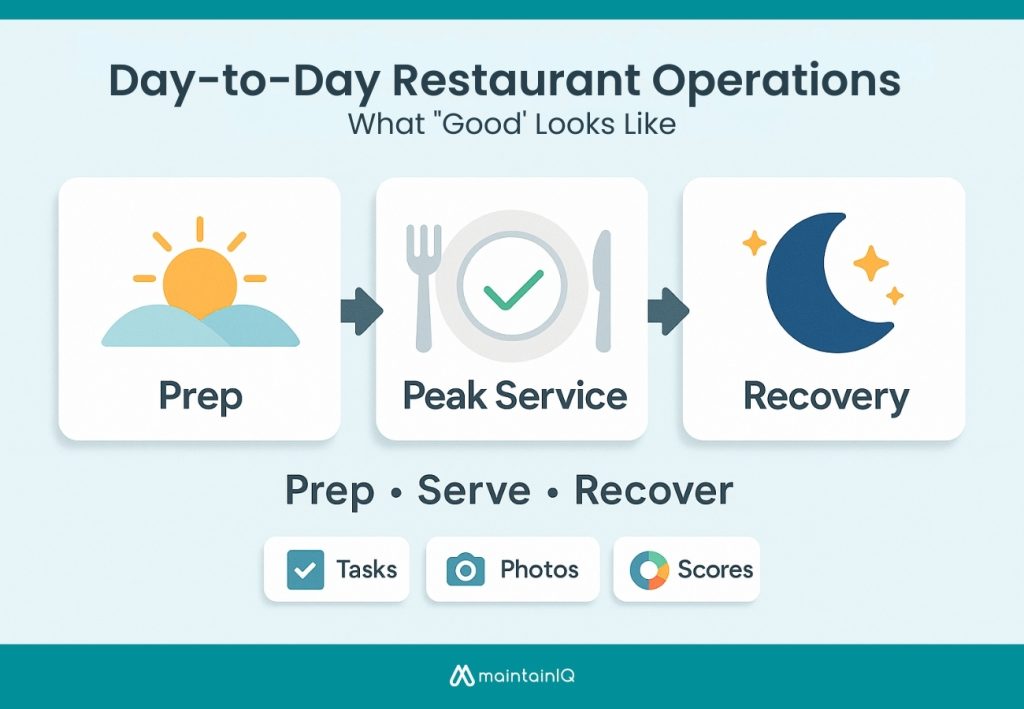
In the morning, set up stations and check inventory, during peak hours, focus on speed and consistency, and after service, you’ll clean, restock, and review performance.
When each phase has defined tasks and measurable standards, you’ll reduce stress, cut waste, and keep guests happy.
AM/PM Rhythm: Prep, Peaks, Recovery
Schedule MOD rounds at set times in the AM and PM to check prep, service flow, and staff readiness.
During rounds, give targeted coaching—correcting technique, reinforcing standards, and offering quick feedback that prevents minor issues from becoming big ones.
After peak service, document observations, adjust staffing or prep plans, and follow up with staff coaching points so the next shift runs smoothly.
Manager on Duty (MOD) Rounds & Coaching
When the Manager on Duty (MOD) leads consistent rounds during the prep, peak, and recovery periods, service runs more smoothly and problems get fixed before they affect guests, staff, or the bottom line.
Make rounds with clear checklists, spot coaching opportunities, reinforce standards, and model leadership.
This builds team accountability, reduces mistakes, and frees you to focus on strategy and growth.
Staff Scheduling & Shift Huddles
You should use labor forecasting—predicting guest counts and peak times—to set staffing levels that control costs while keeping service smooth.
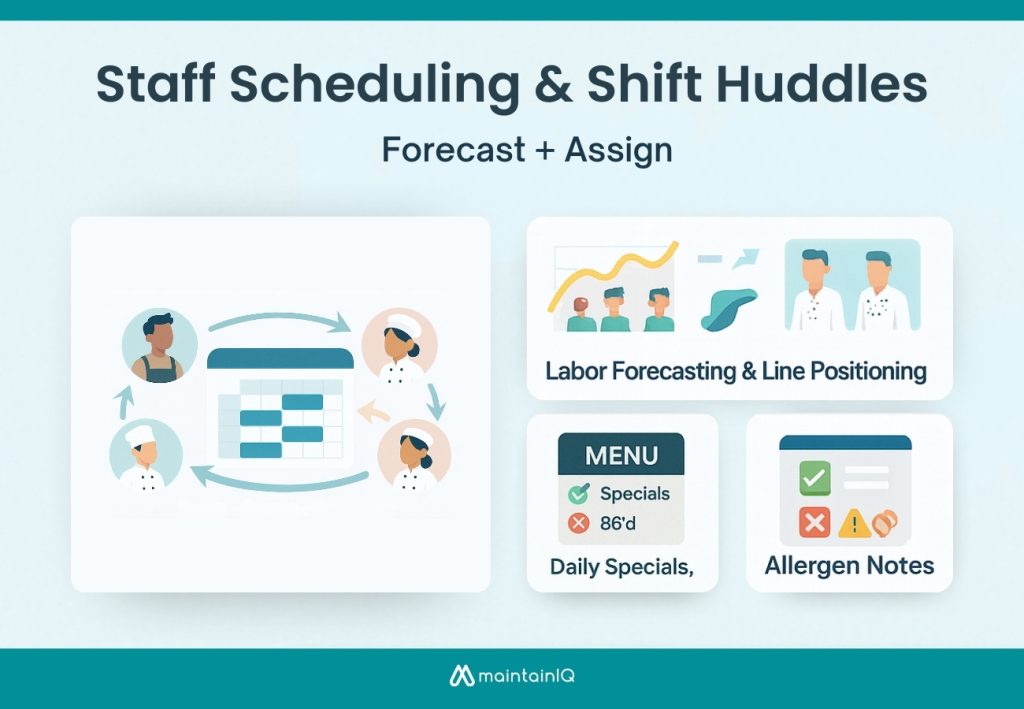
In shift huddles, assign line positions clearly, rotating roles when needed so cooks and servers know who handles which stations and tasks.
Combining accurate forecasts with precise line positioning reduces downtime, prevents bottlenecks, and keeps the kitchen and front-of-house running efficiently.
Labor Forecasting and Line Positioning
When building schedules and assigning stations, factor in daily specials, 86’d items, and allergen notes because they change prep time, plate count, and station workload.
Communicate specials and 86’d items in pre-shift huddles so cooks and servers can adjust line positioning and reduce service bottlenecks.
Record allergen notes prominently and train backups to handle substitutions, which helps you forecast labor needs and maintain safety and speed during busy shifts.
Daily Specials, 86’d Items, and Allergen Notes
Although menu items shift daily, you should make specials, 86’d items, and allergen notes clear and actionable for every station, since those details directly affect labor needs and line positioning.
Use daily inventory levels and menu board updates in huddles to assign cooks, prep, and expo. Mark allergens and 86’d items, then adjust staffing early.
This frees your whole team.
Quality & Service Checks (Front of House)
Start by checking dining room readiness—clean tables, properly set place settings, and a clear path for servers—to make sure guests get a strong first impression.
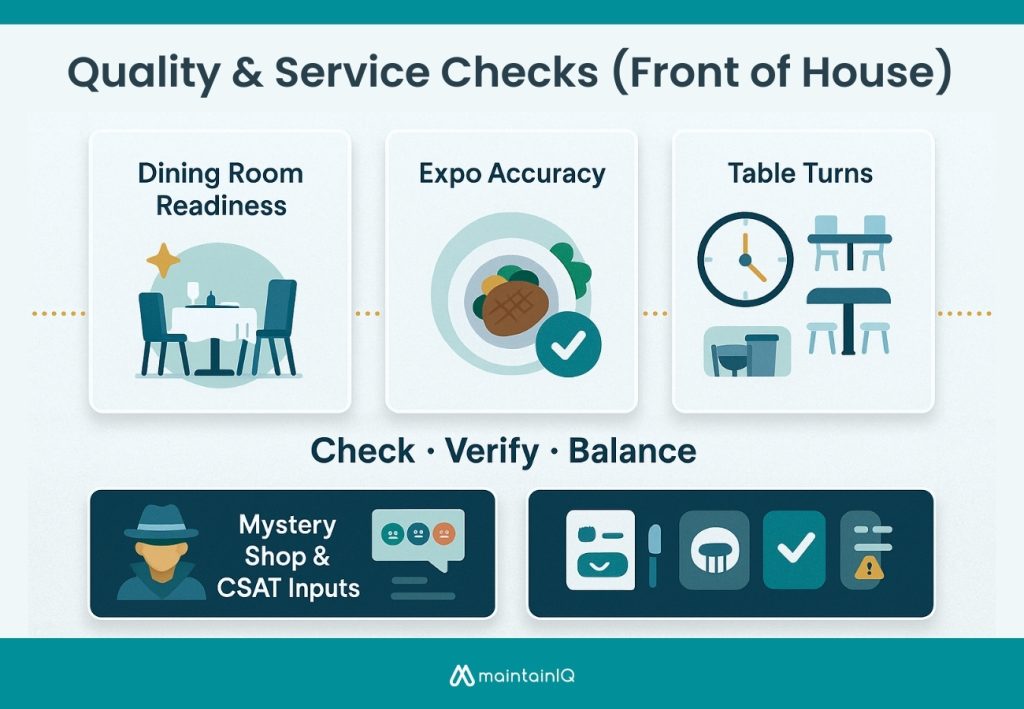
At the expo, verify orders for accuracy and timing, coordinating with cooks and servers so dishes leave the pass hot and correct.
Monitor table turns, balance seating flow and service speed, aiming to maximize covers without rushing guests.
Dining Room Readiness, Expo, and Table Turns
Use mystery shop reports and Customer Satisfaction (CSAT) inputs to assess dining room readiness, expo performance, and table turn quality.
They highlight service gaps, table turn times, and cleanliness, giving actionable feedback you can track and measure.
Mystery Shop & CSAT Inputs
Kick off every service by treating mystery shops and CSAT feedback as your front-line quality checks, since they directly reflect dining room readiness, expo performance, and table-turn efficiency.
Use secret shopper insights and customer satisfaction data trends to pinpoint issues, set clear corrective steps, and empower staff.
Track metrics, coach fast, and free your team to deliver consistent, efficient guest experiences daily.
Safety & Food Safety Controls (Back of House)
Run regular line checks to confirm each prep station is stocked, labeled, and organized, and these checks make it easier to spot missing items or cross-contamination risks before service starts.
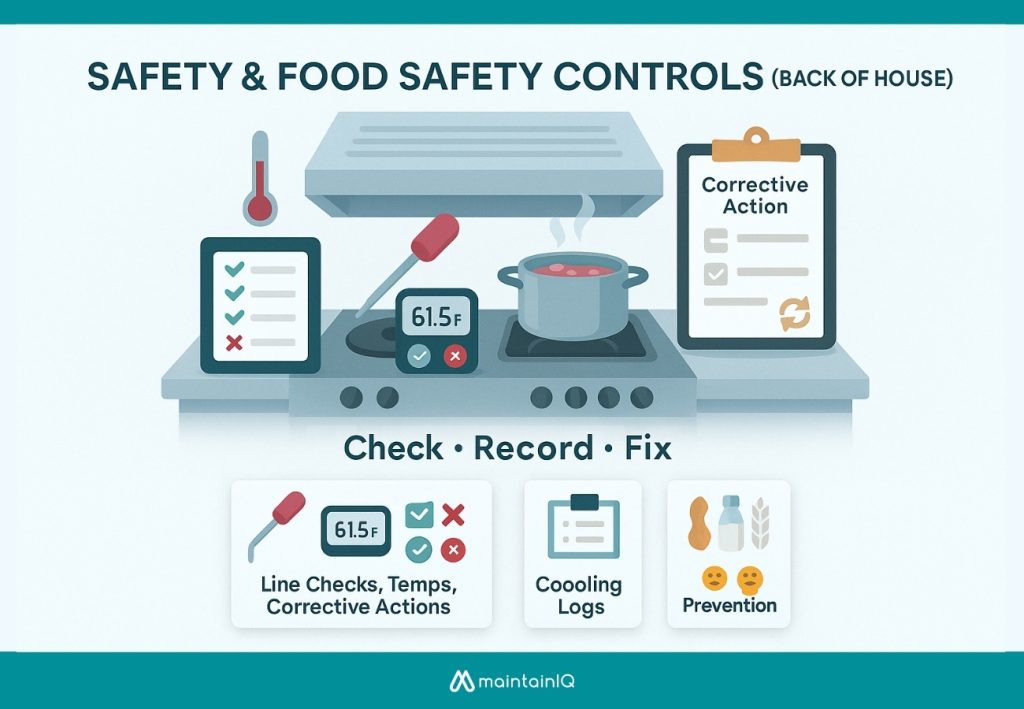
Monitor temperatures for refrigerators, freezers, and hot-holding units, recording readings to make sure cold food stays at or below 41°F (5°C) and hot food stays at or above 135°F (57°C).
When temperatures or line conditions fall outside standards, you take corrective actions right away — for example, adjusting equipment, safely reheating or discarding affected items, and documenting what you did for traceability.
Line Checks, Temps, and Corrective Actions
Maintain accurate cooling logs that record time and temperature during food cooling, since rapid, documented cooling prevents bacterial growth and keeps food safe.
Also need clear procedures to prevent allergen cross-contact—separate utensils, labeled storage, and dedicated prep areas—so guests with allergies aren’t exposed.
When temps or protocols fall short, take immediate corrective actions, document what you did, and retrain staff as needed to close gaps and protect customers.
Cooling Logs and Allergen Cross-Contact Prevention
A clear cooling log and a well-enforced plan to prevent allergen cross-contact are essential tools for maintaining food safety in the back of house, and they protect both customers and your operation’s reputation.
Use cooling log monitoring and periodic allergen risk assessment to free your team from guesswork, set clear corrective actions, and empower staff to act fast and confidently every day.
MaintainIQ for Day-to-Day Restaurant Operations
You can use MaintainIQ to standardize opening and closing checklists, so every shift follows the same clear steps and nothing gets missed.
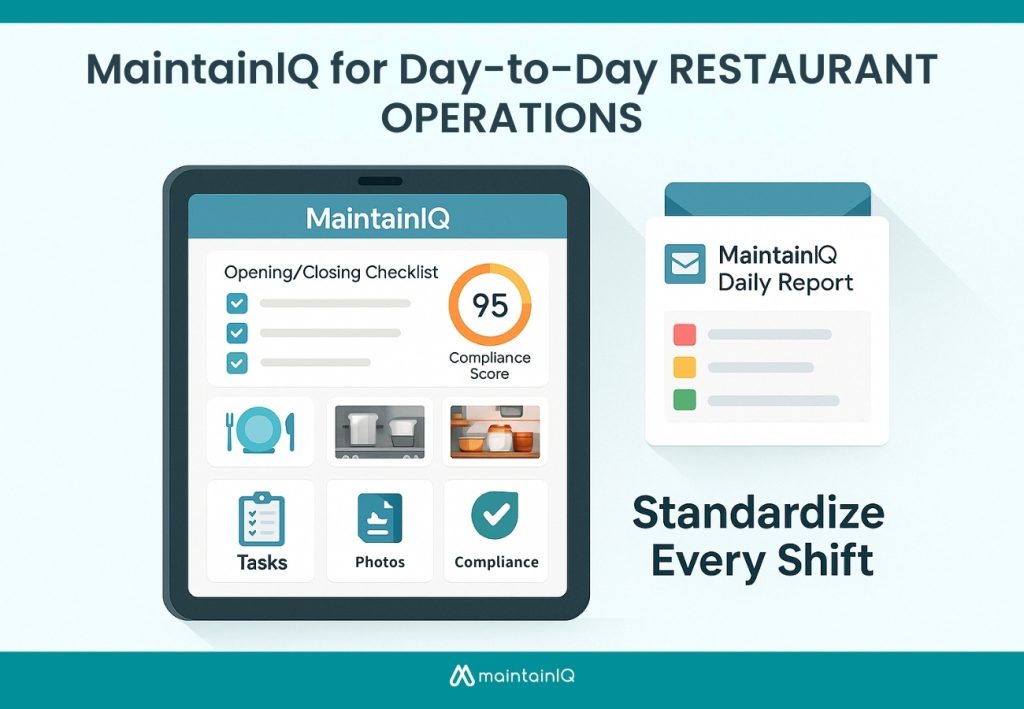
It lets you assign tasks, attach photos, and set time windows, while automatically generating daily scores to measure compliance and performance.
Opening/Closing Checklists & Daily Scoring
Get daily email reports from MaintainIQ that summarize opening and closing checklist completion, scores, and any priority issues so you can see facility performance at a glance.
These emails highlight trends, flag missed tasks or safety concerns, and include links to the underlying checklist entries so you can investigate quickly.
Daily Email Reporting for Owners/Operators
When daily email reports arrive from MaintainIQ, they give owners and operators a concise snapshot of opening and closing checklist compliance, daily scores, and any critical issues that need immediate attention.
You’ll get daily revenue reporting, inventory management updates, and flagged tasks, so you can act quickly.
Reports free you to focus on strategy, empower teams, and maintain consistent standards across locations.
Conclusion
Run a smoother restaurant when you set clear AM/PM rhythms, schedule staff smartly, and hold focused shift huddles.
Use front-of-house checks to keep service consistent, and back-of-house safety and food-safety controls to protect quality.
Forecast labor precisely, position the line efficiently, and gather customer feedback to course-correct.
Standardized checklists and MaintainIQ reporting make tasks visible and actionable, so you can coach proactively, control costs, and sustain steady operational excellence over the long term consistently.
FAQ
What are the essential day-to-day restaurant operations tasks?
Open strong: start-up equipment, verify walk-in and line temps, stock hand sinks and sanitizer, review 86’d items/specials, and set pars. During service, run pre-rush line checks, watch ticket times and expo quality, and log temps and waste.
Keep the loop tight: raise work orders for asset issues, document corrective actions, and finish with a disciplined close—shutdowns, deep clean, final temps, cash/incident logs, and a brief manager report.
How do I run an effective shift huddle?
Keep it to 7–10 minutes, on time, with everyone present. Hit safety, sales/labor targets, 86’d items, specials, station assignments, and any allergen notes; end with one clear quality focus. Use a simple one-pager or whiteboard so targets are visible, do a 2-minute mid-shift check-back, and close with a quick debrief to capture wins, fixes, and carry-overs.
What should be on a restaurant line check?
Verify temps (cold ≤ 41°F/5°C, hot ≥ 135°F/57°C; reheat ≥ 165°F/74°C), labels, discard times, and product appearance/pars. Record every check and note any deviations. Confirm sanitizer strength, clean tools, calibrated probes, intact gaskets, proper utensil storage, and oil quality; if something fails, fix it, log a corrective action, and re-check.
How do I keep food safety tight during rush?
Prep for speed: pre-portion, small-batch cook, keep backups cold, and run timers and discard times so food never drifts out of spec. Make one person the expo gatekeeper for temps/allergens, sanitize probes between uses, follow dedicated allergen tools/areas, and clean-as-you-go so hand sinks and sanitizer stay ready.
How does MaintainIQ support daily restaurant operations?
Mobile opening/line/closing checklists assign tasks by role, capture photos, and enforce temperature thresholds; any fail auto-creates a corrective action with owner
and due date. Daily email roll-ups and scores highlight exceptions, failed items can become work orders, and audits, vendor files, and warranties live alongside assets for faster repair vs. replace decisions.