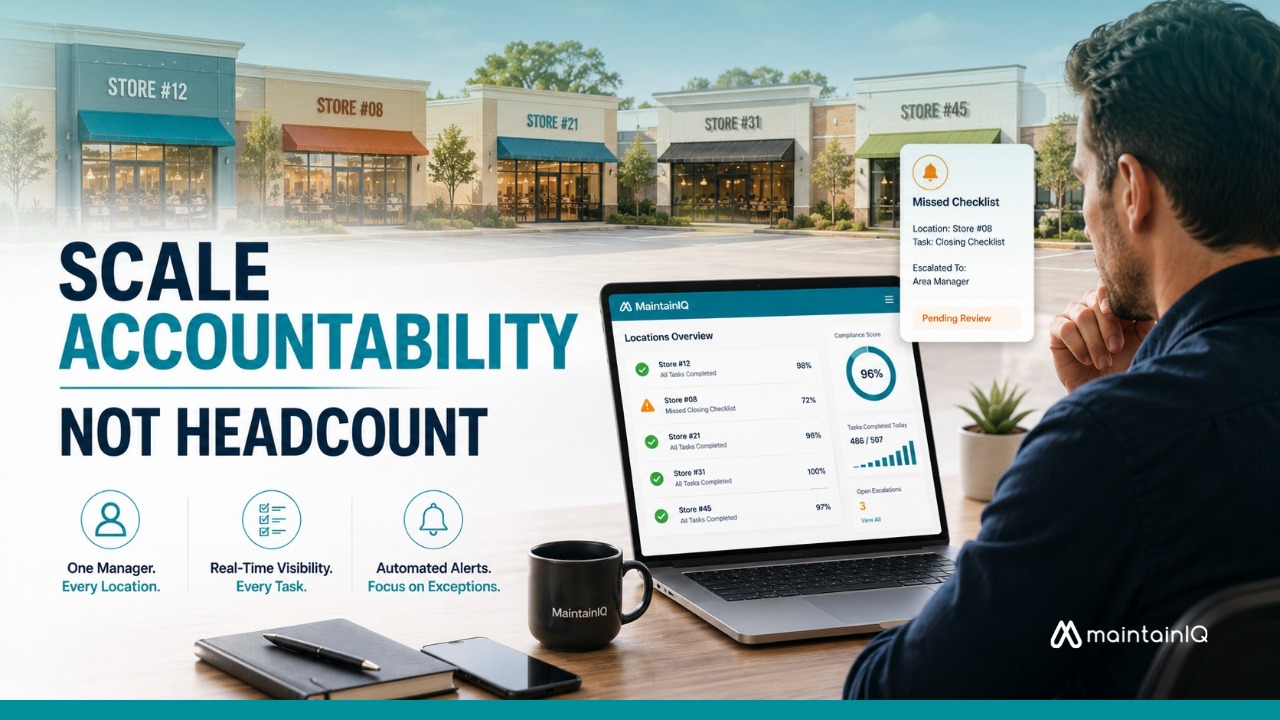
The instinct when a location starts slipping — missed checklists, inconsistent cleaning, a failed health inspection — is to add another manager. More eyes on the floor. More oversight. Problem solved.
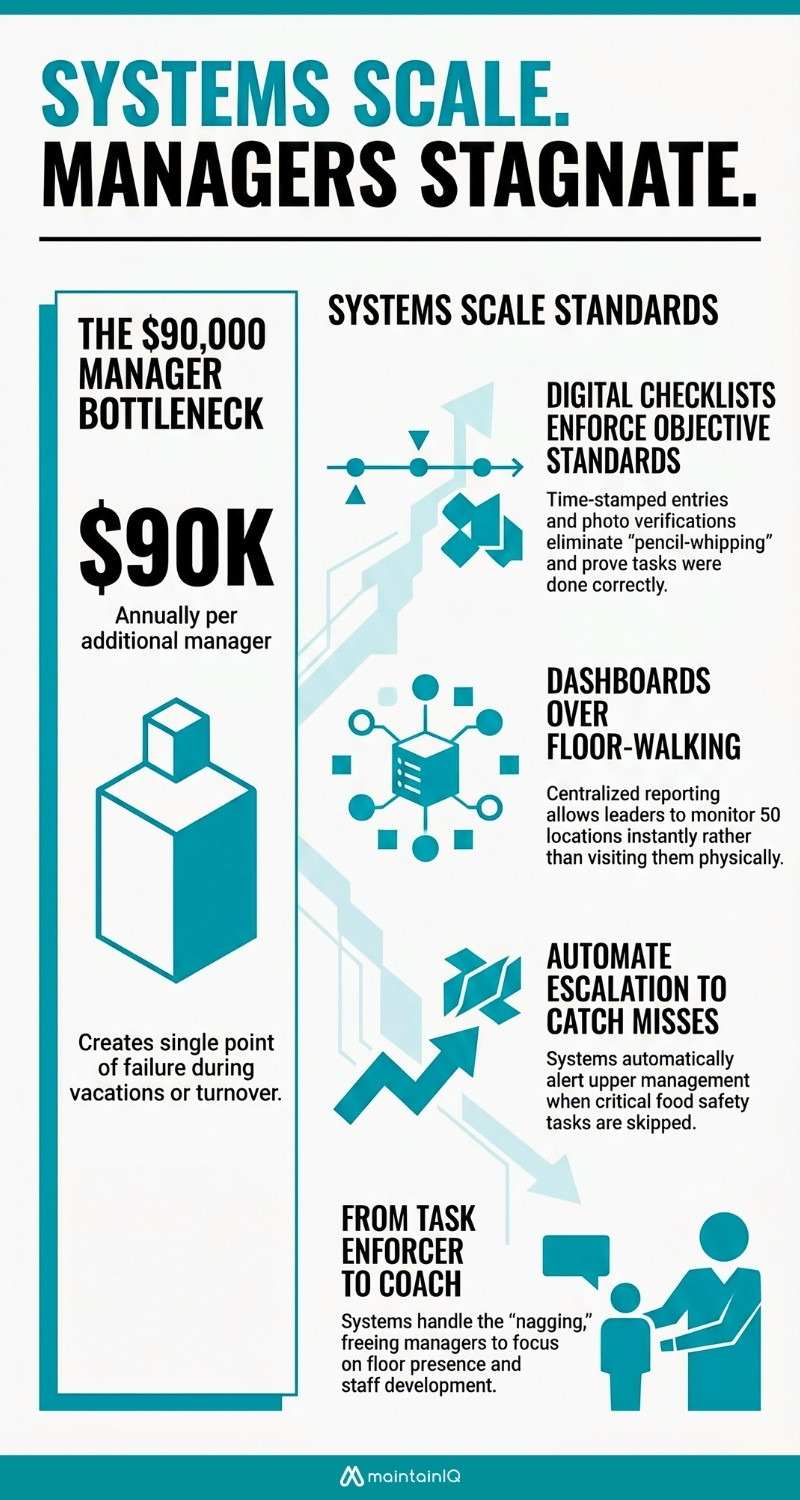
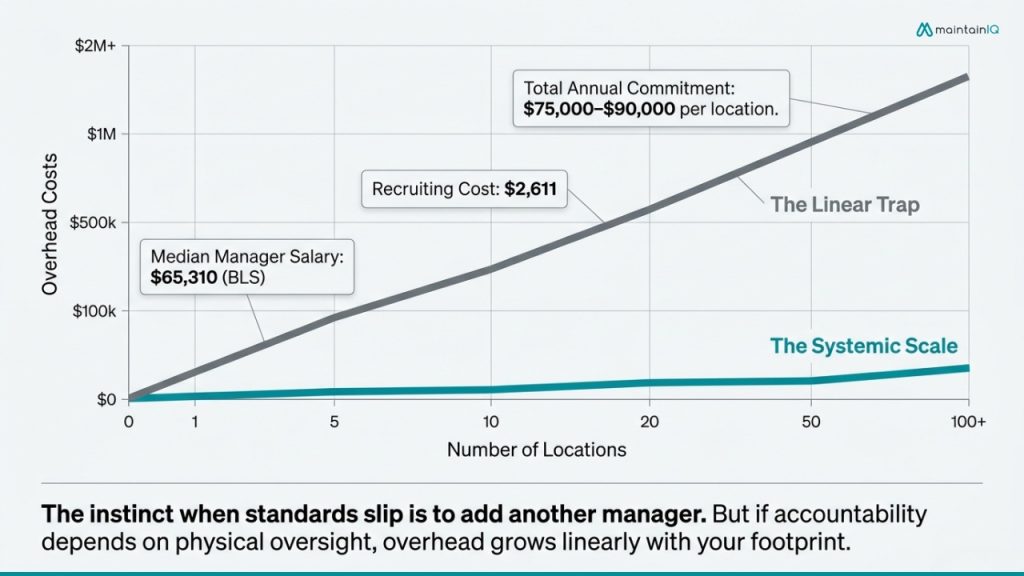
Except it isn’t. The median annual salary for a food service manager is $65,310 according to the Bureau of Labor Statistics. Add benefits, payroll taxes, and the $2,611 average cost to recruit and replace a manager when they leave (which, in an industry averaging 75% annual turnover, happens often), and each additional management hire is a $75,000–$90,000 annual commitment per location.
That’s the cost, and it still doesn’t scale. If accountability depends on a manager physically watching every task, overhead grows linearly with your footprint. And the moment that manager is sick, on vacation, or dealing with a crisis at another location, the accountability disappears.
The operators who scale successfully build systems where accountability is embedded in the workflow — not dependent on any single person being present. The manager’s role shifts from task enforcer to exception handler. The system flags when a checklist wasn’t completed, so they don’t have to verify everyone.
This article explains how to build that system across digital checklists, automated escalation, centralized reporting, and corrective action loops — so your standards hold at 5 locations or 50 without adding headcount.
Table of Contents
Why Adding Managers Doesn’t Fix Accountability
Before building the solution, it’s worth understanding why the default approach — hiring more managers — breaks down at scale.
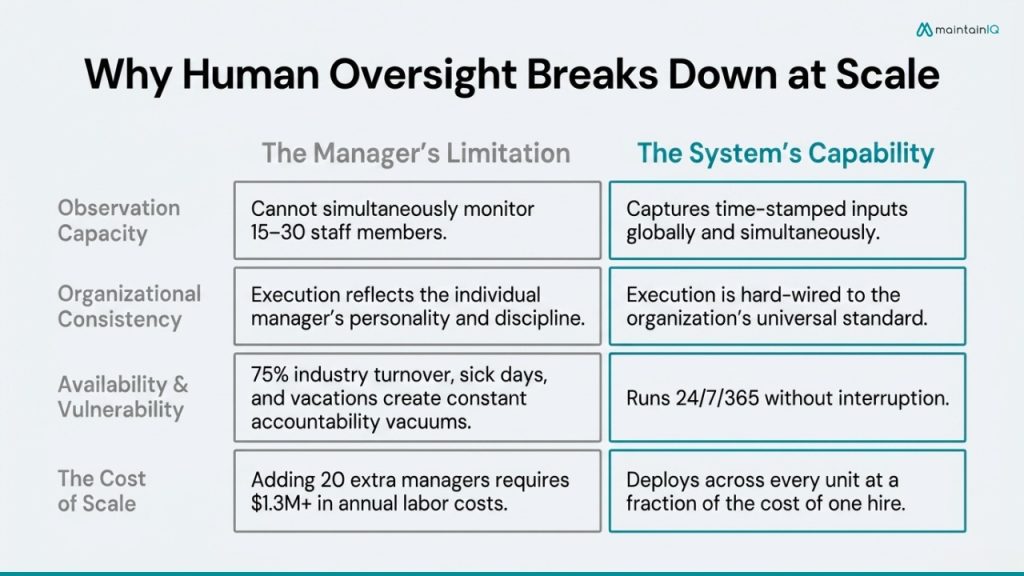
Managers can’t observe everything. A restaurant manager oversees 15–30 staff members across multiple shifts, manages inventory, handles customer issues, coordinates with vendors, and covers gaps in scheduling. Monitoring whether every line cook completed a temperature log and every closer followed the cleaning checklist is simply not possible through direct observation. Tasks get missed not because the manager doesn’t care, but because they’re doing six other things.
Oversight is inconsistent across locations. In every multi-unit operation, some locations have strong managers, and some have weaker ones. The standard of execution at each location becomes a reflection of the individual manager’s personality and discipline — not the organization’s standards. When you lose a strong manager to turnover or promotion, the location’s performance drops with them.
The manager becomes a bottleneck. When accountability runs through a single person, his absence creates a vacuum. Days off, vacations, sick time, and turnover all produce periods where nobody is verifying task completion. In an industry where the average turnover rate for restaurant employees exceeds 75%, these gaps are constant.
It’s the most expensive solution. Every additional manager adds $65,000–$90,000 in annual cost, including salary, benefits, and taxes. For a 20-location operation, adding even one extra manager per location represents over $1.3 million in additional labor cost. That money could fund systems, training, and technology that scale across every location simultaneously.
The alternative isn’t removing managers. It’s making sure the accountability infrastructure doesn’t depend on any one manager being present at any given moment.
The Four Components of Scalable Accountability
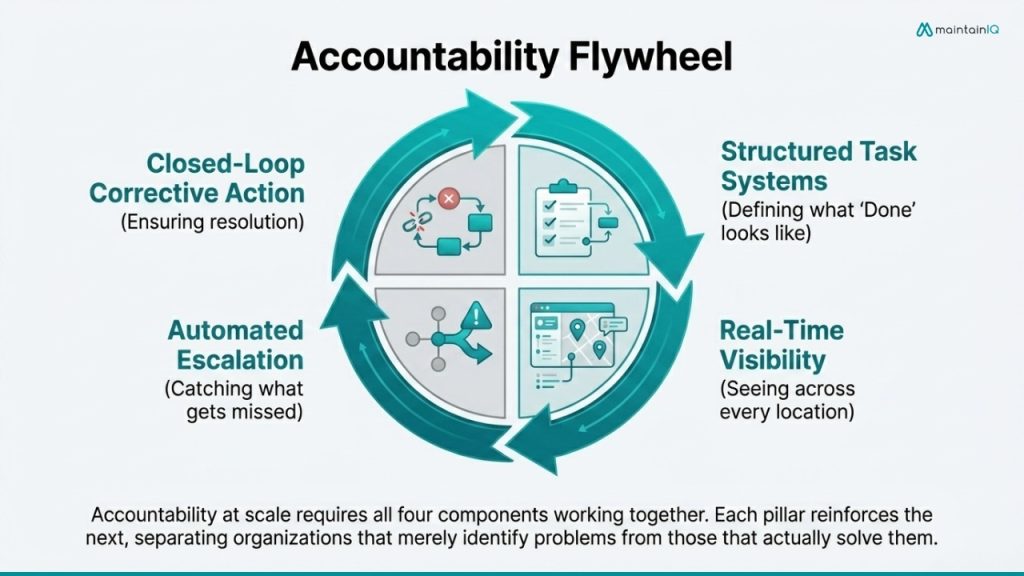
Accountability at scale requires four things working together: structured task systems, real-time visibility, automated escalation, and closed-loop corrective action. Each one reinforces the others.
1. Structured Task Systems That Define What “Done” Looks Like
Accountability starts with clarity. Every person on every shift needs to know exactly what they’re responsible for, when it needs to happen, and what the standard is. Paper checklists technically do this, but they lack the enforcement mechanisms that make accountability stick.
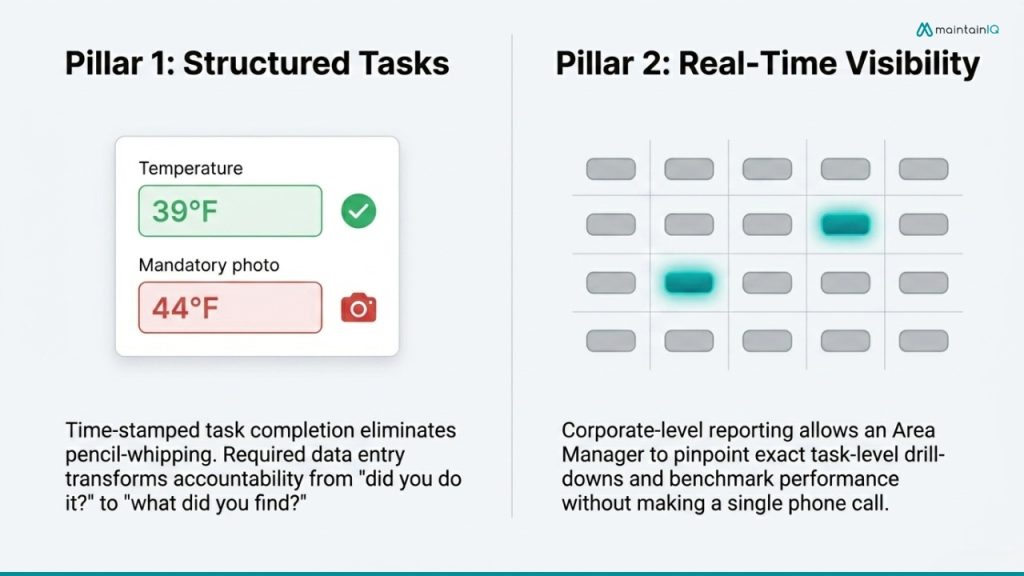
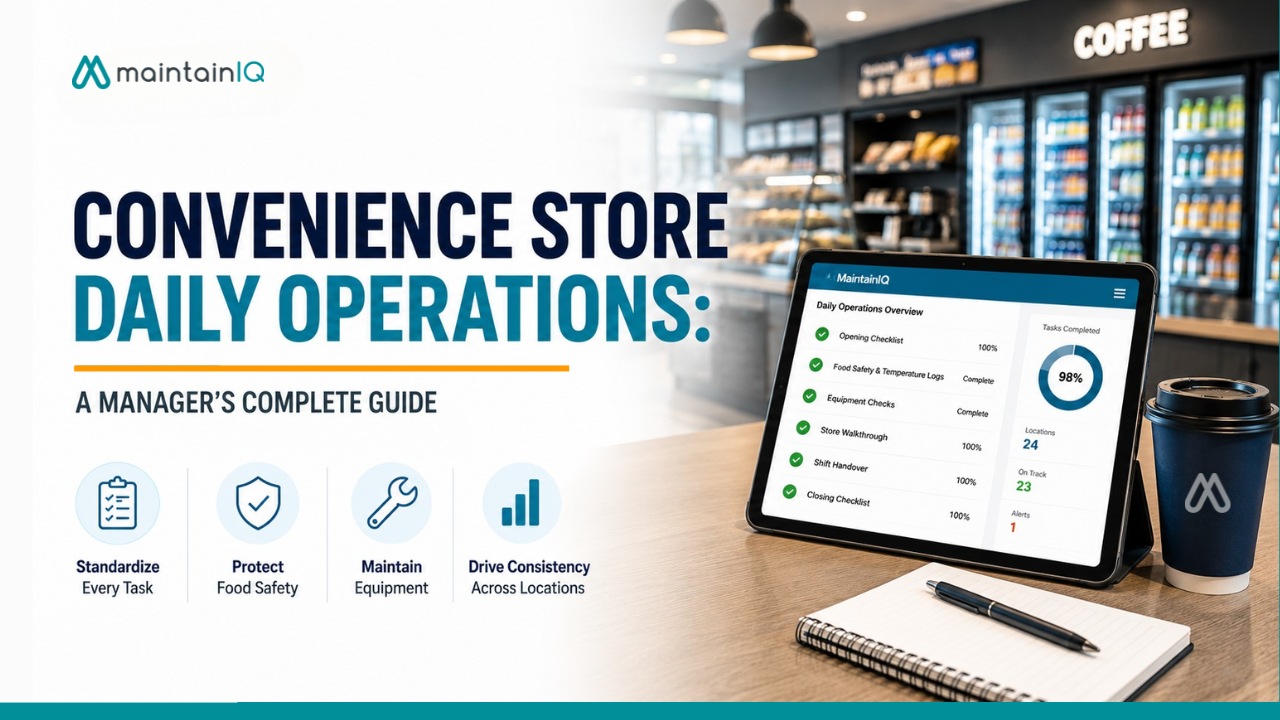
Digital checklists transform accountability from a managerial behavior into a system behavior. Here’s what that looks like in practice:
Time-stamped task completion. When a team member completes a checklist item, the system records who did it and when — not at the end of the shift from memory, but in the moment. This eliminates pencil-whipping and creates a factual record that doesn’t depend on the manager’s presence.
Required data entry for critical tasks. Instead of a checkbox next to “check walk-in cooler temperature,” the system requires the actual reading. A recorded 39°F confirms the cooler is functioning. A recorded 44°F flags a problem — and triggers a response.
Photo verification. For tasks where visual evidence matters — cleaning completion, equipment condition, display setup — the checklist can require a photo before the task can be marked complete. This is accountability that works whether the manager is on the floor or not.
Scheduled prompts and reminders. Tasks appear at the right time for the right person. The opening checklist arrives when the opener clocks in. The mid-shift food safety check appears at a set time. If a task isn’t started within its window, a reminder pushes automatically. The system does the nagging that used to fall on the manager.
The result is a shift where every task has an owner, a timestamp, a standard, and a record — regardless of who is managing that day.
2. Real-Time Visibility Across Every Location
You can’t hold people accountable for things you can’t see. For single-location operators, visibility means walking the floor. For multi-unit operators, it means dashboards.
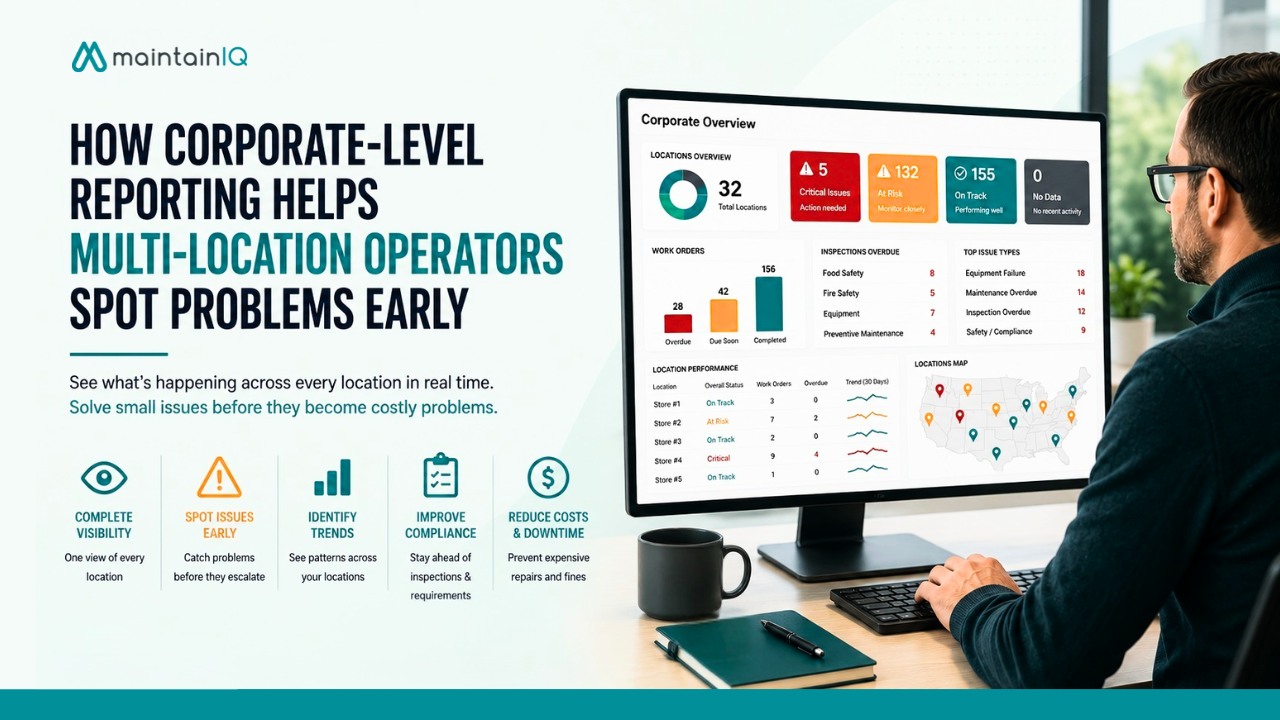
Corporate-level reporting gives district managers, area directors, and operations leaders a live view of what’s happening at every location — without calling, visiting, or waiting for weekly reports.
Checklist completion rates by location. At 2:00 PM on a Tuesday, you can see that 18 of your 20 locations have completed their opening checklists. Two haven’t. You know exactly which two, and you can act immediately.
Task-level drill-down. See not just whether a checklist was completed, but which tasks were marked done, what data was entered, and what was skipped. If Location #12 skipped its hot holding temperature check, that’s visible.
Trend data over time. A single missed checklist is a one-off. A location that misses its closing checklist every Friday is a pattern — and patterns point to systemic issues like staffing gaps, training needs, or a manager who’s disengaged on that shift.
Benchmarking across locations. When every location runs the same checklists, you can compare performance. Which locations consistently complete all tasks on time? Which ones have the highest rates of flagged items or corrective actions? This data tells you where to focus your limited management attention — rather than treating every location the same.
This visibility doesn’t replace the manager — it amplifies them. An area manager overseeing 8 locations can focus on the 2 that need attention rather than spreading equally across all 8.
3. Automated Escalation That Catches What Gets Missed
Visibility is passive — it tells you what’s happening if you look. Escalation is active — it comes to you when something goes wrong.
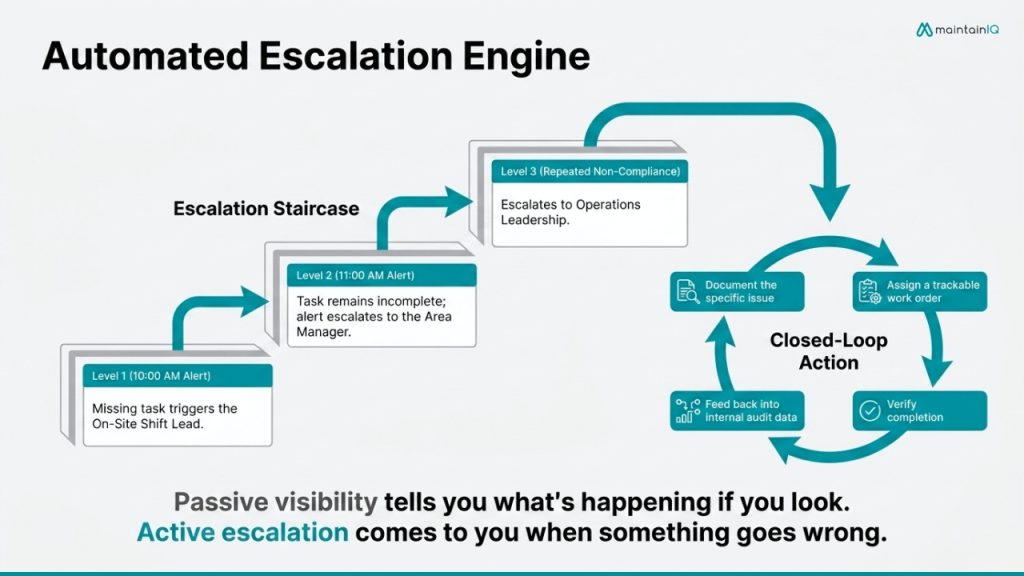
First-level escalation: the shift lead or on-site manager. If the morning food safety checklist isn’t completed by 10:00 AM, the on-site manager gets an alert. They can follow up immediately — while the shift is still happening, and the issue can be corrected.
Second-level escalation: the district or area manager. If the checklist is still incomplete an hour later, or if the on-site manager doesn’t respond, the alert escalates to the next level of management. Now someone outside the location knows there’s a gap.
Third-level escalation: operations leadership. For critical compliance tasks — temperature monitoring, food safety checks, fire safety inspections — repeated non-completion can escalate to the operations director or VP level. This ensures that systemic accountability failures don’t stay buried at the location level.
The power of automated escalation is that it creates consequences for non-completion without requiring the manager to personally chase every task. The system does the chasing. Instead of the manager checking whether everything was done, the system notifies them when something wasn’t. That’s a fundamentally different use of management time.
4. Closed-Loop Corrective Action
Accountability isn’t complete when a problem is identified. It’s complete when the problem is resolved and documented.
When a checklist reveals an issue — a cooler running above 41°F, a cleaning task failed, a safety item flagged — the system should trigger a corrective action workflow:
The issue is documented with specifics. What was found, where, when, and by whom. This creates the factual record needed for compliance and for follow-up.
A corrective action is assigned. Not “someone should look at this,” but a specific task assigned to a specific person with a specific deadline. The cooler issue becomes a work order assigned to the maintenance team. The cleaning failure becomes a retraining task assigned to the shift lead.
Completion is tracked and verified. The corrective action shows as open until it’s marked complete — with documentation. If it stays open past its deadline, it escalates just like any other overdue task.
The loop feeds back into the audit program. Internal audits should review whether corrective actions from previous periods were actually resolved. This prevents the pattern where the same issue gets flagged month after month without ever being fixed.
This closed loop separates organizations that identify problems from those that solve them — and it runs without a manager personally tracking every open item.
What the Manager’s Role Becomes
Scalable accountability doesn’t eliminate management. It changes what managers spend their time on.
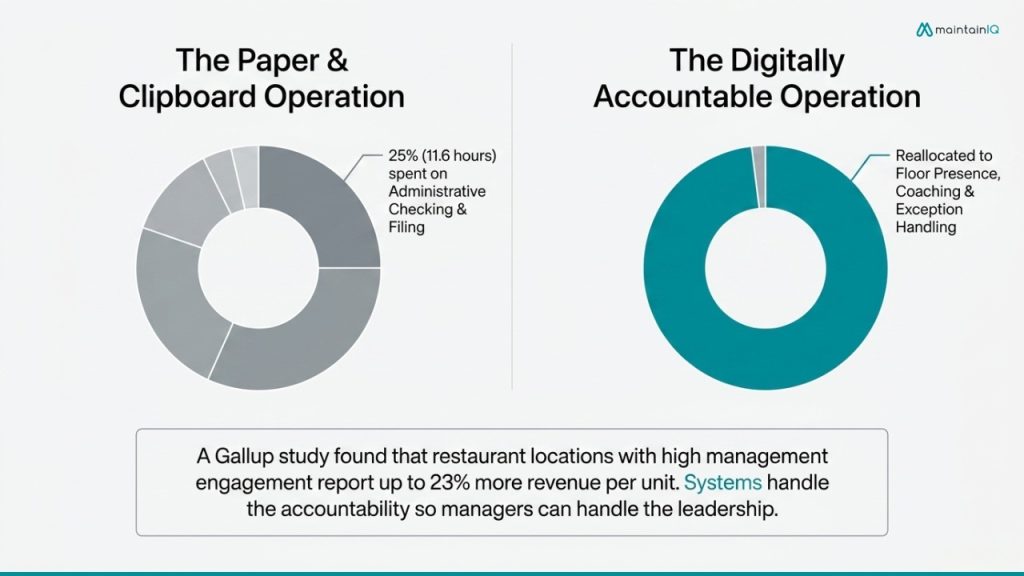
In a paper-and-clipboard operation, the manager’s day includes collecting checklists, reviewing them for gaps, following up on incomplete tasks, filing documentation, and manually reporting to their district manager. Time studies show managers spend roughly 25% of their work week — about 11.6 hours — on administrative tasks like these.
In a digitally accountable operation, those tasks are handled by the system. The manager’s time shifts to higher-value activities:
Coaching and developing staff. Instead of checking whether tasks were done, the manager can focus on how well they were done — and train team members to improve. A Gallup study found that restaurant locations with high management engagement report up to 23% more revenue per unit than those with disengaged leaders.
Handling exceptions. The system surfaces the problems. The manager solves them. A flagged temperature reading, an escalated missed checklist, a corrective action that needs in-person follow-up — these are the items that actually require management judgment.
Improving the operation. When managers aren’t buried in administrative tasks, they can analyze trends, identify recurring issues, and make the operational changes that prevent problems rather than just catching them. They become proactive rather than reactive.
Being present on the floor. The single most valuable thing a restaurant manager can do is be visible to staff and guests during service. Every minute spent in the back office reviewing paperwork is a minute not spent on the floor. Digital accountability gives that time back.
Putting It Together: A Practical Implementation Path
You don’t need to overhaul your operation overnight. Build scalable accountability in layers, starting with the highest-impact changes.
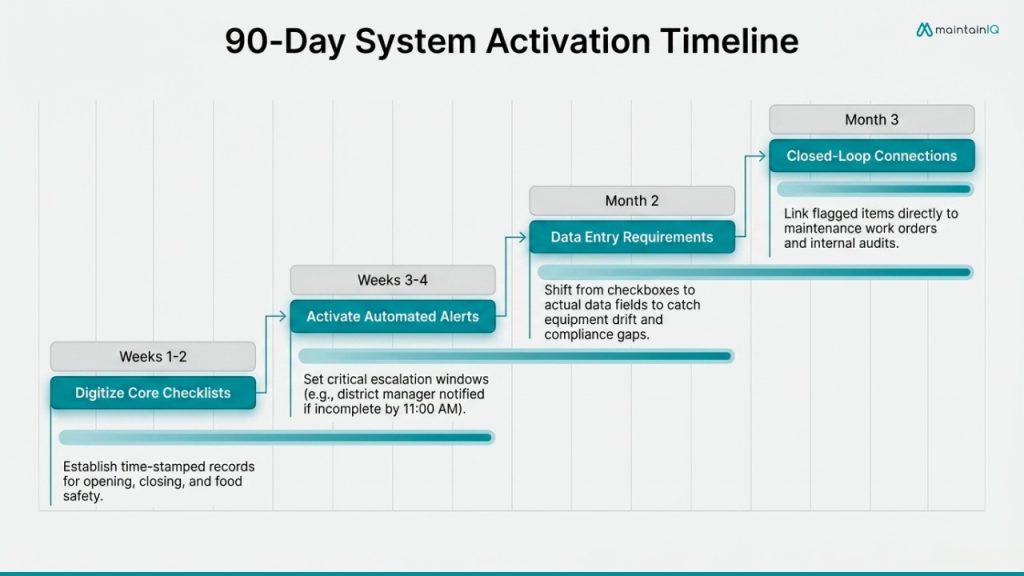
Week 1–2: Digitize your core daily checklists. Start with opening, closing, and food safety checklists. Move the exact same tasks into a digital checklist platform — don’t redesign them yet. The immediate win is time-stamped completion records and elimination of paper collection.
Week 3–4: Activate automated alerts. Configure notifications so that incomplete checklists trigger escalation. Set reasonable windows — if the opening checklist isn’t done by 10:00 AM, the manager gets alerted. If it’s still incomplete by 11:00 AM, the district manager is notified. Start with critical checklists only.
Month 2: Add data entry requirements for critical tasks. Replace checkboxes with actual data fields for temperature readings, cleaning verification, and equipment checks. This is where accountability shifts from “did you do it?” to “what did you find?” — and where you start catching equipment drift, compliance gaps, and training needs.
Month 3: Connect checklists to maintenance and audits. Link flagged checklist items to work orders and preventive maintenance. Build monthly internal audits that review corrective action completion rates. This closes the loop and turns your checklist data into operational intelligence.
Ongoing: Use reporting to manage by exception. Train your district and area managers to use corporate dashboards daily. The dashboard tells them which locations need attention today. They stop spending time on locations that are running well and focus their energy where it will have the most impact.
Conclusion
Accountability doesn’t scale through headcount. Adding managers adds cost, but it doesn’t add consistency — because the accountability still depends on individual people rather than organizational systems.
The operators running 20, 50, or 100 locations successfully have built infrastructure where accountability is embedded in the daily workflow: structured digital checklists that record who did what and when, real-time dashboards that surface completion and compliance across every location, automated escalation that catches gaps before they become violations, and corrective action loops that ensure problems get resolved — not just identified.
The manager is still essential. But their value isn’t in checking boxes and chasing clipboards. It’s in coaching teams, solving problems, and being present where it matters most — on the floor, with staff and guests.
The system handles the accountability. The manager handles the leadership. That’s how you scale.
Book a 20-minute demo to see how MaintainIQ builds accountability across every location without adding headcount.