Did you know that 80% of trampoline park accidents could be prevented through diligent daily maintenance? Your facility’s safety record directly impacts both customer trust and your bottom line.
While most park owners focus on marketing and customer service, it’s the unseen daily safety checks that truly determine your operation’s longevity.
The difference between a thriving business and a liability nightmare often comes down to a systematic approach to equipment inspection and documentation.
That’s why having the ultimate Trampoline Park maintenance checklist for daily safety is essential.
It not only protects your guests, but it also protects your investment, your reputation, and your future.
Table of Contents
Why Daily Maintenance Matters for Your Trampoline Park
Although many trampoline park owners focus on major maintenance inspections, daily upkeep forms the foundation of a safe and profitable operation. When you implement rigorous daily checks, you’re actively preventing accidents before they occur.

Your employee training should emphasize these daily procedures as non-negotiable responsibilities. The connection between maintenance and customer satisfaction is direct—guests notice clean, functional equipment and return more frequently.
Your brand reputation hinges on these seemingly small details. One overlooked maintenance issue can lead to injuries, negative reviews, and lasting damage to your business. Daily vigilance isn’t just good practice—it’s essential to your freedom from liability concerns.
Essential Daily Maintenance Checklist for Trampoline Parks
Your daily trampoline park maintenance routine should include thorough inspections of all mats and jumping surfaces for tears, excessive wear, or debris buildup.

Check springs and connectors for proper tension, stretching, rust, or missing components that could compromise jumper safety.
Inspect padding covers, safety nets, frames, and support structures to identify loose bolts, frame deformation, or structural issues requiring immediate attention.
Inspecting Trampoline Mats and Surfaces
Inspect your trampoline mats daily for tears, rips, and areas of excessive wear that could compromise jumper safety.
Document any damage in your maintenance log and immediately remove damaged trampolines from service until repairs can be completed.
Thoroughly clean and sanitize all mat surfaces using manufacturer-approved disinfectants to prevent the spread of germs and maintain proper hygiene standards.
Check for Tears, Rips, and Excessive Wear
The most critical component of daily trampoline park safety involves thoroughly checking for tears, rips, and excessive wear on all jumping surfaces.
When identifying worn areas, use your hands to feel for inconsistencies in tension. Run your fingers across the mat surface condition, monitoring for damage at connection points where stress concentrates.
Document any suspect areas immediately—your vigilance guarantees jumpers’ freedom to play without fear.
Cleaning and Sanitizing Mats
Properly sanitized trampoline mats directly impact visitor safety and public health within your facility.
Implement daily sanitizing procedures using EPA-approved disinfectants that kill viruses without damaging surfaces.
Establish a documented cleaning schedule with morning and evening mat disinfection sessions.
Include high-touch areas between jumps during peak hours—thorough sanitization liberates your space from harmful microorganisms.
Springs and Connectors Inspection
Check each trampoline for loose or missing springs, which can create dangerous gaps and compromise structural integrity.
Perform a tactile examination of spring tension by pressing down on the mat’s edge to guarantee consistent resistance and proper rebound capabilities.
Document any springs showing signs of metal fatigue, rust, stretched coils, or damaged hooks that require immediate replacement.
Identifying Loose or Missing Springs
Springs and connectors form the critical backbone of every trampoline system, where a single loose or missing component can lead to serious safety hazards and equipment failure.
When checking spring condition, run your hand along each coil, feeling for gaps in the sequence.
Focus on inspecting spring connections at both ends, identifying spring deterioration through rust, stretching, or deformation that compromises jump integrity.
Checking Spring Tension and Integrity
When checking spring durability, analyze resistance consistency across all attachment points.
- Test each spring by pressing down to assess resistance
- Look for signs of spring fatigue including rust, stretching, or deformation
- Monitor spring integrity by listening for unusual noises during compression
- Document and replace springs showing visible deterioration immediately
Padding and Safety Nets Inspection
Inspect all padding thoroughly to guarantee it’s firmly attached to frames and covers all springs, frame edges, and potential impact areas.
Check safety nets daily for tears, holes, or loose connections that could jeopardize their ability to prevent falls or collisions between participants.
Document any identified issues with padding or netting in your maintenance log and address them immediately before permitting guests to use the equipment.
Ensuring Padding is Secure and Damage-Free
Inspect every padding element daily to prevent injuries and maintain safety compliance.
Secure padding prevents shifting during use and extends lifespan.
Always document your findings and immediately schedule replacing worn padding.
Check that all padding is firmly attached with no gaps between sections.
Inspect for tears, rips, or compression that reduces protective qualities.
Verify foam inside padding maintains proper density and resilience.
Test all velcro, zipper, or snap attachments for secure fastening capability.
Inspecting Safety Nets for Tears or Weak Points
Safety nets serve as critical barriers preventing potentially catastrophic falls and collisions in your trampoline park, making their daily inspection non-negotiable.
When inspecting for wear, examine every inch of netting for tears, fraying, or stretched sections. Checking net integrity involves testing tension and resilience.
Don’t overlook evaluating attachment points—these connection zones bear significant stress and can fail first.
Frame and Structural Integrity Checks
Examine all frame components daily for loose bolts, ensuring each connection point remains securely fastened with appropriate torque levels.
Inspect the entire structural system for signs of rust or corrosion, particularly at welded joints, bolt holes, and areas exposed to moisture.
Document any structural concerns immediately in your maintenance log, as even minor issues can compromise the integrity of your trampoline systems over time.
Checking for Loose Bolts and Structural Stability
Why do structural failures in trampoline parks almost always trace back to loose bolts and compromised frame integrity? Daily verification of tightness prevents catastrophic equipment failure.
Inspecting connections and evaluating stability ensures participants’ safety while protecting your business from liability.
- Verify bolt tightness using proper torque specifications
- Check welds for cracks or separation
- Inspect frame connections for corrosion or metal fatigue
- Test stability by applying pressure to frame components
Monitoring for Rust or Corrosion
Rust and corrosion weaken equipment integrity, often forming in high-moisture areas before becoming visible. Examine all metal components daily, identifying early signs to prevent structural failure.
| Inspection Area | What to Look For |
| Frame joints | Orange/brown discoloration |
| Bolt connections | White powder residue |
| Spring attachments | Flaking or pitting |
| Support beams | Surface bubbling |
| High-moisture zones | Texture changes |
Tracking corrosion progression through documentation helps in preventing corrosion risks before they endanger users.
Weekly Maintenance Tasks to Enhance Safety
Weekly safety maintenance at your trampoline park must include thorough inspection of foam pits and landing areas to identify deterioration, contamination, or structural issues.

Examine all equipment components for wear patterns, loose fittings, and potential failure points that weren’t apparent during daily checks.
Each attraction requires specialized maintenance procedures tailored to its unique mechanical systems, high-stress points, and safety features.
Thorough Inspection of Foam Pits and Landing Areas
Inspect all foam blocks for tears, compression damage, and contaminants that could compromise their shock-absorbing capabilities.
Verify that foam pit depths meet safety standards (typically 4-6 feet) and check that foam blocks are evenly distributed with no significant voids or depressions.
Maintain inspection records, note blocks needing replacement, and confirm visibility and legibility of safety signage around landing areas.
Foam Block Integrity and Cleanliness
Maintaining the foam block pit in ideal condition requires a thorough weekly inspection of all foam pieces and surrounding areas.
- Assess foam pit condition by examining each section for proper foam block density and identifying candidates for foam block replacement.
- Check for compression or flattening that reduces impact absorption.
- Remove and sanitize blocks with visible stains or odors.
- Look for tears, rips or degraded foam that could create safety hazards.
- Rotate blocks from high-impact zones to guarantee even wear.
Checking Depth and Evenness of Foam Pits
Three critical measurements determine proper foam pit safety: minimum depth, consistent surface level, and proper compression ratio.
When monitoring foam pit depth, guarantee a minimum of 6-8 feet throughout.
Use a depth gauge at multiple points to check evenness—uneven surfaces create landing risks.
Equipment and Attraction-Specific Maintenance
Inspect your wall trampolines and specialty attractions weekly by checking their frames, springs, and connecting points for any signs of wear, damage, or instability.
Examine all protective barriers and guard rails to verify they’re securely attached, properly positioned, and free from structural weaknesses that could compromise user safety.
Test all safety features with moderate pressure and document concerns needing immediate attention.
Wall Trampolines and Specialty Attractions Inspection
Wall trampolines and specialty attractions need rigorous weekly inspections due to their unique structures and high-impact use. Ensure thorough maintenance for wall trampolines and include specialty attractions in your inspection schedule.
- Check wall-to-trampoline connections for stress points
- Verify padding integrity at all wall-trampoline intersections
- Conduct trampoline park safety audits focusing on high-traffic specialty zones
- Inspect wall angle braces for signs of movement or bending
Inspection of Protective Barriers and Guard Rails
Protective barriers and guard rails are essential for safety, preventing falls and unauthorized access in your trampoline park.
Ensure proper placement around high-risk areas and check guardrail installation weekly.
Conduct routine inspections for loose bolts, cracks, or compromised padding, and repair any barriers with structural weaknesses immediately.
Leveraging Digital Checklists for Efficient Maintenance Tracking
Digital maintenance checklists offer you superior tracking capabilities compared to paper logs, with automatic timestamps and accountability features that prevent record falsification.

MaintainIQ’s platform transforms your daily inspection routines by centralizing all safety documentation in one accessible dashboard that managers can monitor remotely.
Reduce administrative burden and ensure compliance with insurance requirements by capturing photographic evidence of completed maintenance tasks.
Why Digital Checklists Outperform Traditional Paper Logs
Digital checklists allow your maintenance team to monitor trampoline park safety conditions with real-time updates that instantly alert staff to potential hazards.
Eliminate the lag time between inspection and action that often occurs with traditional paper logs, ensuring issues are addressed immediately rather than discovered during quarterly reviews.
Staff can document problems with photos in the system, providing visual evidence paper descriptions can’t match.
Real-Time Monitoring and Instant Updates
Real-time monitoring systems have transformed maintenance protocols.
Gain insights through live data analysis to identify safety issues before they escalate.
- Preventive maintenance alerts notify you when equipment approaches inspection thresholds
- Automated reporting eliminates human error in documentation
- Instant team-wide communication when issues arise
- Data-driven decision making improves resource allocation
Photo Documentation of Issues
The power of visual evidence comes into play when maintenance teams capture photo documentation of issues through digital checklists.
Time-stamped photos record wear, damage, or safety concerns clearly.
Digital platforms organize photos automatically, creating searchable records and definitive proof of completed maintenance.
How MaintainIQ Simplifies Your Maintenance Routine
MaintainIQ transforms your trampoline park maintenance from a complex burden into a streamlined process through automated scheduling that sends timely reminders before inspections are due.
Report equipment issues and track asset conditions in a centralized digital platform.
Compliance management tools store inspection records in accessible logs for audits and visits.
Automating Maintenance Scheduling and Reminders
Modern trampoline park management needs to move from paper-based systems to digital solutions for streamlined maintenance. MaintainIQ’s automated scheduling enhances safety inspections, eliminating the need for manual tracking.
- Cloud-based maintenance tracking that alerts staff about upcoming inspections
- Digital reminder systems that prevent critical safety checks from being missed
- Customizable schedules that align with manufacturer recommendations
- Real-time notificationdelivery across multiple devices for immediate team awareness
Streamlined Asset Tracking and Issue Reporting
Beyond regular scheduling, effective trampoline park management requires precise asset tracking and streamlined issue reporting systems.
MaintainIQ streamlines communication between staff members and management. The platform delivers data-driven insights on equipment performance while triggering automated alerts when maintenance thresholds are reached.
This empowers your team to address issues before they compromise safety.
Ensuring Compliance with Easy-to-Access Digital Logs
MaintainIQ’s system transforms compliance tracking into a streamlined process that inspectors appreciate and managers rely on.
- Digital timestamps create undeniable accountability measures
- Cloud storage prevents record loss or tampering
- Custom reports generated in seconds during inspections
- Real-time compliance tracking alerts prevent regulatory violations
Common Trampoline Park Maintenance Mistakes to Avoid
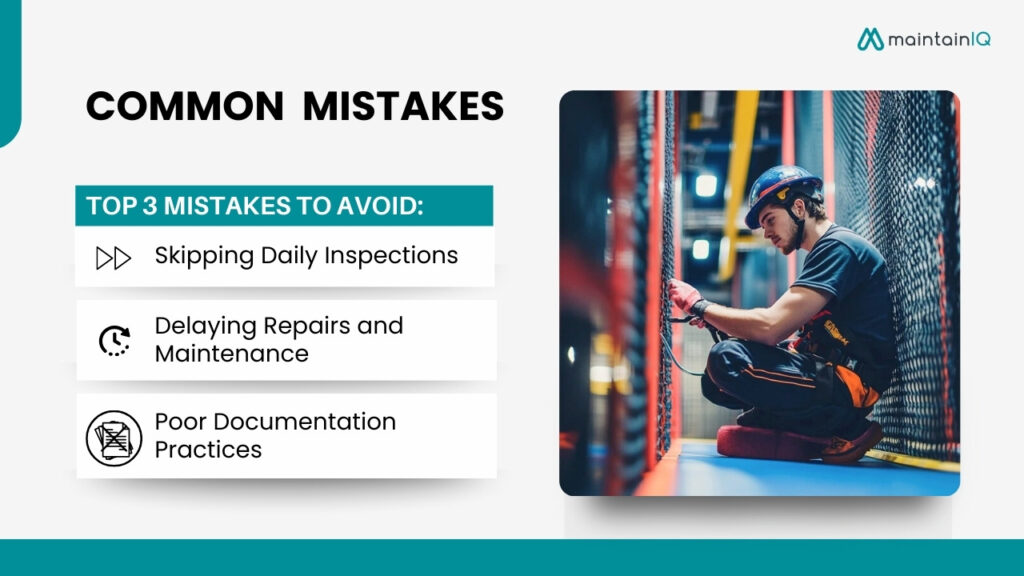
To maintain a safe trampoline park environment, you’ll need to avoid three critical mistakes that commonly lead to accidents and liability issues. Skipping daily inspections, postponing necessary repairs, and maintaining poor documentation records all create significant safety risks that compromise both guest safety and your facility’s reputation.
| Mistake | What It Is | Why It’s Dangerous | What to Do Instead |
| Skipping Daily Inspections | Skipping daily equipment checks to save time | Allows small issues to grow into serious failures; increases risk of injuries from torn mats, damaged springs, or loose frames | Perform thorough daily inspections; document findings; make this your first line of defense against accidents |
| Delaying Repairs and Maintenance | Postponing needed repairs or deferring scheduled maintenance | Minor issues compound over time, leading to equipment failure, serious injuries, and legal liability | Address repairs immediately; use tracking systems to flag deadlines; document all actions with dates, repair details, and verification |
| Poor Documentation Practices | Incomplete, missing, or inconsistent maintenance records | Creates safety gaps, weakens liability defense, and fails to show consistent upkeep | Use digital tracking to prevent paper loss; train staff on proper logs; include time stamps, actions, and follow-ups; audit records quarterly |
Maintaining Compliance and Accountability with Digital Logs
Digital logs transform your trampoline park’s inspection readiness by providing organized, accessible documentation that safety inspectors require.

You’ll strengthen accountability when staff members electronically sign maintenance tasks, creating trackable records that verify compliance with safety protocols.
These digital systems allow you to quickly generate reports demonstrating your facility’s adherence to industry standards during both routine and surprise inspections.
Using Digital Logs to Prepare for Safety Inspections
Modern trampoline parks can transform their inspection readiness through detailed digital logging systems.
With exhaustive digital record keeping, you’ll eliminate the last-minute scramble before inspector visits.
Real-time data access puts critical information at your fingertips when regulators arrive unexpectedly.
Generate instant compliance reports showing consistent maintenance patterns. Present photographic evidence of repairs and modifications with timestamps. Track staff certification status and training completion automatically. Identify potential safety gaps through automated reminders for scheduled checks.
Your digital logs aren’t just administrative tools—they’re your freedom from regulatory anxiety. When inspectors arrive, you’ll confidently demonstrate your commitment to safety protocols through organized, accessible documentation.
Ensuring Staff Accountability with Trackable Maintenance Records
Accountability thrives when your maintenance records create a clear chain of responsibility for every safety check in your trampoline park. Digital tracking systems identify exactly who performed each inspection and when, eliminating blame-shifting and encouraging ownership.
This transparency isn’t just about enforcement—it’s a cost-effective solution that improves staff retention by recognizing diligent employees and identifying training opportunities rather than punishing mistakes.
Conclusion: Prioritize Safety with Effective Maintenance Practices
As we’ve seen throughout this extensive guide, maintaining a trampoline park isn’t just about preserving equipment—it’s fundamentally about protecting lives.
Your consistent record-keeping creates accountability, while a proactive approach prevents accidents before they happen.
By leveraging data-driven insights, you’ll transform maintenance from a chore into your competitive advantage.
- Implement daily, weekly, and monthly inspection schedules without exception
- Train your staff to recognize even subtle signs of equipment deterioration
- Document all maintenance activities in standardized digital formats
- Review safety data quarterly to identify patterns and optimize protocols