The CDC estimates that temperature abuse contributes to nearly 40% of foodborne illness outbreaks linked to restaurants.
If you’re still relying on manual spot checks, you’re leaving compliance — and your customers’ health — to chance.
Digital temperature monitoring closes the gaps that paper logs can’t, catching violations before an inspector ever walks through your door.
Here’s exactly where traditional methods fall short and what continuous monitoring changes.
Table of Contents
Key Takeaways
- Continuous 24/7 monitoring detects cooler or hot holding temperature drift instantly, alerting managers before food enters the danger zone.
- Automated time-stamped logs replace unreliable paper records, eliminating batch logging, pencil-whipping, and overnight monitoring gaps.
- Real-time alerts notify staff immediately when temperatures breach 41°F cold or 135°F hot FDA thresholds.
- Trend data reveals gradual equipment degradation, enabling preventive maintenance before failing coolers cause critical violations.
- Inspector-ready digital records provide documented proof of continuous compliance, replacing missing or inconsistent manual documentation.
The FDA Temperature Requirements Every Operator Must Know
Before you can prevent a violation, you need to know the exact numbers inspectors are checking.
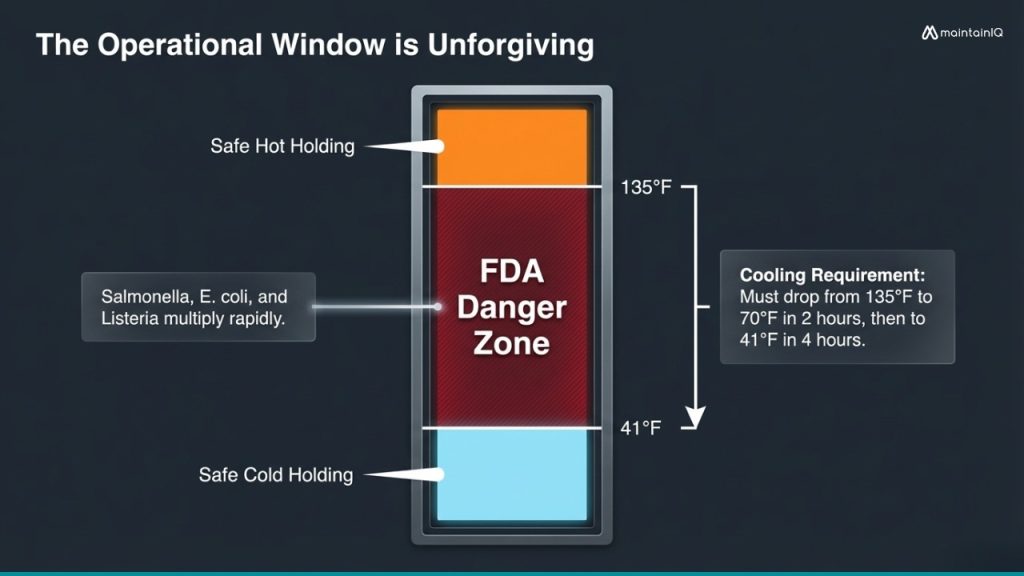
The FDA Food Code defines a temperature danger zone between 41°F and 135°F where Salmonella, E. coli, and Listeria multiply rapidly. You’re required to hold cold TCS foods (Time/Temperature Control for Safety) at 41°F or below and hot foods at 135°F or above.
Cooking minimums are non-negotiable: 165°F for poultry and reheated leftovers, 155°F for ground meats, and 145°F for whole cuts of meat, fish, and eggs.
Cooling requirements are just as strict. Cooked TCS foods must drop from 135°F to 70°F within two hours, then from 70°F to 41°F within four more hours — six hours total. Refrigerated deliveries must arrive at 41°F or below, and frozen items must be frozen solid at receiving.
The CDC links improper holding temperatures to over 60% of retail foodborne illness outbreaks. These numbers are not suggestions — they are the standard health inspectors’ measure against every visit.
The 5 Most Common Temperature Violations That Fail Inspections
Knowing the FDA requirements is one thing. Understanding exactly where operators fail inspections is another. These five temperature violations account for the majority of critical citations inspectors issue, and each one puts your food license at risk.
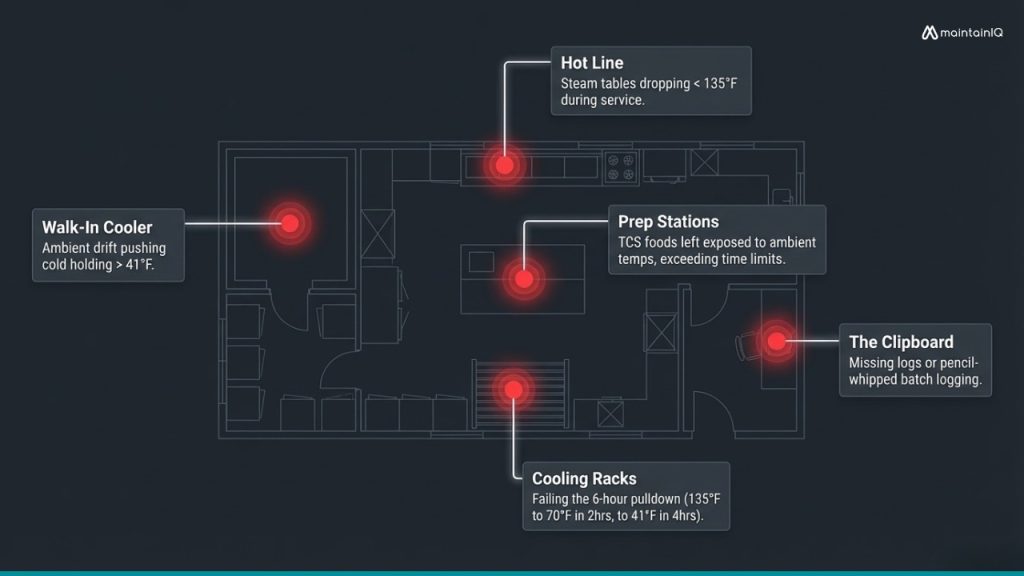
1. Walk-In Cooler Running Above 41°F
When a health inspector checks your walk-in cooler and the ambient temperature reads above 41°F, every TCS item inside is flagged as potentially compromised — and that’s an immediate critical violation.
This rarely happens overnight. Equipment drift, failing door gaskets, and overloaded shelves restricting airflow push cold holding temperature up gradually. Staff don’t catch it because they’re not monitoring continuously — inspectors are the ones who find it.
2. Hot Holding Line Below 135°F
Hot holding failures are just as damaging on an inspection report — and they’re one of the most frequently cited critical violations nationwide. Your hot holding temperature must stay at 135°F or above.
Steam tables not turned up high enough, food sitting without heat checks during a busy service — these are the gaps inspectors target. They’ll use their own calibrated thermometer, so your readings won’t override theirs. You can’t manage what you don’t measure continuously.
3. Food Left in the Danger Zone During Prep
Prep work happens under constant time pressure, and that’s where temperature control most often breaks down. You pull proteins and dairy from the cooler, set them on the counter, and get buried in tickets. Two hours later, those items are sitting deep in the temperature danger zone.
Without scheduled temp checks, there’s no record of when items left refrigeration or how long they’ve been exposed. You’re operating blind — and that’s exactly what inspectors document.
4. Improper Cooling After Cooking
TCS food temperature control requires cooked items to drop from 135°F to 70°F within two hours, then to 41°F within four more. When that timeline breaks, bacteria multiply fast.
Large batches, slow cooling, and missing logs are common issues inspectors look for.
5. No Temperature Documentation Available
Even if your team holds every temperature within range, an inspector who finds no documentation will treat the situation as if no monitoring occurred at all.
Paper logs that are missing, incomplete, or clearly filled in after the fact don’t prove compliance — they undermine it. Inspectors are trained to spot batch-filled logs where every entry shows the same handwriting, same ink, and suspiciously round numbers. That pattern signals fabrication, and it converts a clean inspection into a documented critical violation.
Most of these violations are not about careless staff. They are about having no system that catches problems in real time.
Why Paper Temperature Logs Fail
Paper temperature logs remain the default in most foodservice operations, but they carry a fundamental flaw: they record what staff remembers, not what actually happened.
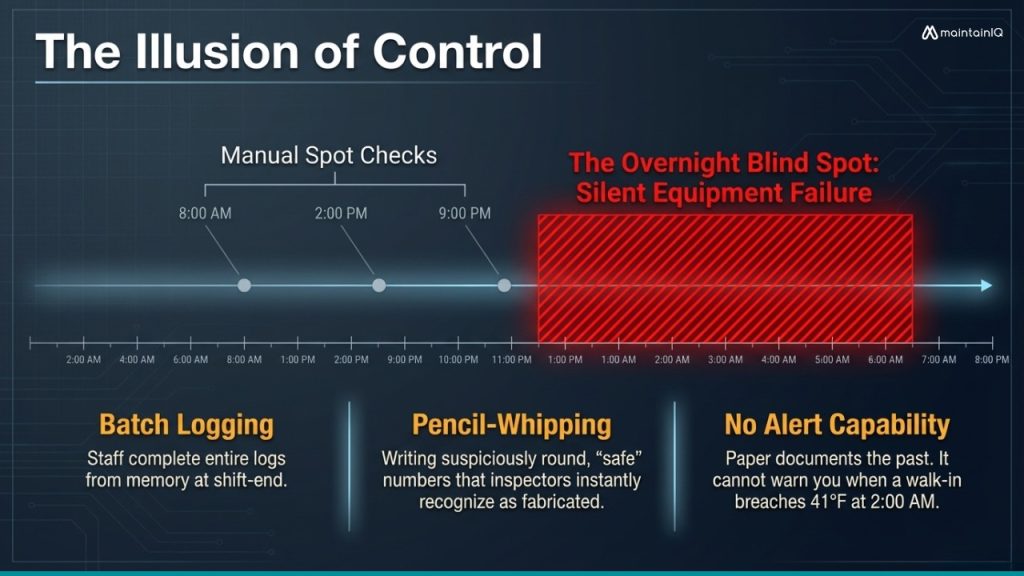
FDA risk factor studies confirm that operations with a robust Food Safety Management System (FSMS) significantly reduce time/temperature violations compared to manual-only methods. Paper logs can’t deliver that.
Batch logging is the most common issue. Staff complete entire logs from memory at the end of a shift, writing “safe” numbers that inspectors immediately recognize as fabricated.
Overnight gaps are just as dangerous — equipment failures between shifts go undetected for hours because nobody is physically present to check.
And paper has no alert capability. It documents the past, never the present. A paper log tells you what the temperature was. It cannot tell you what it is right now or warn you when it drifts.
Paper logs create a false sense of compliance — the records look complete, but the monitoring never actually happened in real time.
How Digital Temperature Monitoring Solves Each Violation
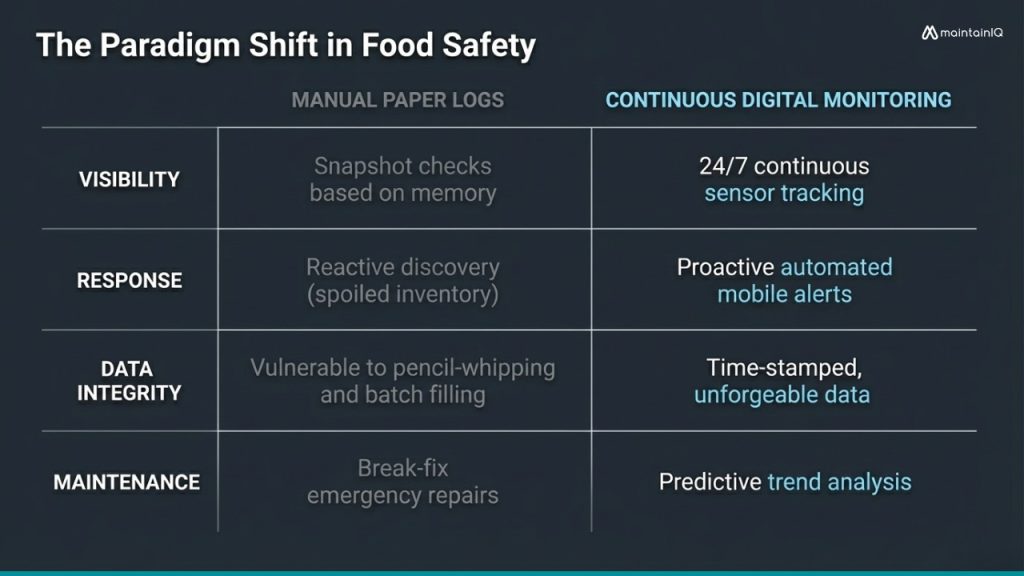
Digital temperature monitoring addresses each common violation by replacing manual processes with automated, continuous oversight. Here’s how each gap gets closed:
Continuous Equipment Monitoring
Digital systems track your cooler and freezer temps 24/7 — not just when staff remembers to check.
If your walk-in creeps above 41°F at 2 AM, the system flags it immediately, giving you time to act before the morning manager discovers spoiled inventory.
Every reading logs automatically, proving to inspectors that your equipment maintains safe temperatures around the clock.
Real-Time Alerts and Corrective Action Triggers
When a cooler breaches 41°F or a hot holding unit drops below 135°F, automated alerts push directly to the manager’s phone — no delay, no reliance on the next scheduled check. Your team acts before the product is compromised, not after.
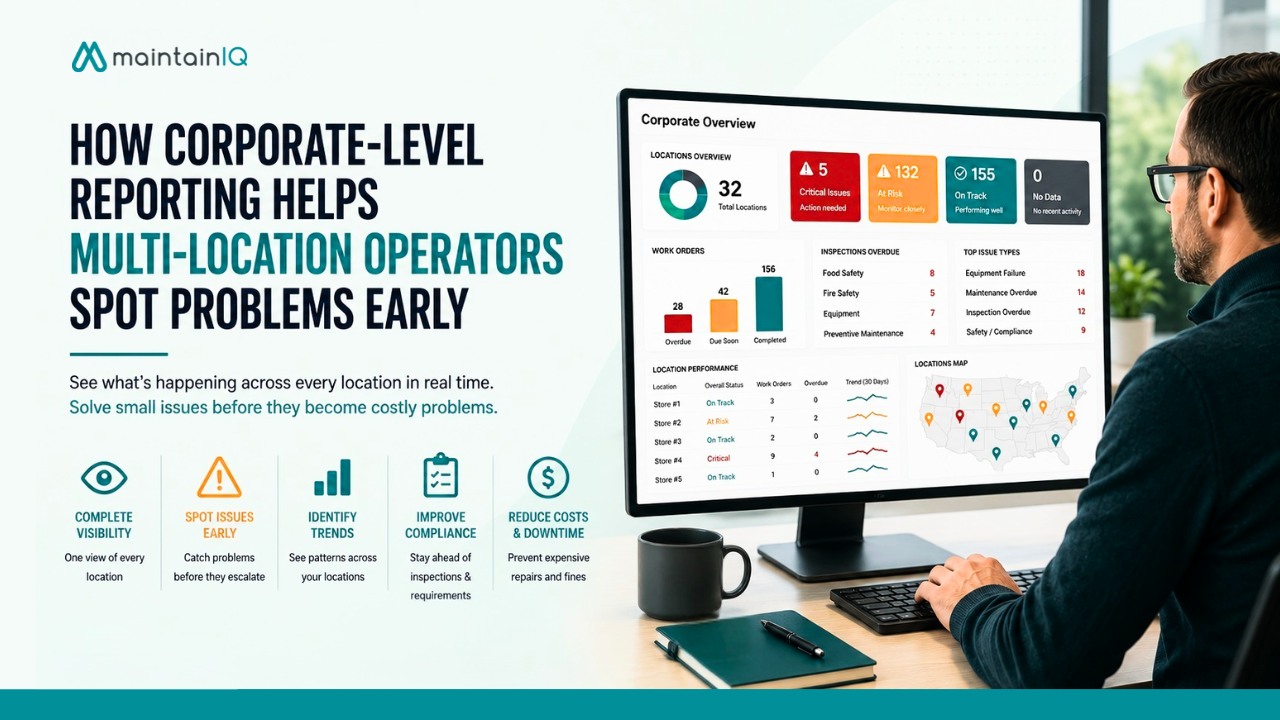
For multi-location operators, the advantage compounds. Corporate and regional managers monitor alerts across every site from a single dashboard, giving you centralized visibility without driving between stores.
Automated Compliance Logs
Every temperature reading a digital system captures is time-stamped, logged, and stored automatically. Compliance records are built in real time without manual entry.
That means no batch logging, no backfilled records, and faster access to complete documentation when inspectors ask for it.
Scheduled Digital Temp Checks During Service
Even with continuous sensor monitoring, certain critical control points still require hands-on verification. Digital temp check systems guarantee those manual checks happen on schedule.
Staff receive automated prompts at preset intervals — line checks during service, receiving logs at delivery, and cooling verifications during pulldown.
Each reading captures the employee’s name and timestamp, so there’s no ambiguity about who checked what and when. That’s documented proof of compliance built into your daily workflow.
Trend Data and Proactive Maintenance
Beyond real-time alerts, digital monitoring systems accumulate weeks and months of temperature data that expose equipment degradation you’d never catch from a single reading.
A cooler that creeps upward every afternoon signals a compressor issue before it becomes a critical violation. That data feeds directly into preventive maintenance scheduling — dispatch a technician based on data, not guesswork.
Connect your temp monitoring to your work order system so a temperature alert can automatically trigger a repair request, removing manual follow-up entirely.
What Multi-Location Operators Gain From Centralized Temperature Monitoring
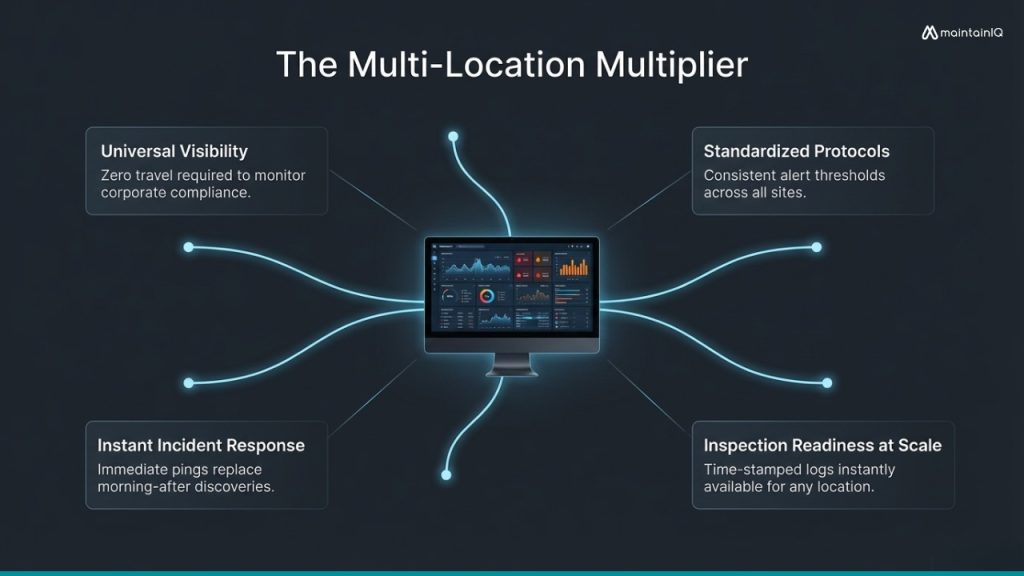
When you’re managing five, ten, or fifty-plus locations, temperature compliance becomes a system-wide risk — not just a single-store issue.
- Visibility across every site. Corporate and area managers can view temperature compliance for all locations from a single dashboard, without physical visits or phone calls.
- Standardized compliance. Every location follows the same monitoring schedule, same alert thresholds, and same documentation standards. No more “that location never logs their temps.”
- Faster incident response. When a location’s cooler goes down, the right people are notified immediately — instead of finding out hours later during the next manual check.
- Inspection readiness at scale. Digital records are always available, always complete. If one location gets inspected, the documentation is already there.
- Lower risk, lower cost. Catching a failing cooler early saves thousands in spoiled product, re-inspections, fines, and potential closures. The hidden costs of failing a health inspection go far beyond the fine itself — reputation damage is harder to recover from.
For operators with more than one location, centralized monitoring makes it easier to maintain standards, respond faster, and reduce compliance risk across every site.
Getting Started With Digital Temp Checks
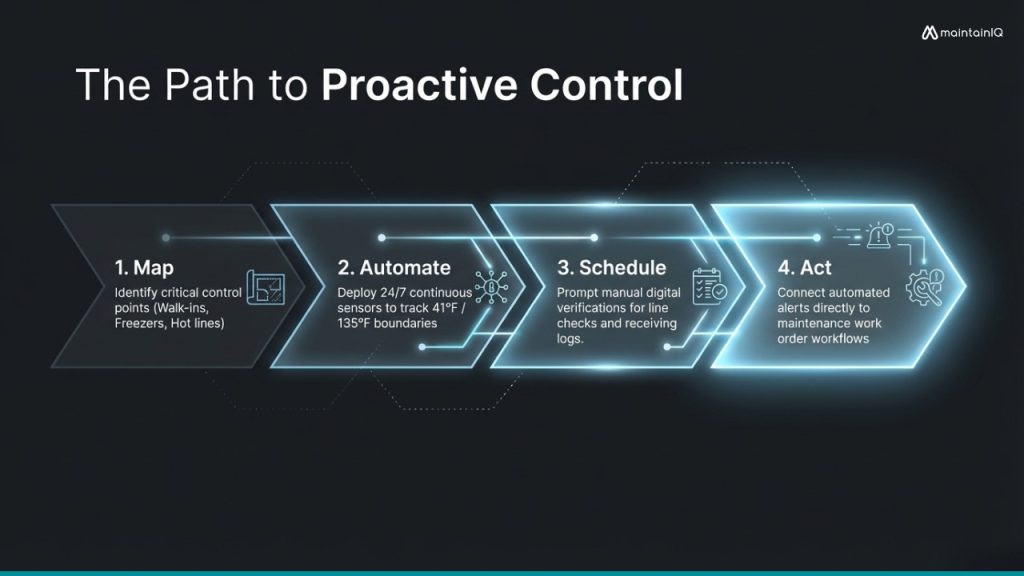
You don’t need to overhaul everything at once. Start by mapping your critical control points and building a system around them.
- Identify every monitoring point — walk-ins, freezers, hot holding units, and receiving areas. Set alert thresholds at 41°F cold and 135°F hot per FDA Food Code requirements.
- Set up scheduled manual checks for line temps during service and receiving temps during deliveries. These supplements continuously monitor and give you documented verification at every critical step.
- Train your team on alert response — who acts, what corrective actions to take, and how to document every incident. A system is only as good as the response protocol behind it.
- Connect temperature monitoring to your broader food safety program — digital checklists, internal audits, and preventive maintenance. Temperature is one piece of a complete food safety management system.
MaintainIQ’s Digital Temp Checks feature lets operators set up automated and manual temperature monitoring, receive real-time alerts, and maintain inspection-ready records across every location — all from one platform.
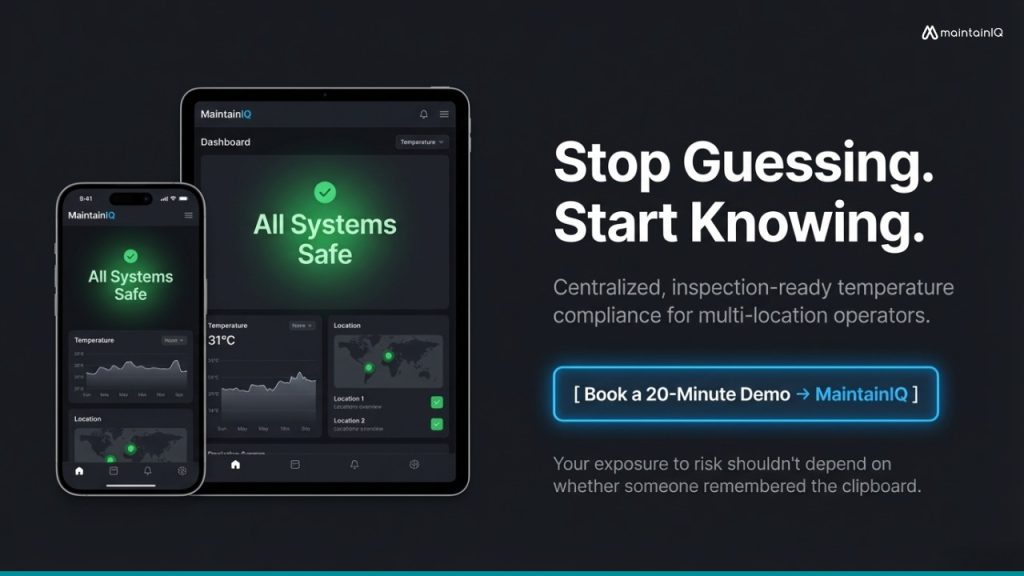
Book a 20-minute demo to see how it works for multi-location operations.
Conclusion
The FDA Food Code requirements haven’t changed. The gap between compliance and violation comes down to one factor: whether your system catches a temperature drift before an inspector does.
Digital monitoring removes the guesswork that paper logs perpetuate. You get continuous tracking, instant alerts, and automated records that hold up under scrutiny.
For multi-location operators, centralized oversight means consistent standards across every site — without depending on individual managers to remember the clipboard.
The regulations aren’t shifting. Your risk exposure shouldn’t depend on whether someone remembered to check a thermometer.
Frequently Asked Questions
How is digital temperature monitoring different from manual temp logs?
Manual logs rely on staff checking and recording temps at set times, which leaves gaps and can miss overnight issues. Digital monitoring tracks temperatures continuously, sends real-time alerts, and creates automatic time-stamped records that are easier to review and more reliable for compliance.
Will health inspectors accept digital temperature records?
In most cases, yes. Electronic records are widely accepted and often preferred because they’re more accurate, consistent, and easier to access than paper logs. Local requirements can vary, so it’s still smart to confirm with your health department.
How does temperature monitoring support preventive maintenance?
Temperature data helps catch equipment issues early by showing trends and alerting teams when readings go out of range. When connected to maintenance workflows, those alerts can trigger follow-up action before a small issue becomes an equipment failure or food loss.