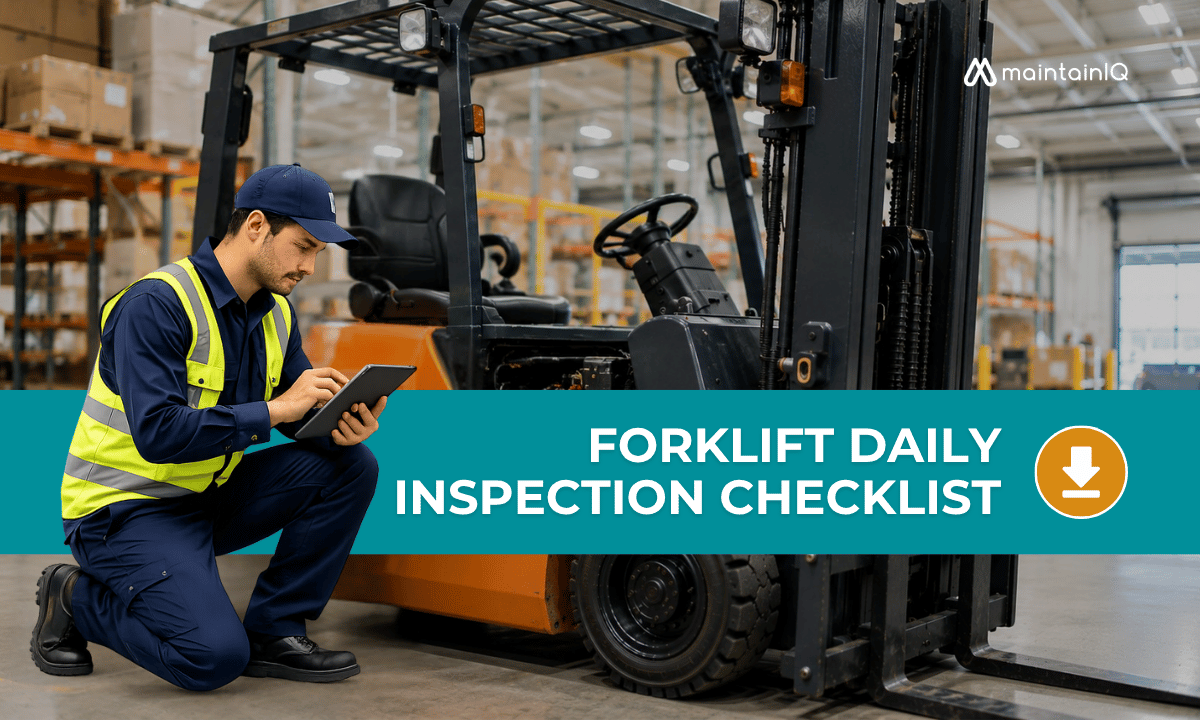
Forklifts cause roughly 85 deaths and 34,900 serious injuries every year in the U.S. — and powered industrial truck violations consistently rank among OSHA’s top-10 most-cited standards, with over $15 million in forklift-related penalties in 2024 alone. OSHA requires every forklift to be examined before it goes to work, and a two-minute pre-shift check catches the hydraulic leak, worn fork, or failing brake before it puts someone under a dropped load.
This Forklift Daily Inspection Checklist gives multi-location operators an OSHA-aligned program built the way the standard actually works: a key-off walk-around, an engine-on operational test, power-type-specific checks for electric, propane, and diesel trucks, and a clear out-of-service procedure for when something fails.
Digitize and automate this checklist with MaintainIQ, your all-in-one maintenance management platform.
What’s Inside This Checklist
- Pre-Operation Inspection (Key OFF): The full visual walk-around — forks, mast and lift chains, hydraulic hoses, tires and wheels, overhead guard, seatbelt, data plate, and leak checks — tracked across a MON–SUN week.
- Operational Inspection (Engine/Motor ON): Running checks for brakes, parking brake, steering, drive, hoist, tilt, attachments, horn, lights, backup alarm, gauges, and hydraulic drift — tracked daily across the week.
- Power-Type-Specific Checks: Separate sections for electric (battery charge, case, electrolyte), propane/LP (tank mounting, relief valve position, leak/odor test), and internal combustion (oil, coolant, fuel, air filter, exhaust).
- Defect Reporting & Out-of-Service: Pass/Fail/N/A recording, out-of-service tagging, defect reporting to a qualified mechanic, and OSHA-ready recordkeeping per 1910.178(p)(1).
Why Daily Forklift Inspection Matters
- Life and Limb: A hydraulic hose failure while a load is elevated can cause a sudden mast drop — one of the leading causes of forklift fatalities. The daily check is the last line of defense before the truck carries a load over people.
- OSHA Compliance: 29 CFR 1910.178(q)(7) requires forklifts to be examined before each shift, and 1910.178(p)(1) requires any defective truck to be pulled from service. Only trained, authorized operators may inspect and operate them (1910.178(l)).
- Power-Type Hazards: Each fuel type carries its own risk — hydrogen gas and acid from wet-cell batteries, propane leaks on LP trucks, and carbon monoxide or exhaust sparks on internal combustion units. A generic checklist misses these.
- Equipment Cost and Uptime: Catching a worn chain, low coolant, or a failing brake early prevents a mid-shift breakdown and the far larger repair bill that follows a component failure under load.
- Documented Due Diligence: After an incident, inspection records establish whether the truck was examined and maintained. A consistent, dated inspection history protects the operator and the company; missing records do the opposite.
OSHA Forklift Inspection Quick Reference
| REQUIREMENT | WHAT OSHA REQUIRES | STANDARD |
| Frequency | Examine before each shift / daily | 1910.178(q)(7) |
| Round-the-clock use | Examine after every shift | 1910.178(q)(7) |
| Two-part check | Key-off walk-around + engine-on operational test | 1910.178(q) |
| Who may inspect | Trained, authorized operators only | 1910.178(l) |
| Defective truck | Take out of service until repaired | 1910.178(p)(1) |
| Exhaust | No hazardous sparks or flames | 1910.178(q)(8) |
| Records | Keep available for OSHA review | 1910.178(q) |
Source: OSHA 29 CFR 1910.178 (Powered Industrial Trucks). Federal OSHA does not mandate a specific written form, but records must be available for review and many states and insurers require them. Always verify against your state plan and company policy.
How to Use This Checklist
- Pre-operation page: The operator completes the key-off walk-around before every shift. Trucks run around the clock are examined after each shift.
- Operational page: Run the engine-on checks after the walk-around, before entering the work area. Test every control and watch for hydraulic drift.
- Power-type page: Use the section matching the truck’s fuel source. The propane leak/odor check is the single most safety-critical item on LP trucks.
- Out-of-service page: If any safety-critical item fails, tag the truck out, remove the key, and report it. Do not return it to service until a qualified mechanic corrects the defect.
- Or go digital with MaintainIQ — assign pre-shift inspections by operator, flag any failed item to a supervisor instantly, tag trucks out of service, and keep OSHA-ready records across your whole fleet.
Go Digital with MaintainIQ
Paper inspection sheets pile up on a clipboard, can’t alert a supervisor the moment an operator flags a failing brake, and won’t produce a clean inspection history when OSHA or an insurer asks for it. MaintainIQ replaces the clipboard with per-operator pre-shift inspections on a phone or tablet, instant out-of-service flagging and tagging, photo documentation of defects, and centralized records organized by truck and location. Whether you run one forklift or a fleet across multiple warehouses, MaintainIQ keeps every truck inspected, every defect tracked, and every record ready.