CMS surveys arrive unannounced, and Life Safety Code deficiencies are among the most common and most serious findings — a blocked exit, a chained egress door, or a dead exit sign puts residents who can’t self-evacuate at direct risk. Falls, meanwhile, are a leading cause of resident injury, and most trace back to the ordinary hazards a daily round is built to catch: wet floors, loose rugs, poor lighting, and a call light no one tested.
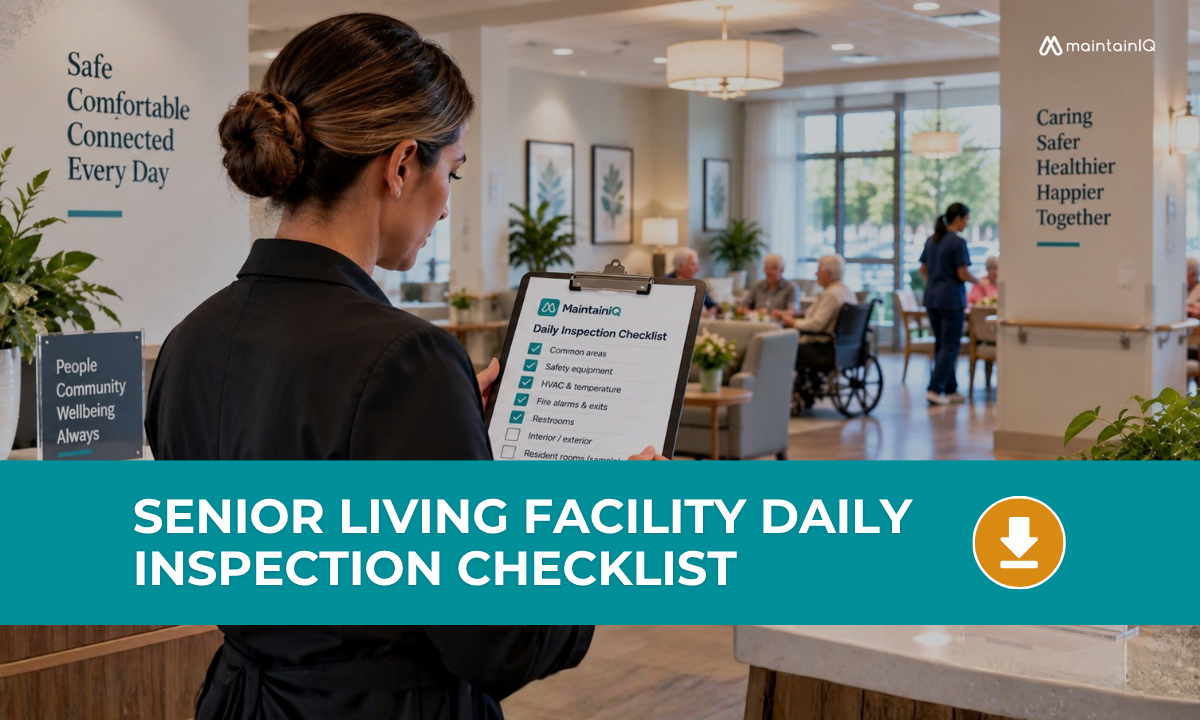
This Senior Living Facility Daily Inspection Checklist gives operators a documented daily safety round: life-safety and egress, resident safety and environment of care, and building systems — plus the documentation CMS and state surveyors expect.
Digitize and automate this checklist with MaintainIQ, your all-in-one maintenance management platform.
What’s Inside This Checklist
- Daily Life-Safety & Egress Round: Clear exit routes, egress doors, exit signs and emergency lighting, fire/smoke doors, and extinguisher checks — across a MON–SUN week.
- Resident Safety & Environment of Care: Call-light testing, fall-hazard sweep, grab bars and handrails, anti-scald water temperature, and wander-management for memory care.
- Building Systems & Environment: Fire panel status, generator status, refrigeration temps, HVAC, elevator operation, and exterior walkway safety.
- Documentation & Compliance: Daily signed logs, deficiency tracking, fire-safety and generator records, water-management, and emergency-preparedness documentation.
Why Daily Inspection Matters
- Egress Is Life Safety: Under NFPA 101 (the Life Safety Code CMS enforces), exit routes must stay clear and exit doors must open from the inside without keys or special knowledge. A blocked exit is a top survey finding and a direct danger in an evacuation.
- Falls Are Preventable: The environment-of-care round targets the exact conditions that cause falls — wet or cluttered floors, loose rugs, poor lighting, unstable furniture, and loose grab bars — before a resident is hurt.
- Call Lights Are a Lifeline: A resident who can’t summon help is a serious safety and liability exposure. Testing call lights daily confirms the system that residents depend on actually works.
- Systems Fail Silently: A generator fault or a fire panel in trouble is a life-safety issue in a building where residents can’t move quickly. Daily status checks catch it early.
- Surveys Check the Records: CMS surveys are unannounced and run against the State Operations Manual F-tags. A signed daily inspection record is the evidence surveyors expect — and it has to be retrievable fast.
Daily Round Quick Reference
| AREA | DAILY CHECK | STANDARD |
| Egress | Exits clear, doors operable inside | NFPA 101 |
| Fire safety | Exit signs, emergency lights, extinguishers | NFPA 101 / fire code |
| Fall prevention | Floors, rugs, lighting, grab bars | Environment of care |
| Call systems | Test resident call/emergency lights | Answered promptly |
| Generator | AUTO, no faults, fuel adequate | NFPA 110 |
| Elevators | Operation + certificate posted | ASME A17.1 |
Sources: NFPA 101 Life Safety Code and NFPA 99 (as adopted by CMS), CMS State Operations Manual Appendix PP (F-tags) and Appendix I, ADA Standards, and OSHA exit-route rules. Skilled-nursing facilities follow CMS directly; assisted-living requirements are largely state-governed — confirm your state’s rules.
How to Use This Checklist
- Egress round: Walk exit routes and doors daily; a blocked or chained egress path is corrected immediately, not logged for later.
- Resident-safety round: Test call lights and sweep for fall hazards every day; confirm grab bars and safe water temperatures.
- Systems round: Check fire panel, generator, refrigeration, and elevator status; route any fault for correction.
- Or go digital with MaintainIQ — run daily inspection rounds on a phone with timestamps and photos, auto-generate life-safety and generator PM on the required frequency, and produce CMS-ready records in under a minute instead of digging through binders.
Frequently Asked Questions
What life-safety code applies to senior living facilities?
NFPA 101, the Life Safety Code, is the standard CMS enforces for certified facilities, alongside NFPA 99 for health care. It sets minimum requirements for egress, fire protection, and exit signage. Existing nursing facilities follow the health-care-occupancy chapters; assisted living generally follows residential board-and-care provisions and state rules.
How often should senior living safety inspections be documented?
A documented daily safety round is best practice for egress, resident safety, and building systems, with recurring records for fire drills, generator testing, and water management. CMS surveys are unannounced, so records must be current and retrievable at any time.
What do CMS surveyors look for during a life-safety survey?
Clear egress, functioning exit signs and emergency lighting, current fire-protection and generator records, an all-hazards emergency-preparedness plan with documented training and drills, and evidence that deficiencies were identified and corrected.
Do assisted living facilities follow the same rules as nursing homes?
Not always. Skilled nursing facilities that participate in Medicare/Medicaid follow federal CMS regulations directly. Assisted living is typically governed by state-specific standards. Many life-safety fundamentals overlap, but confirm your state’s specific requirements.
Go Digital with MaintainIQ
Paper inspection binders can’t prove the call lights were tested this morning, can’t trend a generator that keeps faulting, and can’t produce a life-safety history in the 60 seconds a surveyor gives you. MaintainIQ replaces them with daily inspection rounds on a phone, automated fire-safety and generator PM on the required frequency, deficiency tracking with owners and due dates, and CMS-ready records available instantly. Whether you operate one community or a portfolio, MaintainIQ keeps residents safe, deficiencies tracked, and every survey covered.