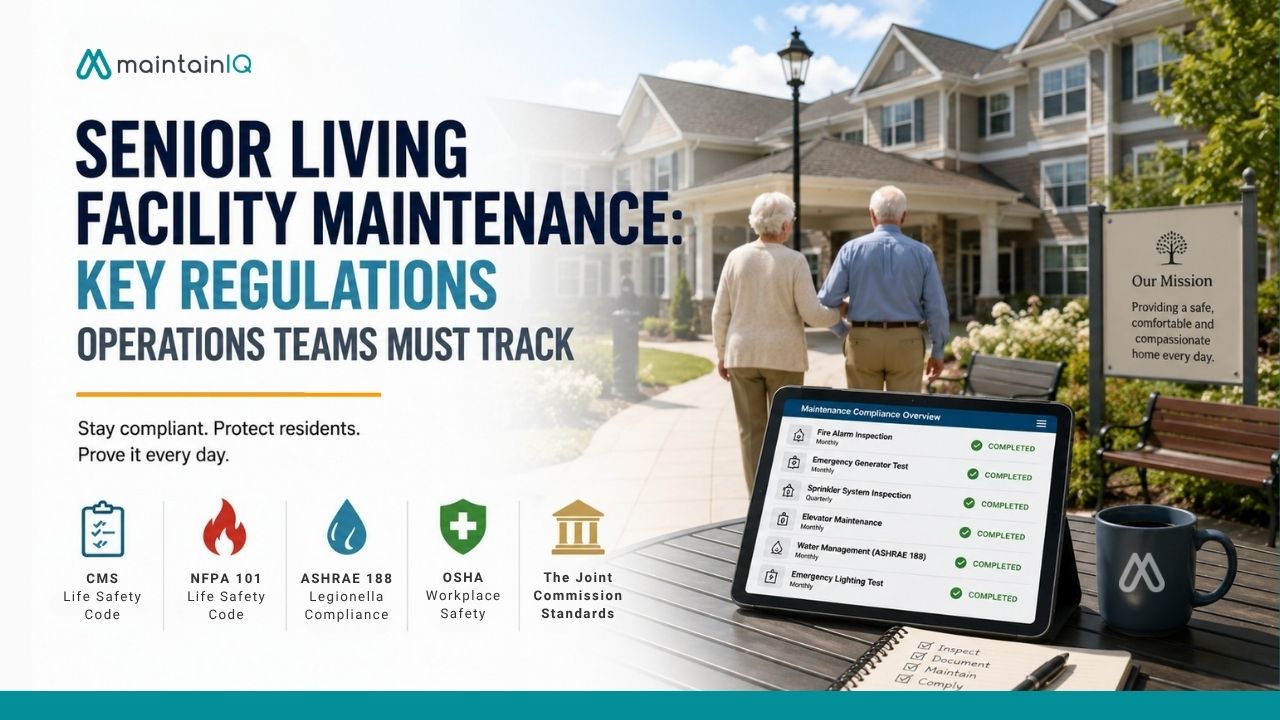
Senior living facility maintenance is not primarily about fixing things. It’s about proving — at any moment a surveyor walks through the door — that every system has been inspected, tested, and maintained on schedule, and that every deficiency has a documented corrective action.
CMS (Centers for Medicare & Medicaid Services) surveys are unannounced. When a surveyor arrives at your skilled nursing facility or assisted living community and asks for the last 12 months of fire alarm testing records, emergency generator test logs, and elevator maintenance documentation, the answer cannot be “let me check the file room.”
The documentation either exists — complete, organized, and immediately accessible — or it doesn’t. And if it doesn’t, the deficiency goes on your survey report, potentially putting your Medicare and Medicaid certification at risk.
The regulatory landscape for senior living maintenance spans multiple agencies and standards: CMS conditions of participation, the NFPA 101 Life Safety Code, ASHRAE 188 water management requirements, state licensing regulations, OSHA workplace safety standards, and the Joint Commission (for accredited facilities). Each has its own inspection frequencies, documentation requirements, and consequences for non-compliance.
This guide breaks down the key maintenance regulations operations teams must track, organized by system — so you know exactly what to document, how often, and what’s at stake.
Table of Contents
CMS and the Life Safety Code: The Non-Negotiable Baseline
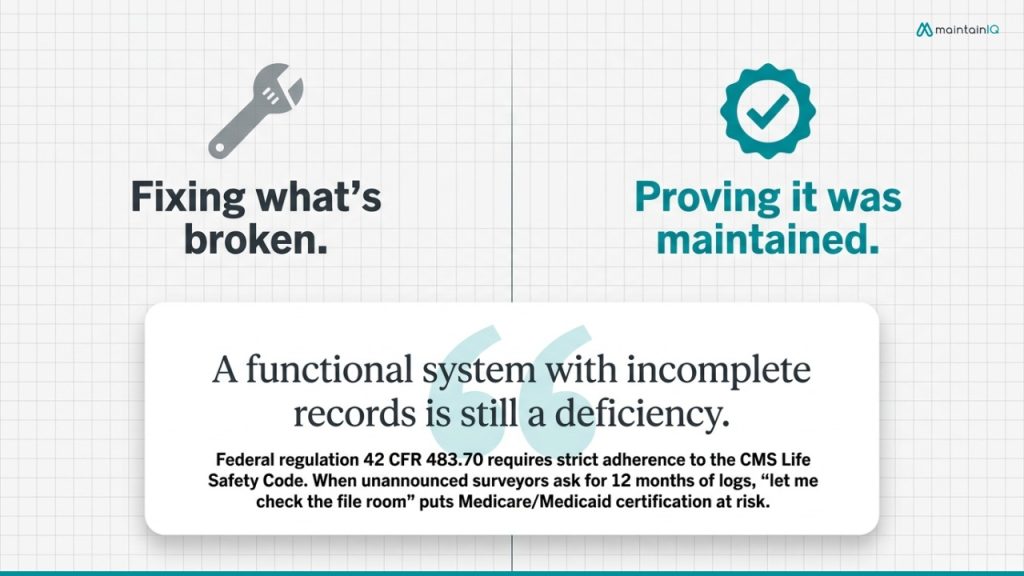
Federal regulation 42 CFR 483.70 requires nursing home facilities to meet NFPA 101 Life Safety Code provisions. This is the non-negotiable compliance baseline for any facility that participates in Medicare or Medicaid — which is effectively all of them.
CMS adopted the 2012 edition of NFPA 101 (Life Safety Code) and NFPA 99 (Health Care Facilities Code) as the standards for all certified healthcare facilities.
State surveyors conduct annual Life Safety Code surveys that evaluate the physical environment, fire safety systems, and maintenance documentation. Deficiencies can result in plans of correction, civil monetary penalties, or termination of Medicare/Medicaid participation.
The critical point for operations teams: CMS doesn’t just check whether your fire alarm works today. They check whether your documentation proves it has been tested on the correct schedule for the past 12 months. A functional system with incomplete records is still a deficiency.
Fire Protection Systems
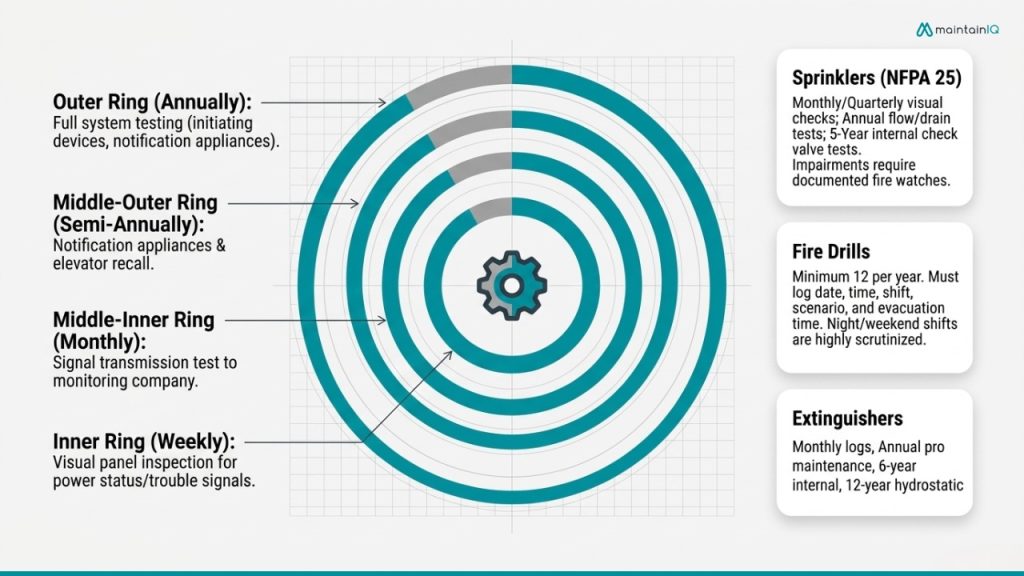
Fire protection is the single largest maintenance documentation burden in senior living facilities — and the area where survey deficiencies are most common.
Fire Alarm Systems
Weekly: Visual inspection of fire alarm control panel for trouble signals, supervisory conditions, and power status.
Monthly: Test signal transmission to the monitoring company to verify the alarm communicates properly.
Semi-annually: Comprehensive testing of all notification appliances (horns, strobes), duct detectors, door holders, and elevator recall. This typically requires a fire alarm service company.
Annually: Full system testing and inspection per NFPA 72, including all initiating devices (smoke detectors, pull stations, heat detectors), notification appliances, and supervisory devices. Documentation must include every device tested, its result, and any deficiencies found and corrected.
That’s four separate inspection frequencies running simultaneously for a single system. Miss one, and the surveyor has a deficiency to cite.
Automatic Sprinkler Systems
| Frequency | Required Action |
| Monthly/Quarterly | Visual inspection of sprinkler heads, control valves, fire department connections, and alarm devices per NFPA 25. |
| Annually | Full flow test, main drain test, and full component inspection |
| Every 5 years | Internal check valve inspection and additional testing by system type (wet, dry, pre-action) |
Sprinkler system impairments — even temporary ones during maintenance — must be documented with the impairment start time, reason, notification of the fire watch, and restoration time.
Fire Suppression Systems (Kitchen)
If your facility has a commercial kitchen, the hood and exhaust system falls under NFPA 96, and the kitchen fire suppression system falls under NFPA 17A.
Monthly: Visual inspection of nozzle caps, gauges, and physical condition of the suppression system. Verify that the manual pull station is accessible and clearly marked.
Semi-annually: Professional inspection and testing of gas and electric shutoffs, mechanical links, and fusible links.
Annually: Full system service by a certified technician, including recharge or replacement of agents as needed.
Kitchen hood and duct cleaning frequency depends on cooking volume — quarterly for high-volume operations, semi-annually for moderate volume, and annually for light cooking per NFPA 96.
Fire Extinguishers
| Frequency | Required Action |
| Monthly | Visual check — location, pin/tamper seal, no damage, gauge in charged range. Log date and initials |
| Annually | Professional maintenance, examination, recharge if needed, and certification |
| Every 6 years | Internal examination of stored-pressure extinguishers |
| Every 12 years | Hydrostatic testing |
Fire Drills
CMS requires fire drills on every shift, every quarter — meaning a minimum of 12 fire drills per year (four per shift if running three shifts). Each drill must be documented with the date, time, shift, participants, scenario, evacuation time, and any issues identified. Drills on night and weekend shifts are frequently missed and are a common survey deficiency.
Emergency Power Systems
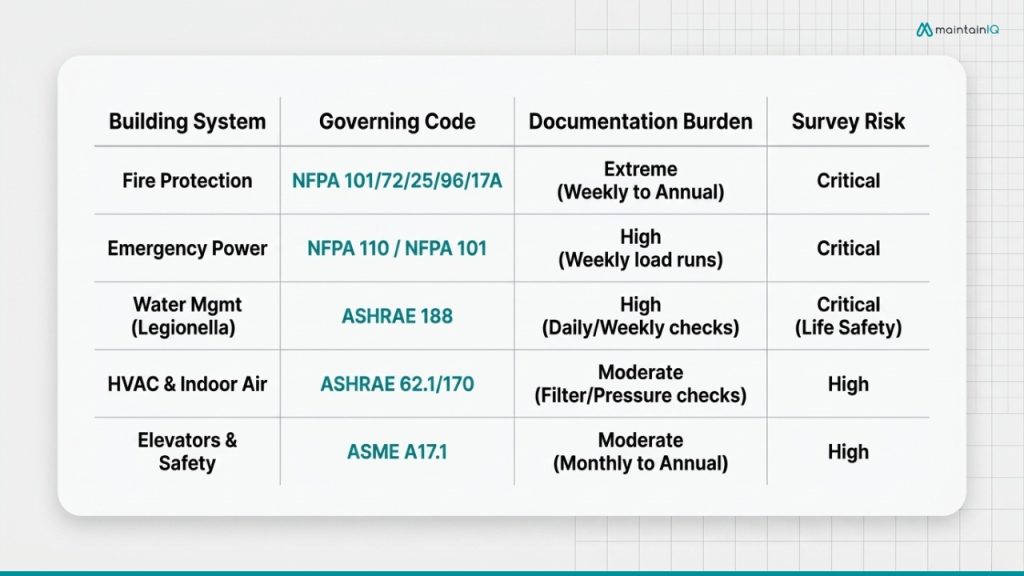
Senior living facilities are required to maintain emergency power systems capable of providing electricity to life safety systems, critical care areas, and essential building services during utility power failures.
Emergency Generators
Weekly: Run the generator under load for a minimum of 30 minutes per NFPA 110. Document start time, transfer time, voltage, frequency, and any alarms. This is one of the most commonly cited deficiencies — facilities either don’t test weekly or don’t document consistently.
Monthly: Comprehensive inspection of fuel levels, coolant levels, battery condition, oil pressure, and transfer switch operation.
Annually: Full load bank test — running the generator at full rated load for a sustained period to verify it can actually power the facility’s emergency circuits under real conditions.
Fuel storage must be maintained at a level sufficient to run the generator for the duration required by your facility type — typically 24–96 hours depending on the classification and state requirements. Document fuel levels during every weekly test.
Emergency Lighting and Exit Signs
Monthly: Test all emergency lighting units and illuminated exit signs by activating the test button for a minimum of 30 seconds to verify the battery and lamp function.
Annually: Full 90-minute battery discharge test per NFPA 101 to verify that emergency lighting will operate for the required duration during a power failure.
Exit signs and emergency lighting in stairwells, corridors, and common areas are inspected during every Life Safety Code survey. Burned-out lamps, failed batteries, and missing documentation are easy deficiencies for surveyors to cite — and easy to prevent with a consistent preventive maintenance schedule.
HVAC and Indoor Air Quality
HVAC maintenance in senior living facilities carries both comfort and health implications. Residents — particularly those who are elderly, immunocompromised, or have chronic respiratory conditions — are vulnerable to poor indoor air quality in ways that healthy adults in commercial buildings are not.
ASHRAE Standards for Air Quality
ASHRAE 62.1 (Ventilation for Acceptable Indoor Air Quality) and ASHRAE 170 (Ventilation of Health Care Facilities) establish minimum ventilation rates and air quality requirements. For senior living facilities with skilled nursing wings, these standards require specific air change rates, pressure relationships between rooms, and filtration levels.
Monthly: Replace or clean HVAC air filters. In facilities with skilled nursing, dietary, or memory care areas, filter maintenance frequency may need to be higher depending on filter type and environmental conditions.
Quarterly: Clean evaporator and condenser coils. Inspect ductwork for visible contamination. Verify that pressure relationships between areas are maintained (negative pressure in soiled utility rooms, positive pressure in clean areas).
Semi-annually: Full professional HVAC system service — refrigerant levels, blower motor condition, thermostat calibration, and economizer operation.
Annually: Full system evaluation including energy efficiency assessment and documentation of all maintenance performed during the year.
Temperature Control for Resident Areas
CMS conditions of participation require that resident rooms and common areas maintain comfortable temperatures — typically between 71°F and 81°F. Surveyors check room temperatures during their walk-through, and resident complaints about temperature are taken seriously. Maintaining consistent temperatures across a facility with varying sun exposure, occupancy patterns, and equipment age requires both a properly maintained HVAC system and ongoing temperature monitoring.
Water Management and Legionella Prevention
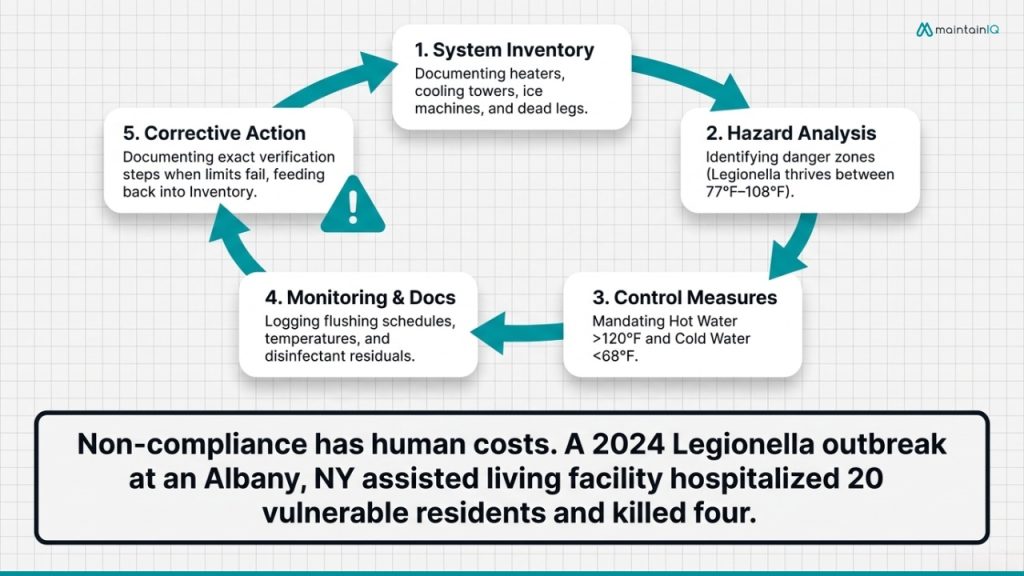
This is one of the most critical — and increasingly scrutinized — maintenance areas in senior living. Legionella bacteria thrive in building water systems where temperatures fall between 77°F and 108°F, and senior living residents are among the highest-risk populations for Legionnaires’ disease.
ASHRAE 188 and CMS Requirements
CMS requires all Medicare and Medicaid facilities to implement a water management program that considers ASHRAE Standard 188 and the CDC toolkit for Legionella prevention. This is mandatory — facilities that cannot demonstrate a documented water management program face survey deficiencies.
ASHRAE 188 requires a site-specific water management plan that includes:
System inventory — document every water system component that can harbor or transmit Legionella: domestic hot water heaters and recirculation loops, cooling towers, decorative fountains, ice machines, hydrotherapy equipment, and any areas with low-use fixtures where water stagnates.
Hazard analysis — identify conditions that promote Legionella growth: water temperatures between 77°F and 108°F, stagnation in dead legs or low-use fixtures, biofilm accumulation, and inadequate disinfectant residual.
Control measures — maintain hot water above 120°F at the heater and throughout the distribution system. Keep cold water below 68°F. Flush low-use fixtures on a documented schedule (weekly is standard). Monitor disinfectant residual levels.
Monitoring and documentation — regular temperature checks at representative points throughout the system. Document water temperatures, disinfectant levels, and any flushing activity. The monitoring frequency should be defined in your water management plan and followed consistently.
Corrective actions — when monitoring reveals conditions outside your control limits (low hot water temperature, stagnant fixture, elevated Legionella counts from testing), document the corrective action taken, who performed it, and the verification that conditions returned to acceptable levels.
The consequences of non-compliance are severe. A 2024 Legionella outbreak at an Albany, New York, assisted living facility hospitalized 20 residents and killed four. Beyond the human toll, non-compliance exposes facilities to CMS enforcement, state penalties, and significant litigation.
Elevator Systems
Facilities with elevators must maintain them per ASME A17.1 (Safety Code for Elevators and Escalators) and applicable state regulations.
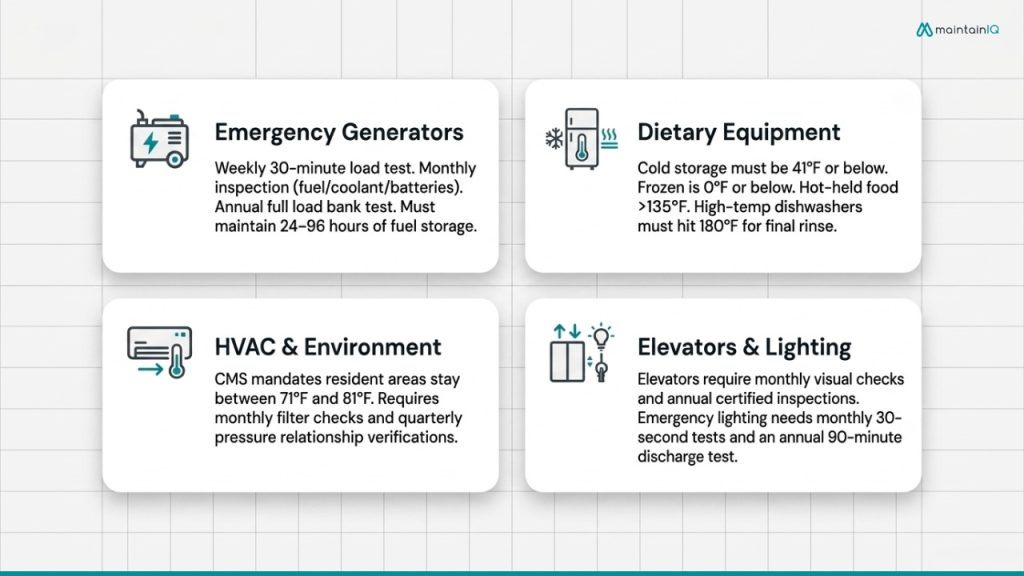
Monthly: In-house visual inspection of cab condition, door operation, leveling accuracy, emergency phone function, and emergency lighting.
Quarterly: Verify operation of all safety devices and interlocks.
Annually: Full certified inspection by a licensed elevator inspector — required by most states, with a certificate posted in or near the cab.
Elevator maintenance records — including all service calls, repairs, and annual inspections — must be retained and available for surveyor review. CMS surveyors check elevator certification during Life Safety Code surveys, and an expired certificate is an immediate deficiency.
Dietary and Kitchen Equipment
Senior living facilities that prepare meals on-site (most do) must maintain kitchen equipment under the same standards as commercial restaurants, with additional considerations for the vulnerable population being served.
Refrigeration and food storage — walk-in coolers, reach-in refrigerators, and freezers must maintain FDA Food Code temperatures (41°F or below cold, 0°F or below frozen). Temperature monitoring must be documented, and corrective actions for out-of-range readings must be recorded.
Cooking and hot holding equipment — ovens, steamers, steam tables, and tray delivery carts must maintain safe temperatures. Hot-held food must stay at 135°F or above.
Dishwashers — must reach proper sanitizing temperatures (180°F for high-temp machines) or maintain correct chemical sanitizer concentrations. Document verification of final rinse temperatures regularly.
Kitchen hood and exhaust — NFPA 96 cleaning schedule applies, and the kitchen fire suppression system follows NFPA 17A inspection requirements as described above.
State health department inspections cover the dietary operation separately from the CMS Life Safety Code survey. Food safety deficiencies in a senior living facility carry additional weight because residents are an at-risk population for foodborne illness.
Building the Documentation System
The thread running through every regulation above is the same: documented proof of maintenance. Not just that it was done, but when it was done, who did it, what was found, and what corrective action was taken if anything was deficient.
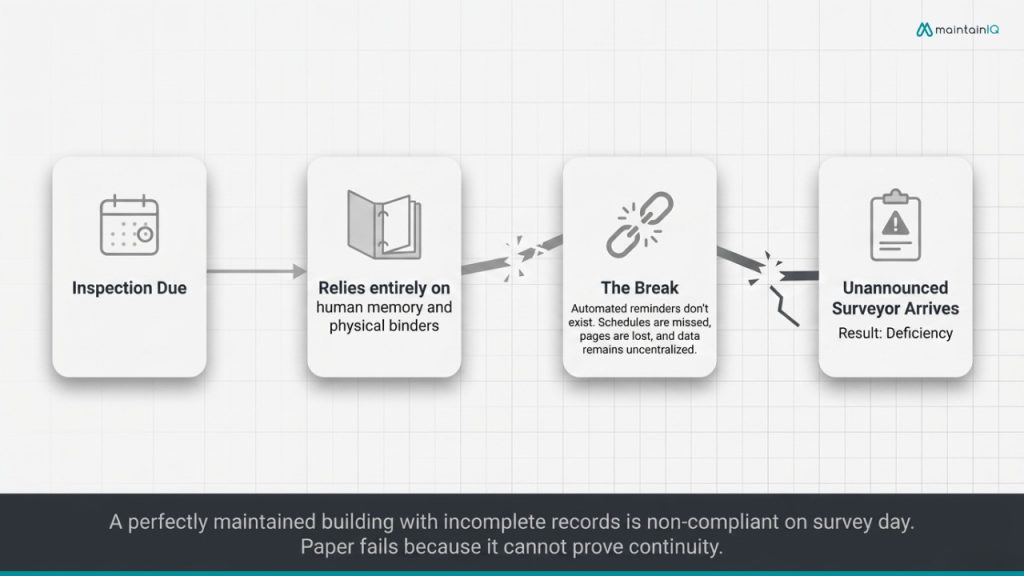
Paper-based systems can technically meet this requirement — but in practice, they fail for the same reasons they fail everywhere: binders get disorganized, records get lost, inspection schedules get missed without automated reminders, and there’s no centralized visibility for operators managing multiple facilities.
What a Compliant System Looks Like
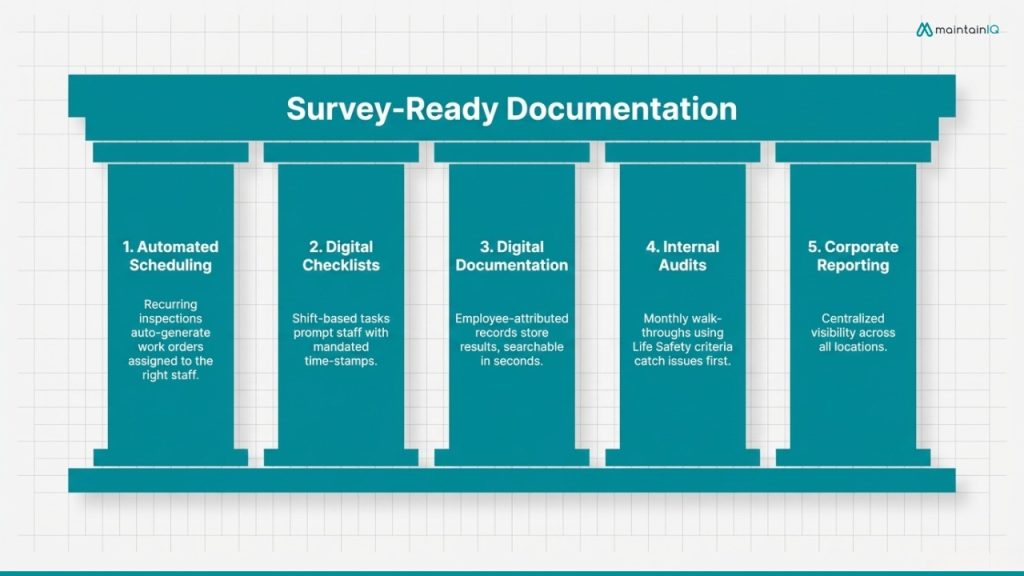
Automated scheduling — every recurring inspection and test (weekly generator runs, monthly fire extinguisher checks, quarterly sprinkler inspections, semi-annual fire alarm testing) should generate automated work orders on schedule, assigned to the right person, with completion tracked in real time.
Digital documentation — every completed inspection produces a time-stamped, employee-attributed record with results, deficiencies found, and corrective actions taken. Stored digitally and searchable so that when the surveyor asks for 12 months of generator test logs, you pull them up in seconds.
Digital checklists — daily and weekly tasks (fire alarm panel check, emergency lighting test, kitchen temperature logs, HVAC filter inspection) should be built into shift checklists that prompt staff and log completion automatically.
Internal audits — monthly walk-throughs using Life Safety Code survey criteria catch deficiencies before the surveyor does. Audit findings link directly to corrective work orders, creating a closed-loop system where every identified problem has a documented resolution.
Corporate-level reporting — for organizations operating multiple senior living communities, centralized reporting shows compliance status across every facility. Which communities are current on all fire safety testing? Which have overdue generator tests? Which have open corrective actions from the last internal audit? This visibility is what allows operations leaders to manage compliance proactively rather than reactively.
Multi-Facility Operators: Standardizing Compliance Across Communities
Managing multiple senior living communities demands consistent standards across every location — same schedules, same checklists, same documentation, same corrective action protocols. Non-compliance carries amplified risk here: a CMS survey deficiency at one community affects the entire organization’s regulatory standing and reputation.
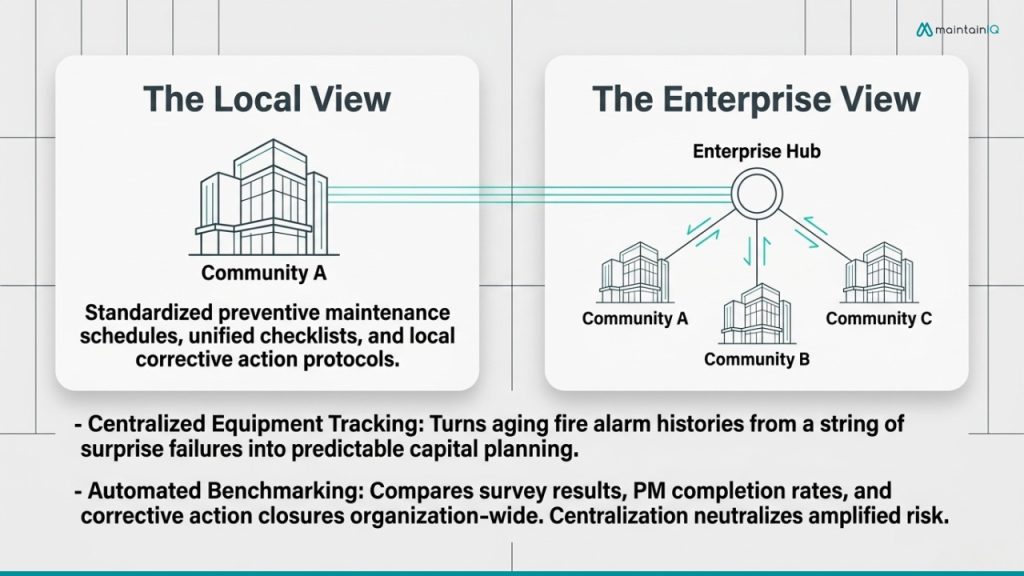
Three priorities drive success at scale:
Standardized maintenance programs — every community should operate from the same preventive maintenance schedule, the same checklists, the same documentation standards, and the same corrective action protocols. The generator test at Community A should produce the same documentation as the generator test at Community B.
Centralized equipment tracking — monitoring the age, service history, and condition of every critical asset organization-wide turns aging fire alarm systems into a capital planning conversation, not a string of surprise failures.
Benchmarking — comparing survey results, corrective action closure rates, and PM completion rates across communities- reveals where training and resources are needed most.
Getting Started
Start with the systems that carry the highest survey risk: fire protection, emergency power, and water management. These are the areas where CMS surveyors focus most intensely and where deficiencies carry the most serious consequences.
Map every required inspection and test for each system with the correct frequency. Set up automated work orders so each task is generated on schedule. Assign ownership — who completes the weekly generator test? Who coordinates the semi-annual fire alarm testing? Who manages the water management program?
Build digital records for everything. The documentation is the compliance. A perfectly maintained building with incomplete records is still non-compliant on survey day.
MaintainIQ brings preventive maintenance scheduling, digital checklists, work order management, internal audits, and corporate reporting into one platform — built for multi-location operators who need every community to meet the same standard, with documentation that’s always survey-ready.
Book a 20-minute demo to see how it works for senior living operations.
Conclusion
Senior living facility maintenance regulation is complex because the stakes are high. The residents you serve are vulnerable. The agencies that oversee you are thorough. And the documentation requirements reflect both realities.
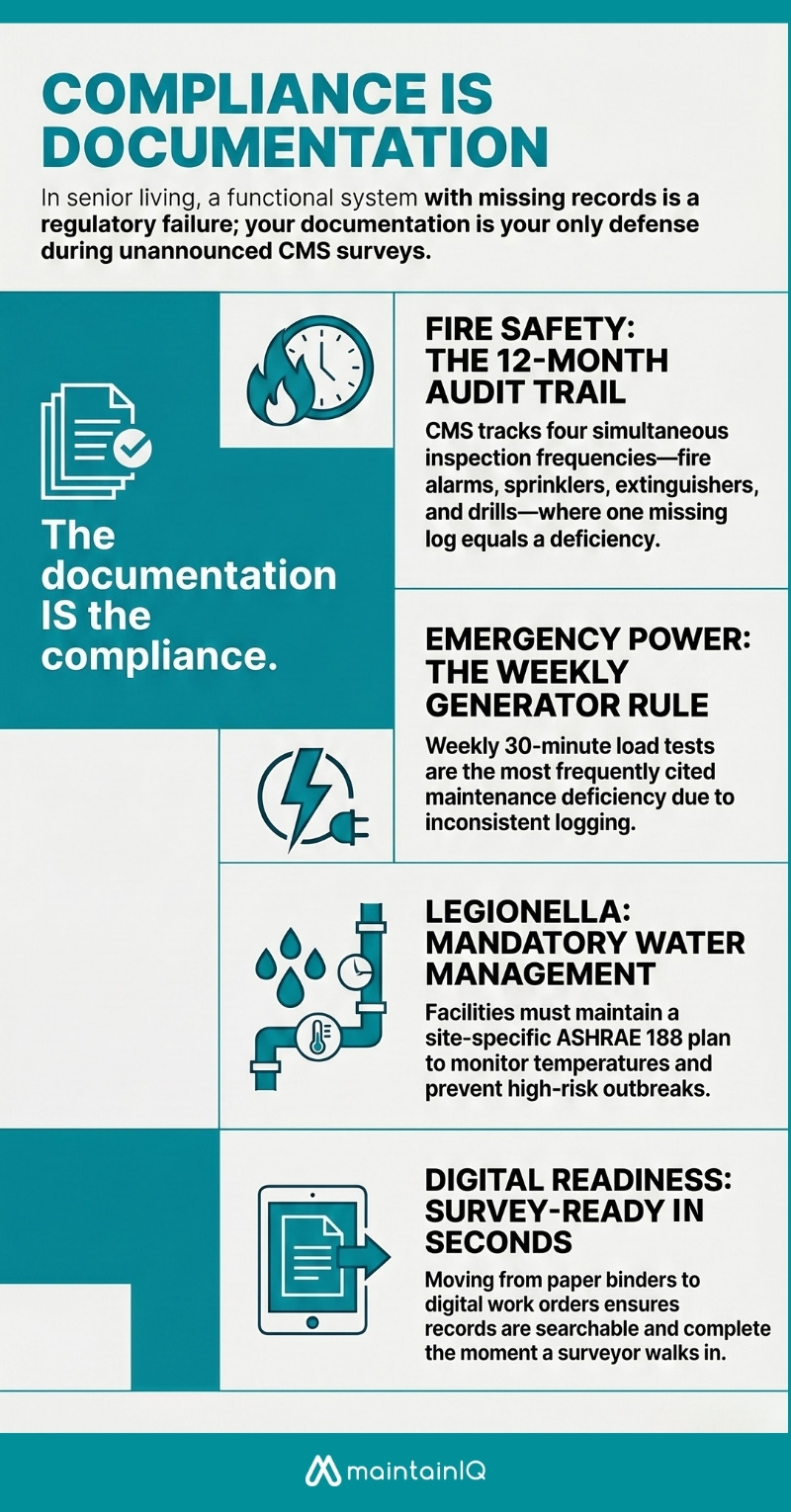
Every fire alarm test, every generator run, every water temperature reading, every sprinkler inspection, every kitchen temp log, every elevator certification — each one has a defined frequency, a defined standard, and a defined expectation for documentation. The facilities that pass surveys confidently are the ones that built a system to manage all of it — not the ones that scramble to compile binder pages when the surveyor arrives.
The regulations aren’t going to simplify. The only thing that changes is whether your system is built to keep up with them.