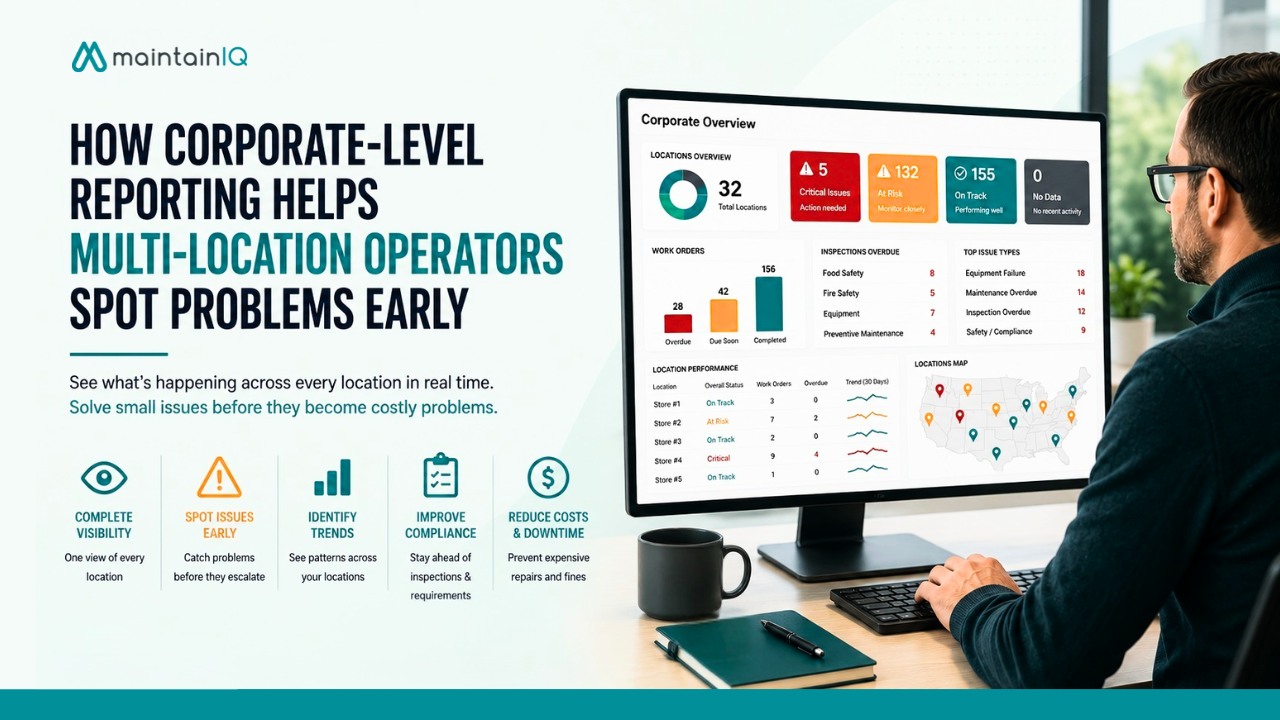
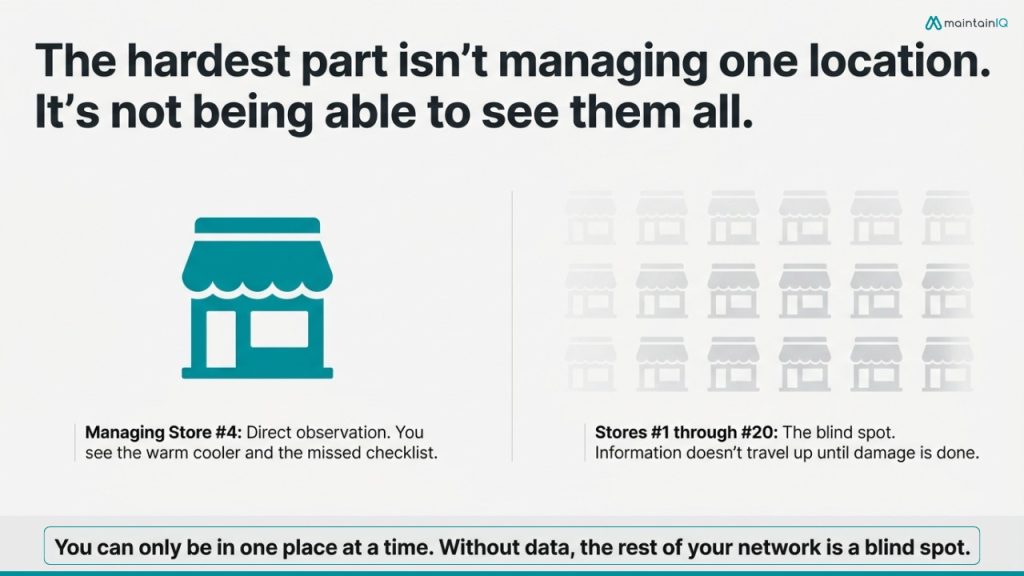
The hardest part of running multiple locations isn’t managing any single one. It’s not being able to see them all at once. A district manager can be standing in Store #4 while Store #11’s walk-in cooler is slowly failing, Store #7 hasn’t completed a food safety checklist in three days, and Store #2 is one missed inspection away from a fire code violation. By the time those problems surface — through a customer complaint, a failed health inspection, or an emergency repair call — they’ve already become expensive.
This is the fundamental challenge of distributed operations: visibility gaps where individual location problems remain hidden until they force a costly response. The location knows about the issue. The frontline staff might even know. But the information doesn’t travel up to the people who can allocate resources, intervene, or spot the pattern across locations — until it’s too late to prevent the damage.
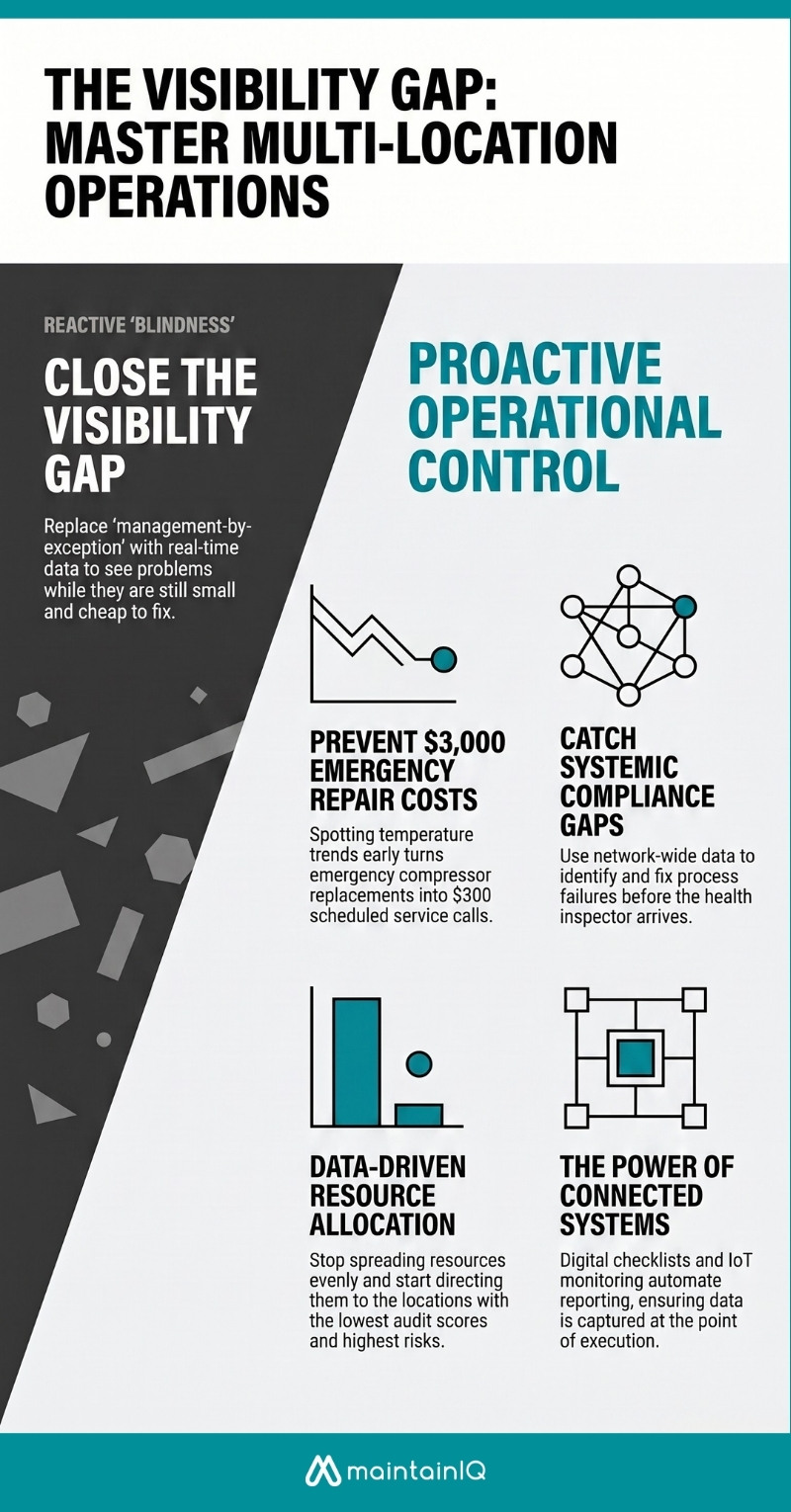
Corporate-level reporting closes that gap. It pulls operational data from every location into a single view, so the people responsible for the whole network can see what’s happening at each site in real time — and act on problems while they’re still small.
This article explains what corporate-level reporting is, the specific problems it catches early, and how multi-location operators use it to shift from reactive firefighting to proactive management.
Table of Contents
The Core Problem: You Can’t Manage What You Can’t See
When you operate one location, you manage by walking the floor. You see the cooler that’s running warm, the checklist that didn’t get done, the prep area that needs attention. Management is direct observation.
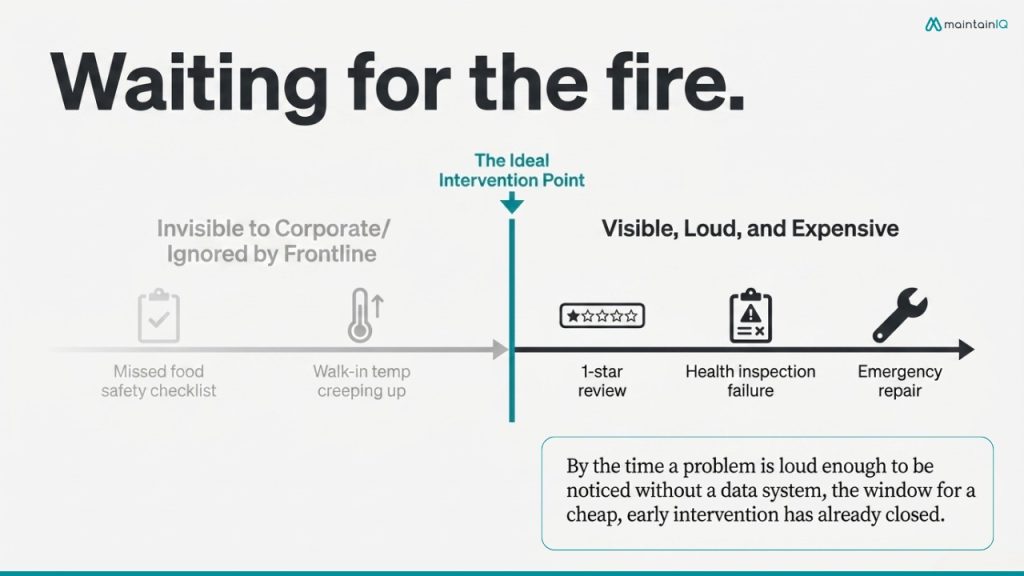
That model breaks the moment you add locations. A regional manager overseeing ten or twenty sites physically cannot be present at all of them. They drive between stores, spending hours in transit, and when they arrive, they see a snapshot — one moment in time at one location. They have no idea what’s happening at the other nineteen sites right now, and there’s no reliable way to know whether problems are isolated or systemic.
So multi-location operators end up managing by exception — reacting to whatever rises to their attention. And by definition, what rises to attention are problems that have already gotten bad: the one-star review, the failed inspection, the equipment that broke during peak service. By then, the window for early intervention has closed.
Corporate-level reporting replaces management-by-exception with management-by-visibility. Instead of waiting for problems to announce themselves, operators see the leading indicators — the missed checklist, the temperature trending the wrong way, the overdue maintenance task — and act before the problem becomes an incident.
What Corporate-Level Reporting Actually Shows
Corporate-level reporting aggregates operational data from every location into a centralized dashboard, giving leadership a unified view of the entire network. The specific data depends on what systems feed into it, but for operations-focused reporting, the most valuable views include:
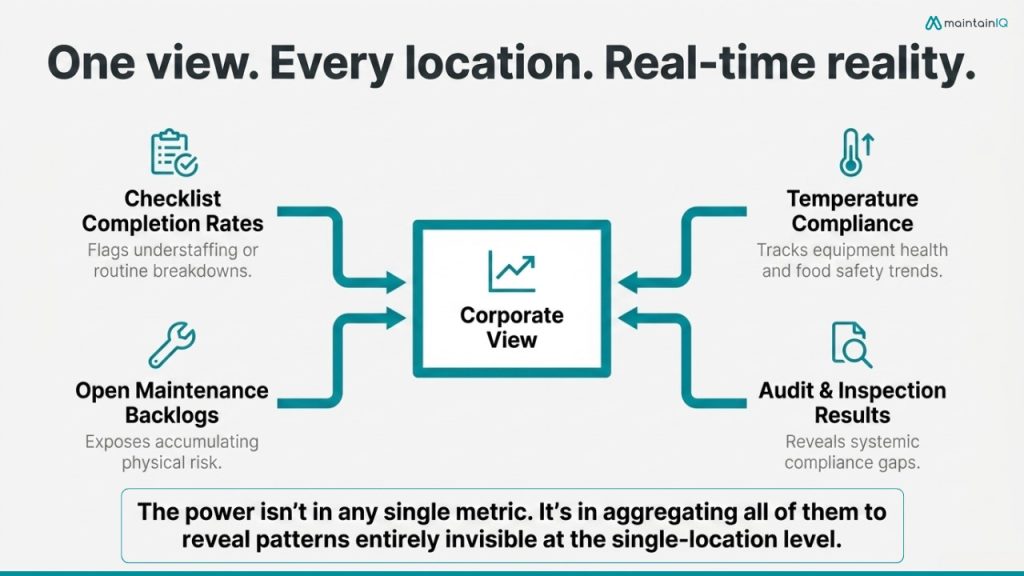
Checklist completion rates by location. Which stores are completing their opening, closing, food safety, and cleaning checklists on schedule — and which aren’t. A location whose completion rate is slipping is often the first sign of a deeper problem: understaffing, a struggling manager, or a breakdown in routine that will eventually show up as a customer experience or compliance failure.
Temperature compliance across all sites. Which locations are logging temperatures, which have readings out of range, and which have equipment trending toward failure? A walk-in cooler that’s gradually warming over two weeks is visible in the data long before it fails — but only if someone is looking at the trend across all locations.
Open and overdue maintenance work orders. Which locations have unresolved equipment issues, which have overdue preventive maintenance, and how long are corrective actions taking to close? A location with a growing backlog of open work orders is accumulating risk that will eventually surface as a breakdown or a safety issue.
Audit and inspection results. How each location scored on internal audits, what deficiencies were found, and whether corrective actions were completed. This reveals which locations consistently struggle in which areas — and whether problems found in an audit actually got fixed.
Corrective action status. When a problem is identified — an out-of-range temperature, a failed audit item, a maintenance issue — does it get resolved? Corporate reporting closes the corrective action loop, showing not just that issues were flagged, but that they were actually fixed.
The power isn’t in any single metric. It’s in seeing all of them, across all locations, in one place — so patterns become visible that no individual location manager could ever see on their own.
The Problems Corporate Reporting Catches Early
Equipment Failures Before They Happen
Equipment rarely fails without warning. A refrigeration unit’s temperature creeps upward over days or weeks before the compressor finally gives out. A piece of cooking equipment shows rising fault counts before it breaks down. These signals are present in the data — but at the single-location level, they’re easy to miss because no one is watching the trend.
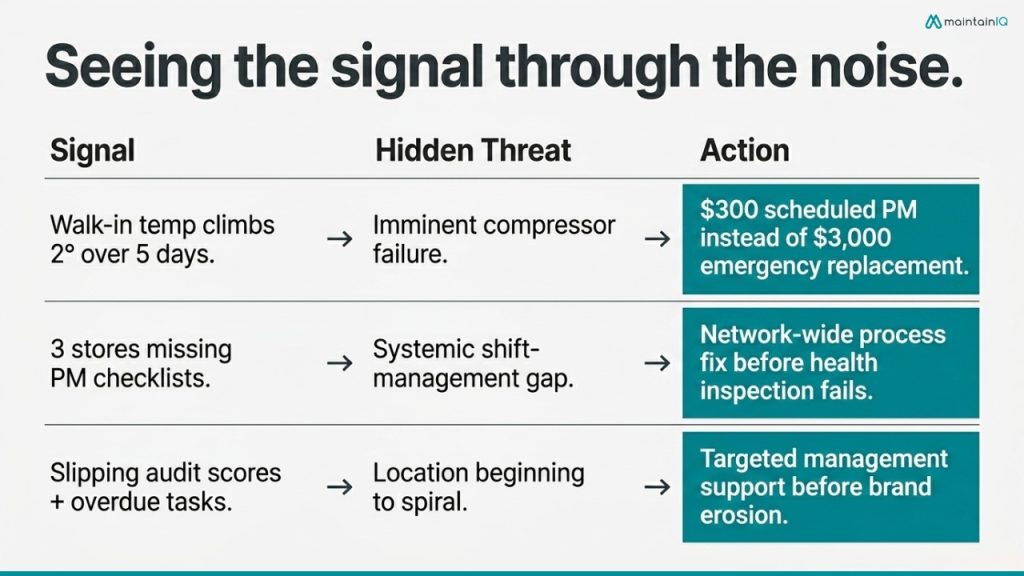
When temperature and equipment data from every location flows into corporate reporting, the warning signs become visible to the people who can act on them. A regional manager sees that Store #8’s walk-in has logged borderline temperatures for a week and dispatches a preventive maintenance technician — turning a $3,000 emergency compressor replacement and a day of lost revenue into a $300 scheduled service call.
Compliance Gaps Before the Inspector Finds Them
A health inspection failure or fire code violation at one location is a problem. But the deeper issue is usually that the same gap exists at other locations too — you just haven’t been inspected there yet.
Corporate reporting reveals compliance patterns across the network. If three locations are consistently missing their afternoon temperature checks, that’s not three isolated problems — it’s a systemic gap in how the afternoon shift operates, and it’s present at every location running that shift the same way. Catching it in the data lets you fix the process everywhere before the next inspection at any location finds it.
Underperforming Locations Before They Spiral
A location that’s slipping rarely fails all at once. Checklist completion drops. Maintenance tasks pile up. Audit scores decline. Each individual signal might not trigger a response, but together they describe a location heading toward trouble.
Corporate-level reporting surfaces these trends early. When a location’s operational metrics start declining across the board, leadership can intervene — additional training, management support, or resource reallocation — before the decline becomes a customer experience problem, a compliance failure, or a location that needs a full turnaround. As one industry framework puts it, performance dashboards let managers implement targeted improvement programs before problems escalate.
Inconsistency Before It Erodes the Brand
For multi-location operators, consistency is the brand. A customer who has a great experience at one location expects the same at every location. When execution varies — one store spotless, another struggling — the inconsistency erodes the trust the brand depends on.
Corporate reporting makes inconsistency visible and measurable. When every location is measured against the same standards and the same metrics, operators can see exactly which locations are meeting the standard and which aren’t — and address the gap before customers notice it.
From Data to Action: Closing the Loop
Visibility alone doesn’t fix anything. The value of corporate-level reporting comes from what it enables you to do with what you see. The most effective reporting systems don’t just display data — they drive action.
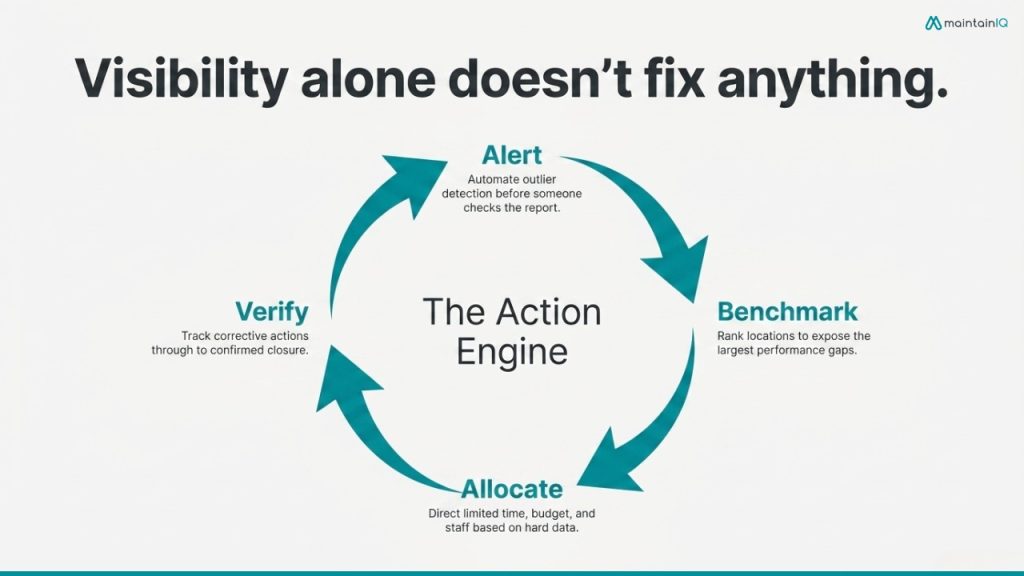
Automated alerts for outliers. Rather than requiring someone to study a dashboard, the best systems flag exceptions automatically. A temperature out of range, a checklist not completed by a deadline, a maintenance task overdue — these generate alerts to the right person so the response happens immediately, not whenever someone next checks the report.
Benchmarking across locations. When every location reports the same metrics, you can rank them — identifying both your strongest performers (whose practices you can replicate) and your weakest (who need support). This comparative view turns raw data into a prioritized action list: focus attention where the gap between actual and expected performance is largest.
Targeted resource allocation. Limited time, staff, and budget should go where they’ll have the most impact. Corporate reporting shows you exactly where that is — the locations with the most overdue work orders, the lowest audit scores, the most compliance gaps. Instead of spreading resources evenly or reacting to whoever complains loudest, you allocate based on data.
Verified corrective action. The loop closes when a flagged problem is confirmed resolved. Corporate reporting tracks not just that an issue was identified, but that a corrective action was assigned, completed, and verified. This is what separates real operational control from a dashboard that just displays problems without ensuring they get fixed.
Why This Requires Connected Systems
Corporate-level reporting is only as good as the data feeding into it — and that data has to be captured consistently, in real time, at every location. This is where paper-based and disconnected systems fail.
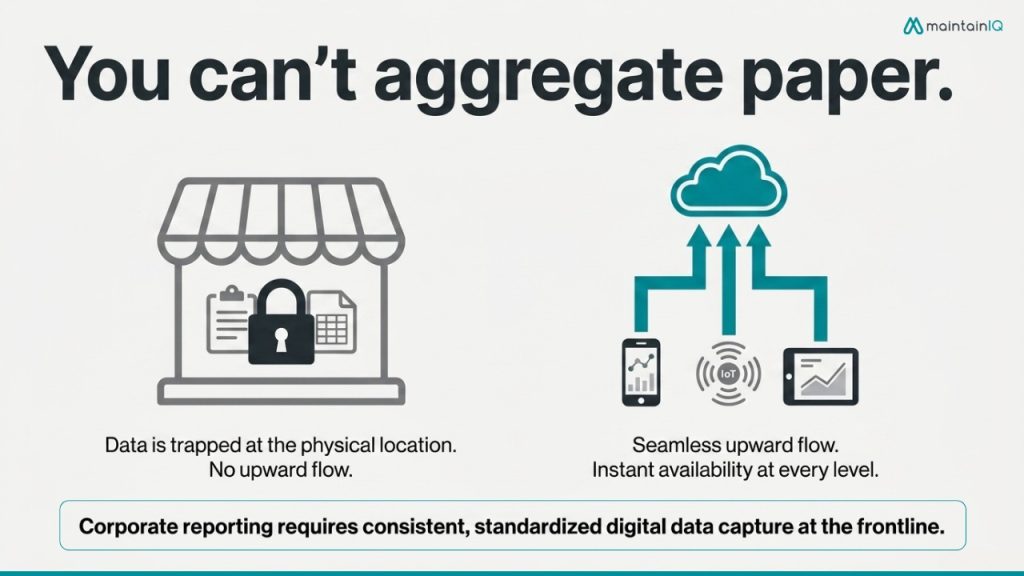
If each location tracks its operations on paper, in a binder, or in a local spreadsheet, there’s no way to roll that information up to a corporate view. The data is trapped at the location. A regional manager who wants to know whether Store #7 completed its checks today has to call the store or drive there. The information exists, but it’s not visible where decisions get made.
Connected digital systems solve this by capturing operational data at the point of execution and making it instantly available at every level of the organization:
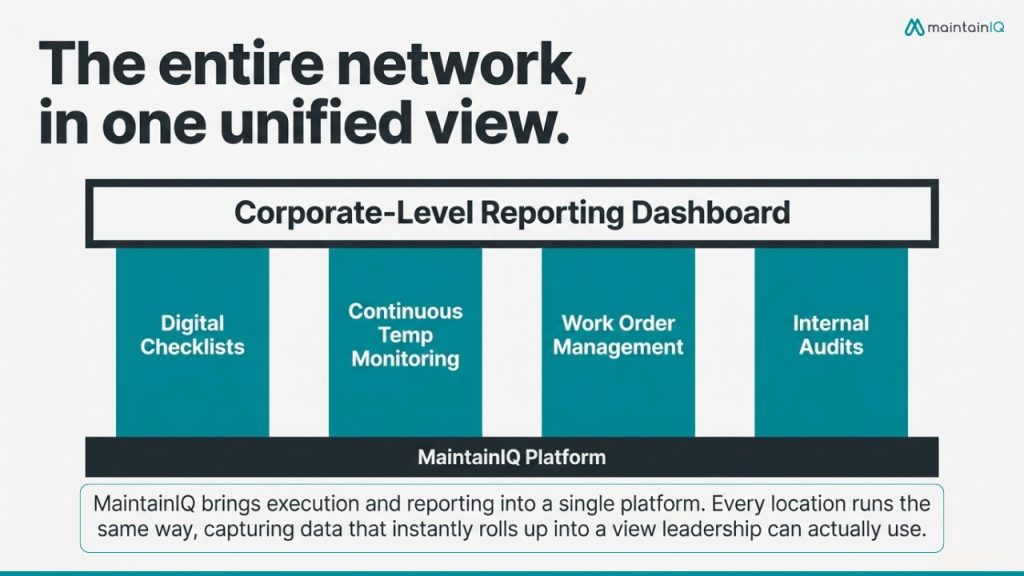
- Digital checklists capture completion data in real time as staff complete tasks — feeding checklist compliance metrics to corporate reporting automatically.
- Digital temperature monitoring logs readings continuously and flags out-of-range conditions across every location — making temperature compliance visible network-wide.
- Work order management tracks every maintenance request and corrective action from creation to completion — showing open, overdue, and resolved issues at every site.
- Internal audits record inspection results and corrective actions — revealing compliance patterns across locations.
When all of these feed into unified corporate-level reporting, leadership gets a complete operational picture of every location, updated continuously, without anyone having to compile reports manually. The system does the aggregation; the people do the deciding.
What Changes When You Have It
Operators who implement corporate-level reporting describe the same fundamental shift: from reacting to problems after they happen to preventing them before they do.
The district manager stops spending their week driving between stores to check on things and starts spending it at the specific locations the data says need attention. The operations director stops finding out about equipment failures when the emergency repair invoice arrives and starts catching them when the temperature trend first appears. The compliance team stops scrambling after a failed inspection and starts fixing process gaps across the network before the next inspection happens.
The locations don’t change. The equipment, the staff, the daily tasks — those stay the same. What changes is that the people responsible for the whole network can finally see the whole network, in time to do something about what they see.
Getting Started
Corporate-level reporting starts with capturing consistent operational data at every location. You can’t report on what you don’t capture, and you can’t aggregate what isn’t standardized.
Begin by standardizing your operations across locations — the same checklists, the same monitoring points, the same audit criteria, the same corrective action protocols. Then move that execution to digital systems that capture completion data automatically. Finally, connect those systems to centralized reporting that rolls everything up into a view that leadership can actually use.
MaintainIQ brings digital checklists, temperature monitoring, work order management, internal audits, and corporate-level reporting into one platform — so every location runs the same way, captures the same data, and reports into one unified view. Leadership sees compliance status, equipment health, checklist completion, and open issues across every location, in real time, without compiling a single report by hand.
Book a 20-minute demo to see how it works for multi-location operations.
Conclusion
The cost of distributed operations isn’t the complexity of running multiple locations. It’s the blindness — the inability to see what’s happening across the network until problems have already grown expensive. Every multi-location operator has experienced it: the equipment failure that gave warning signs nobody saw, the compliance gap that existed at five stores but was only found at one, the location that quietly declined until it needed rescue.
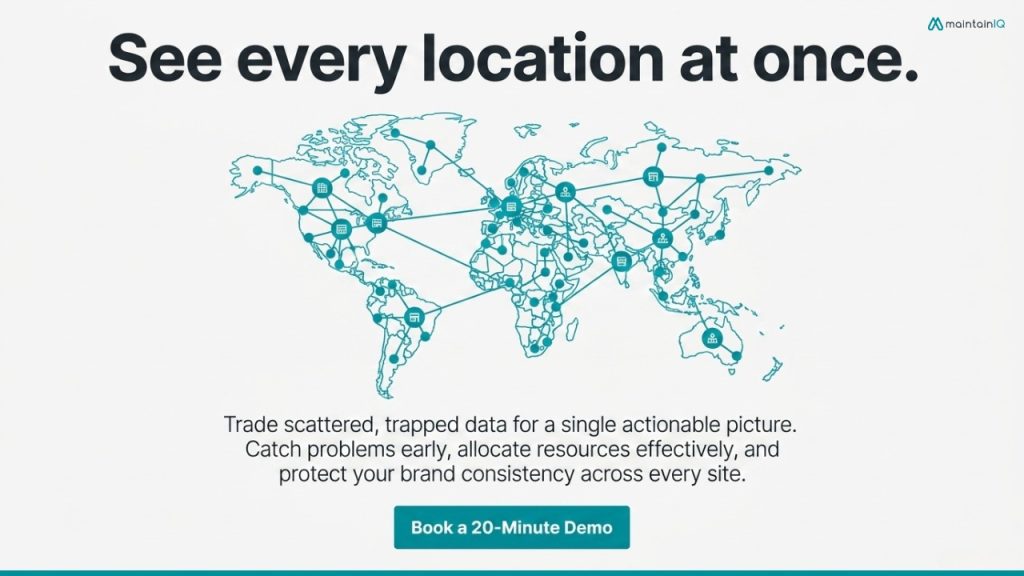
Corporate-level reporting is how operators trade that blindness for visibility. It turns the scattered, location-trapped data of a distributed operation into a single, actionable picture — one that surfaces problems while they’re still small, reveals patterns no single location could show, and directs attention and resources where they’ll do the most good.
You can’t be at every location at once. But with the right reporting, you can see every location at once — and that’s what makes the difference between catching a problem early and paying for it later.