The prep list is the most overlooked document in the kitchen, and it quietly controls two of the three biggest costs you have. Prep too much, and tomorrow morning you’re scraping product into the trash. Prep too little, and you’re 86’ing items mid-rush, pulling cooks off the line to catch up, and paying the overtime that follows.
Most kitchens still run prep off a laminated sheet, a whiteboard, or whatever the closing shift scribbled down last night — none of which reflect what today actually needs. That gap between what you prepped and what you should have prepped is money, and across several locations, it’s real money, every single day.
Prep list automation closes that gap. Here’s how it works, and why it moves both your food cost and your labor cost in the right direction.
Table of Contents
Your prep list is a cost-control document, not a to-do list
Two numbers decide whether a restaurant makes money: cost of goods sold and labor. Together, they make up prime cost, and the industry guidance is to hold prime cost between 55% and 65% of sales. Cross 65%, and profit becomes very hard to reach, regardless of how busy you are. In 2024, only 42% of U.S. restaurants were profitable, with food costs running more than 35% above pre-pandemic levels — so the margin for waste has never been thinner.
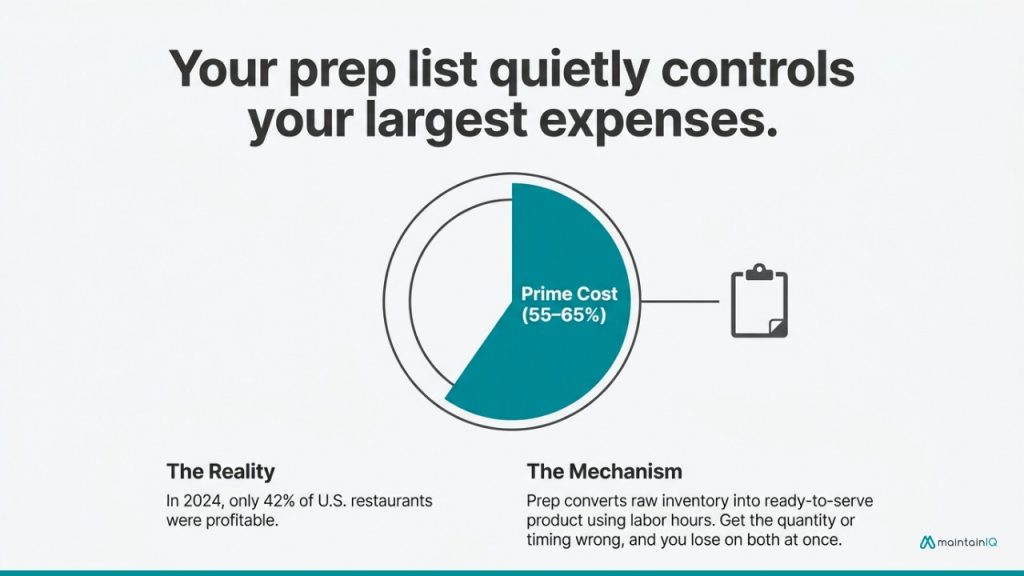
Food cost alone runs 28–35% of sales for most operators, with an industry average around 32%. And the waste inside that number is enormous: U.S. restaurants generate roughly 11.4 million tons of food waste a year, full-service restaurants accounting for the largest share. On the labor side, full-service restaurants now run a median labor cost of about 36.5% of sales. Prep sits directly on top of both of these lines — it’s the step that converts raw inventory (food cost) into ready-to-serve product using labor hours (labor cost). Get the quantity or the timing wrong, and you lose on both at once.
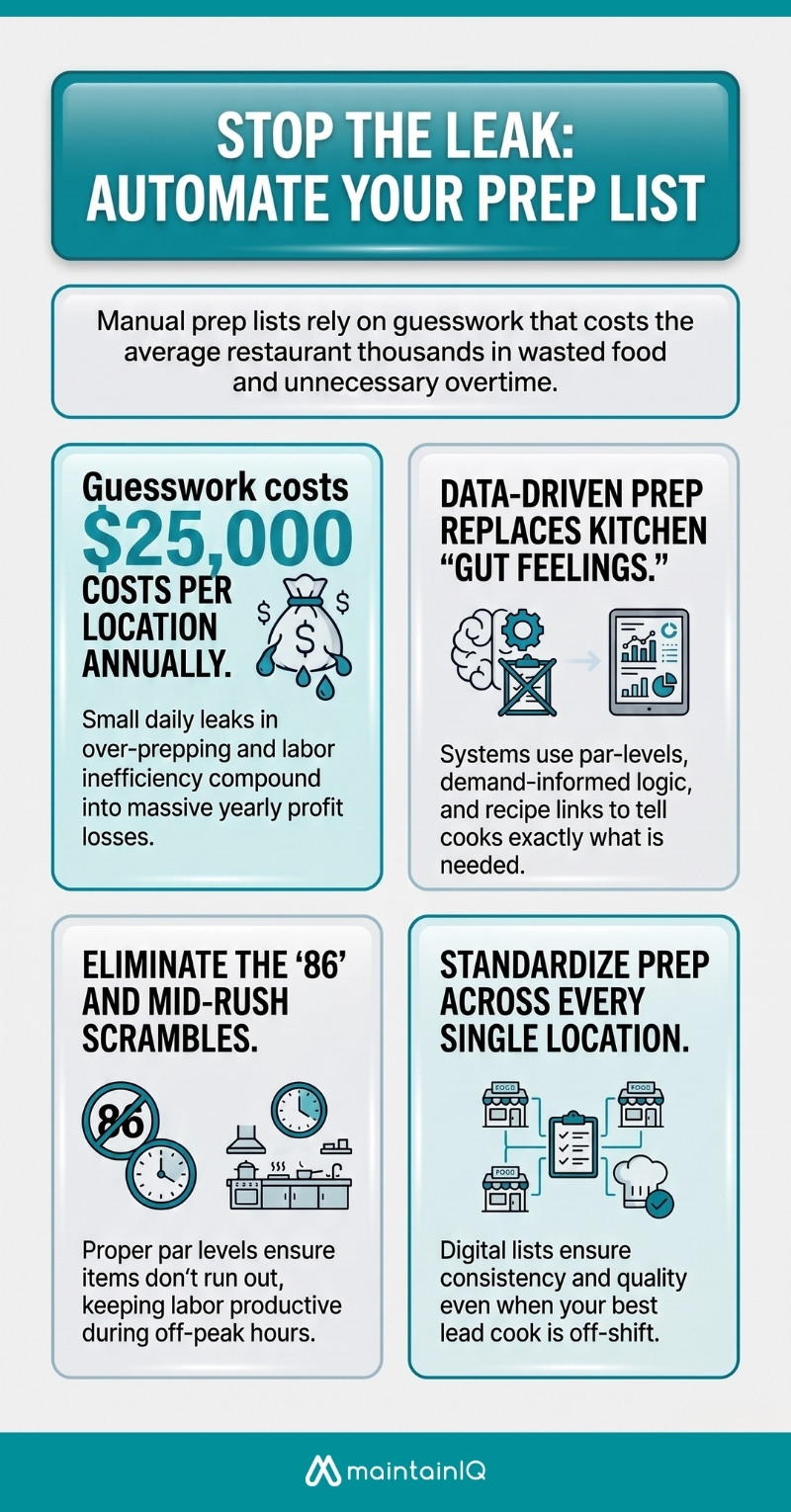
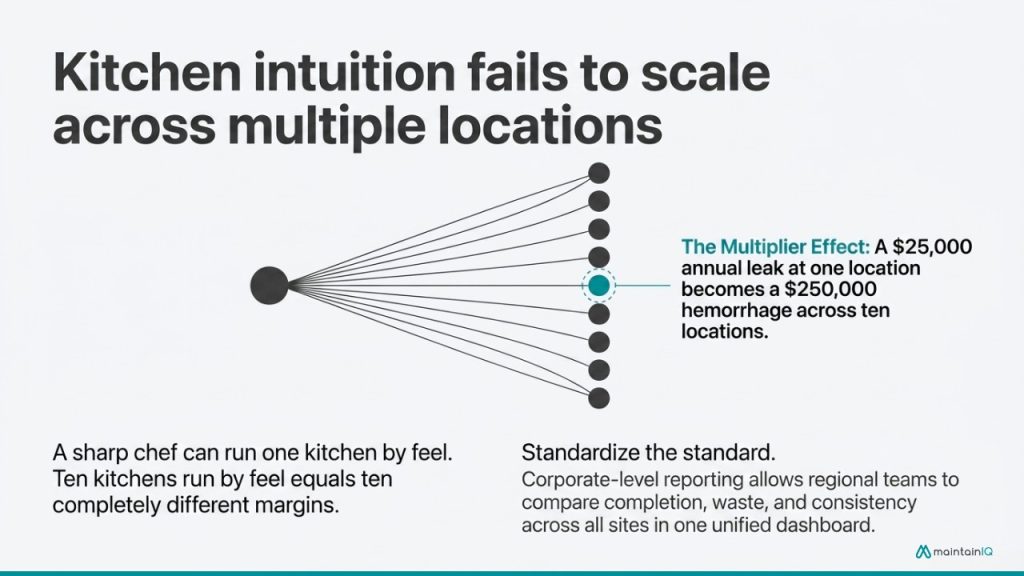
Put rough numbers on it: a single kitchen that over-preps and tosses just $40 of perishable product a day, while burning one extra hour of catch-up labor, loses under $70 a day — easy to shrug off. But that’s roughly $25,000 a year at one location, and north of $250,000 across ten. None of it shows up as a single alarming line on a P&L; it leaks out in small daily increments that no one location manager feels responsible for. That’s what makes it dangerous — and what a disciplined prep process recovers.
What a bad prep process actually costs
A prep list that’s built on guesswork fails in two directions, and both are expensive.
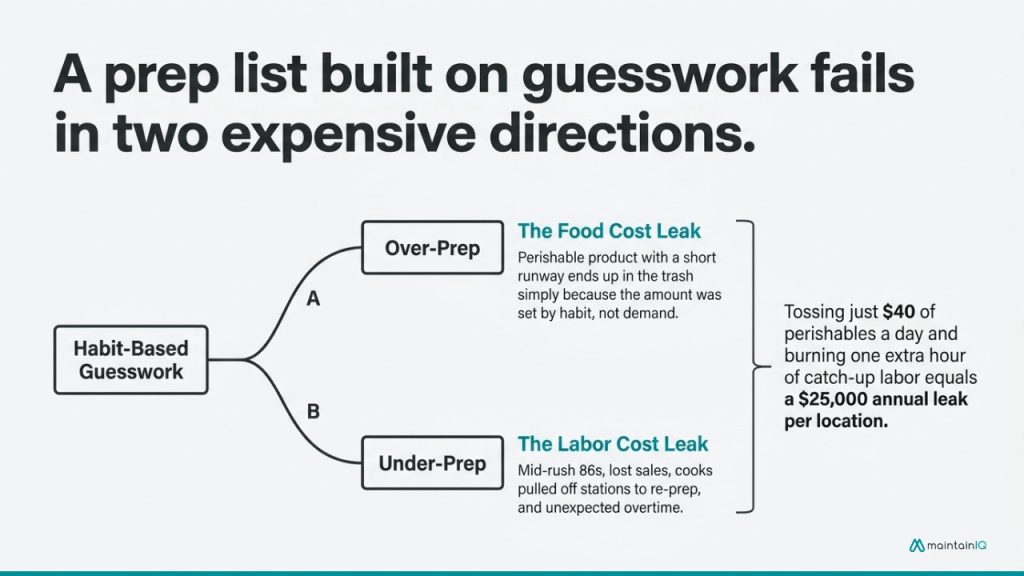
Over-prep is a food-cost leak. Perishable product that gets prepped and doesn’t sell has a short runway — much of it is in the trash within a day or two. This is the most avoidable kind of waste there is, because it’s entirely inside your control. Nobody forced you to make six pans of a component you sold two of. It happens because the prep amount was set by habit, not by demand.
Under-prep is a labor-and-revenue leak. Run short during service and the costs pile up fast: menu items get 86’d (lost sales), cooks get pulled off their stations to re-prep in the middle of a rush, tickets slow down, and someone stays late to rebuild for tomorrow. A prep-heavy scramble is one of the quiet drivers of kitchen overtime, and overtime raises payroll and pushes prime cost the wrong way.
Underneath both is the same root problem: the prep amounts are a guess. A slow Tuesday gets prepped like a busy Saturday because the number on the sheet never changes. Or there are no par levels at all — just whatever the person on shift thinks feels right. When that person is off, the new cook over- or under-preps because the knowledge lived in their head, not the system. Multiply that inconsistency across a dozen locations, and you can’t even see where the money is going, let alone fix it.
Signs your prep process is leaking money
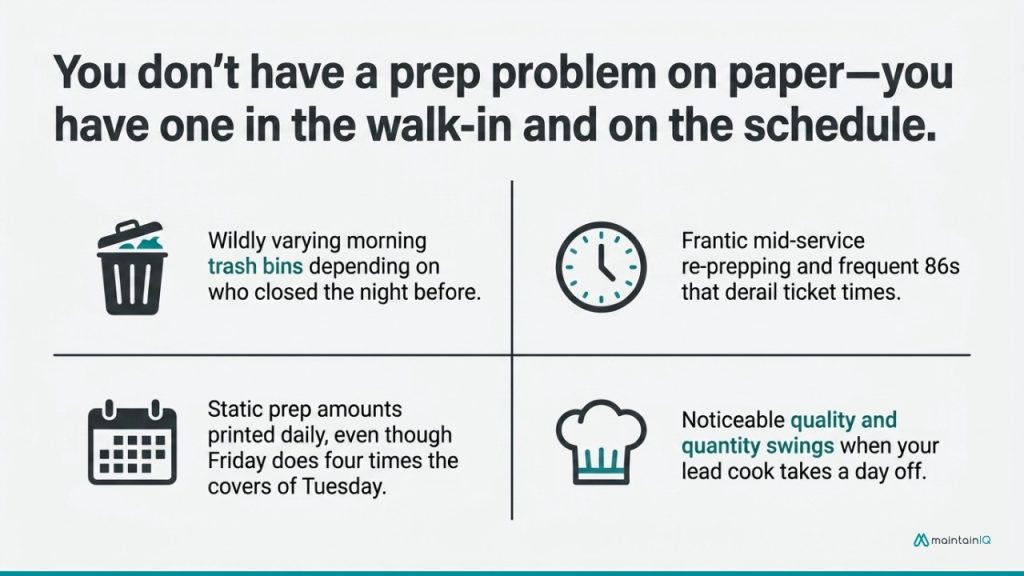
Most operators don’t have a prep problem on paper — they have one in the walk-in and on the schedule. A few tells:
- You throw out prepped product most mornings, and the amount varies wildly depending on who worked the night before.
- You 86 items during service more than occasionally, then re-prep in the middle of a rush.
- Prep amounts never change, even though your Friday does four times the covers of your Tuesday.
- When your lead cook is out, prep quality and quantity noticeably swing — because the process was really that person, not a system.
- You can’t answer, per location, how much prepped food got wasted last week. If the number doesn’t exist, it isn’t being managed.
What “prep list automation” actually means
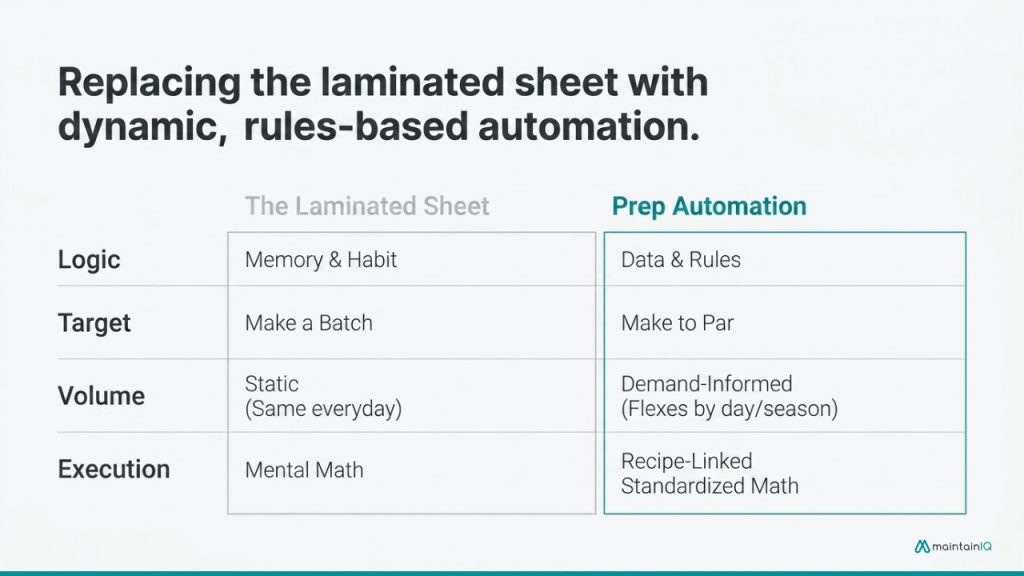
Automation here doesn’t mean robots in the kitchen. It means the prep list is generated from data and rules instead of memory and guesswork — so the amount in front of a cook reflects what the day actually needs. In practice, an automated prep process is:
- Par-based. Every prep item has a target level. Instead of “make some pico,” the list says how much to make to reach par, based on what’s already on hand — so you produce the gap, not a habit.
- Demand-informed. Pars flex for the day of the week, the season, and known events, so Friday’s prep list isn’t a carbon copy of Monday’s.
- Recipe-linked. Because the list is tied to standardized recipes, “make four quarts” translates into the correct ingredient amounts and batch size every time — no re-doing the math, no drift between cooks.
- Standardized and trackable. Delivered as digital checklists rather than a paper sheet, the same prep logic runs on every shift, and you can see what got prepped, by whom, and when.
That last point matters more than it sounds. A paper prep list ages the moment it’s written and tells you nothing afterward. A digital one becomes a record you can actually manage against.
How automation cuts food waste
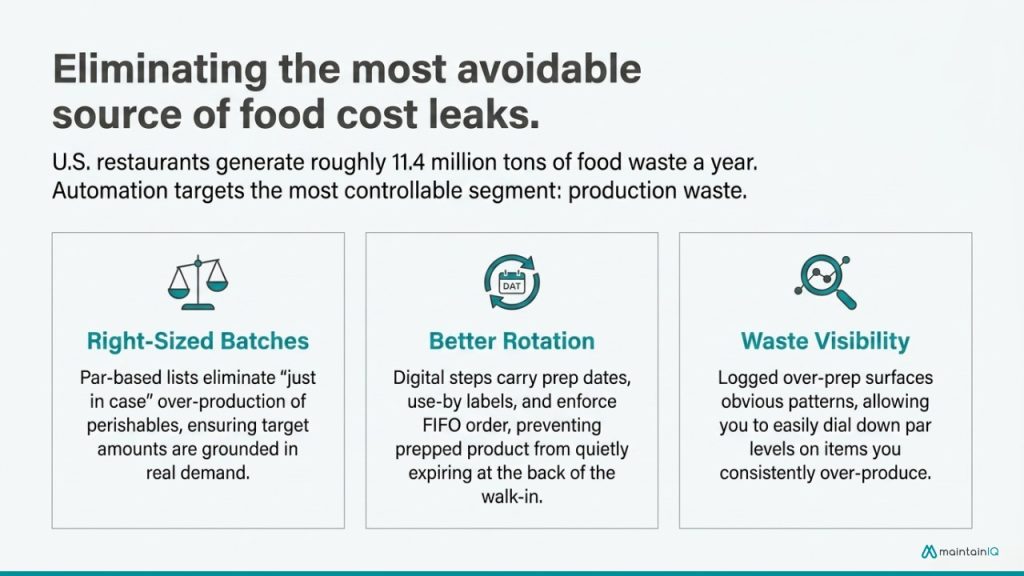
Waste drops for four concrete reasons, not because anyone is trying harder:
- Right-sized batches. Making to par instead of to habit means less prepped product with no home. The single biggest source of avoidable kitchen waste — over-production of perishables — shrinks because the target amount is grounded in real demand.
- Prep only the gap. When the list accounts for what’s already prepped and on hand, cooks make the difference needed to hit par, not a full batch on top of yesterday’s leftovers.
- Better rotation and dating. A digital prep step can carry prep dates, use-by labels, and FIFO order, which ties prep directly into food safety and keeps prepped product from quietly expiring at the back of the walk-in.
- Visibility into what you waste. When over-prep and tossed product are logged instead of forgotten, the pattern becomes obvious — and you can dial a par down on the items you consistently over-produce. You can’t fix waste you never measured.
It’s worth being precise about which waste this fixes. Some restaurant waste is guest-driven — plate waste from oversized portions, for instance — and prep automation won’t touch that. But production waste, the food that never even reaches a plate because it was prepped, held, and then thrown out, is squarely inside your control. That’s the lever prep automation pulls, and for most kitchens it’s the larger and more recoverable of the two.
How automation cuts labor costs
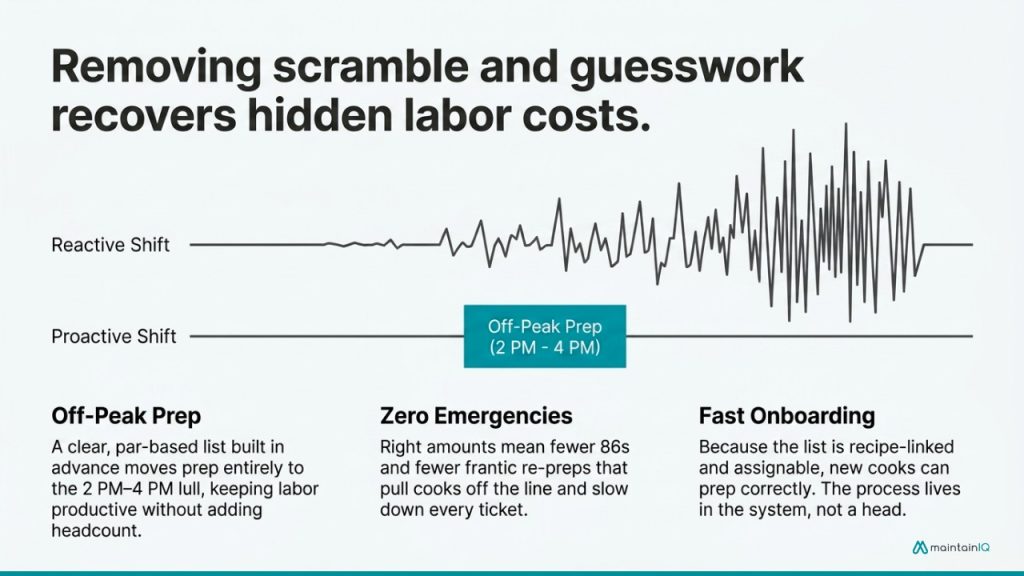
The labor savings are just as real, and they come from removing scramble and guesswork from the day:
- Prep moves to off-peak hours. A clear, par-based list built in advance lets you schedule prep for slow periods — that 2 p.m.-to-4 p.m. lull — instead of paying people to catch up during service. Prepping during kitchen down time is one of the most reliable ways to keep labor productive without adding headcount.
- No time lost deciding what to prep. When the list is ready and correct, cooks execute instead of standing around interpreting a vague sheet or waiting on a manager to tell them what’s needed.
- Fewer mid-service emergencies. Right amounts mean fewer 86’s and fewer frantic re-preps that pull a cook off the line and slow every ticket behind them.
- Faster onboarding, less key-person risk. A recipe-linked, assignable prep list means a newer cook can prep correctly without a veteran hovering — the process no longer lives in one person’s head, which is exactly what makes cross-training and coverage possible.
- Manager time back. Rebuilding a prep sheet by hand every day is quiet administrative drag. Folding prep into daily operations as a standing, auto-generated list gives managers those minutes back for the floor.
Why are these compounds across multiple locations
At a single restaurant, a sharp chef can run prep by feel and mostly get it right. Feel doesn’t scale. The moment you’re operating five, ten, or twenty kitchens, “whatever the chef thinks” becomes five, ten, or twenty different answers — and different amounts of waste and overtime at each one.
Consider two locations with near-identical sales. One has a lead who preps tightly to demand; the other has a lead who over-produces “to be safe.” On paper, their food costs look similar, so nobody investigates. In reality, the second kitchen is quietly burning a few points of margin every week in tossed product — and without a standard prep process and a way to compare the two, that gap can run for months before anyone catches it. Standardizing the prep list removes the difference at the source instead of chasing it after the fact.
Standardized, par-based prep lists fix that by making the process the same everywhere, regardless of who’s on shift. And with corporate-level reporting, a regional or corporate team can compare prep completion, waste, and consistency across all sites in one view — instead of finding out at month-end that one location has been over-prepping produce for a quarter. The same daily reporting that surfaces the outlier location is what lets you correct it before it becomes a line item.
What to look for in prep list software
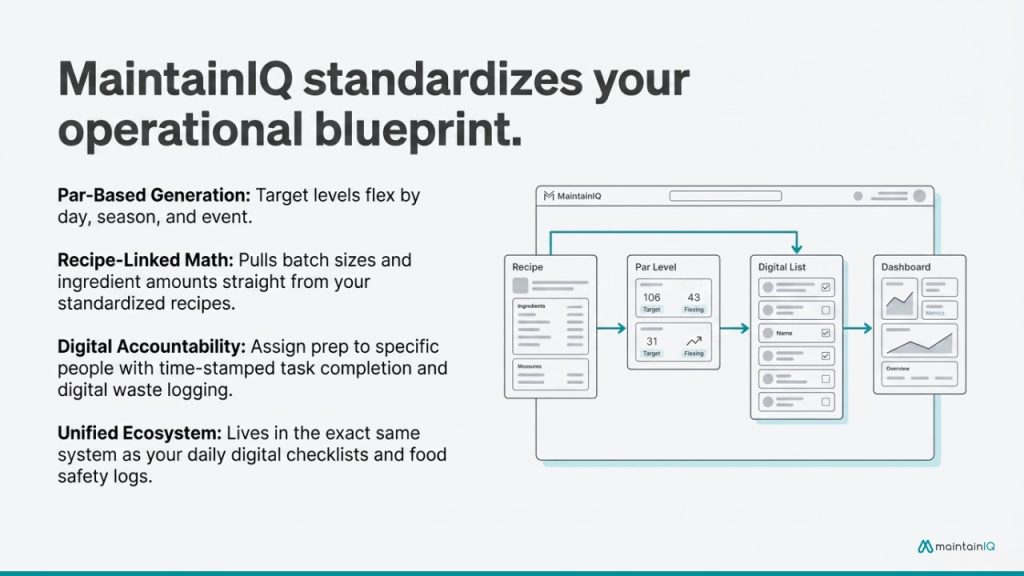
If you’re evaluating a way to replace the laminated sheet, the features that matter are the ones that remove guesswork and travel across locations. A system worth adopting should let you:
- Set par levels per item and generate the list from the gap between par and what’s on hand
- Flex those pars by day, season, and event instead of printing the same amounts every day
- Pull batch sizes and ingredient amounts straight from your standardized recipes
- Assign prep to specific people and time-stamp what’s completed, so nothing depends on memory
- Capture prep dates and waste, and roll both up across locations for comparison
Anything less leaves you where you started — a static amount that ignores demand and tells you nothing after the shift ends.
Automating prep with MaintainIQ
This is exactly what MaintainIQ’s prep list software is built to do. Instead of a paper sheet that resets to guesswork every morning, MaintainIQ gives each kitchen a digital, par-based prep list that’s tied to your recipes and standardized across every location. With it, your team can:
- Build par-based prep lists so cooks make what the day needs, not a habitual amount
- Link prep to standardized recipes so quantities and batch sizes stay correct across shifts and sites
- Assign, track, and time-stamp prep tasks, with prep dates and labels that support food safety
- Roll it all up through corporate-level reporting so waste and consistency are visible across the whole group
Because prep lives in the same system as your digital checklists, daily operations, and food safety logs, it’s not one more disconnected tool — it’s part of the record your kitchen already keeps. The payoff is straightforward: less product in the trash, fewer mid-service scrambles, and a prep process that runs the same whether your best cook is on shift or not.
If prep at your locations still runs on guesswork and a laminated sheet, it’s worth seeing the alternative. Book a 20-minute demo, and we’ll walk through how automated prep lists would work for a kitchen of your size.
Frequently asked questions
What is prep list automation?
It’s a prep list generated from data and rules — par levels, on-hand quantities, and standardized recipes — instead of memory or a static sheet. The result tells each cook how much to make to meet the day’s demand, which reduces both over-prepping (food waste) and under-prepping (lost sales and overtime).
Can prep lists adjust to how busy we expect to be?
Yes. With par-based prep lists in MaintainIQ, target levels can reflect the day of the week, season, and known events, so a busy Friday isn’t prepped the same as a slow Monday — and cooks produce the gap to par rather than a fixed batch.
Can I standardize prep lists across multiple locations?
Yes. MaintainIQ lets you run the same recipe-linked, par-based prep lists across every location, and corporate-level reporting lets you compare prep completion, waste, and consistency across all your sites in one place.