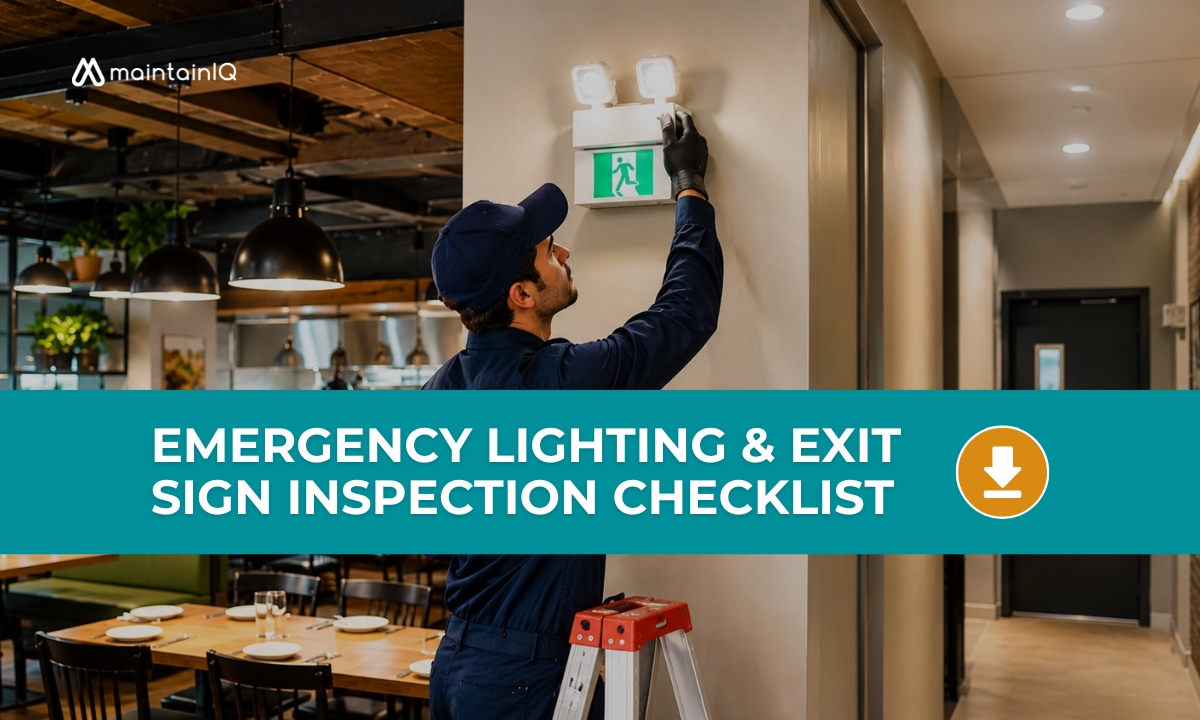
When the power goes out during a fire or evacuation, emergency lighting and exit signs are the only thing guiding people to the door. Yet missing monthly test records is one of the most common citations fire marshals write — and a sign can look fine on the wall while its battery no longer holds a charge for the 90 minutes NFPA 101 requires.
This Emergency Lighting & Exit Sign Inspection Checklist gives multi-location operators a structured program built around the way these systems are actually tested: the monthly 30-second functional test, the annual 90-minute duration test, a placement and visibility audit, battery and fixture maintenance, and the documentation the AHJ asks for first.
Digitize and automate this checklist with MaintainIQ, your all-in-one maintenance management platform.
What’s Inside This Checklist
- Monthly Functional Test (30 Seconds): Push-to-test procedure for every fixture, 10-second activation check, lamp and exit-sign illumination verification, obstruction check, and self-diagnostic status review — tracked monthly across a full year (NFPA 101 §7.9.3).
- Annual 90-Minute Duration Test: Full battery-discharge procedure, illumination measurement (1 ft-candle initial / 0.6 ft-candle end-of-test), 40-to-1 uniformity check, battery replacement triggers, and UL 924 verification.
- Exit Sign Placement & Visibility Audit: 100-foot viewing-distance check, 6-inch letter-height verification, mounting height, directional arrows, externally illuminated sign lighting levels, and misleading-signage checks per NFPA 101 §7.10.
- Battery & Fixture Maintenance: Terminal cleaning, battery age tracking and proactive replacement, load testing, lens cleaning, lamp replacement, charging-circuit verification, and post-construction re-testing.
- Documentation & Compliance: Fixture numbering, monthly and annual test logs, corrective-action records, battery replacement tracking, power-outage credit records, and AHJ-ready recordkeeping.
Why Emergency Lighting Inspection Matters
- Life Safety: During a power failure, emergency lighting must illuminate the egress path within 10 seconds and stay lit for 90 minutes. A dead battery means occupants navigate a dark building during the exact emergency the system exists to handle.
- Code Compliance: OSHA 29 CFR 1910.37 requires exit routes to be adequately lit, and NFPA 101 §7.9.3 mandates the monthly 30-second and annual 90-minute tests with written records. NFPA 70 Article 700 governs the electrical system behind them.
- Documentation Drives Inspections: Fire marshals check records first. Missing monthly test logs trigger violations even when every light works. A documented program is the difference between a passed inspection and a citation.
- Battery Failure Is Silent: A battery that passes a 30-second test can still fail the 90-minute duration test. Sealed lead-acid batteries typically last 3–5 years, and the only way to catch a weak one is the annual full-duration test.
- Liability and Insurance: If someone is injured during an evacuation where emergency lighting failed, inspection records establish whether the system was maintained. A documented testing history protects the operator; missing records do the opposite.
Emergency Lighting Quick Reference
| REQUIREMENT | STANDARD / VALUE | STANDARD |
| Monthly functional test | 30 seconds minimum | NFPA 101 §7.9.3 |
| Annual duration test | 90 minutes on battery | NFPA 101 §7.9.3 |
| Activation after power loss | Within 10 seconds | NFPA 101 §7.9 |
| Initial egress illumination | 1 ft-candle avg / 0.1 min | NFPA 101 §7.9.2 |
| End-of-test illumination | 0.6 ft-candle avg / 0.06 min | NFPA 101 §7.9.2 |
| Max-to-min light ratio | Not to exceed 40 to 1 | NFPA 101 §7.9.2 |
| Exit sign letter height | ≥ 6 in. tall, ¾ in. stroke | NFPA 101 §7.10 / IBC 1013 |
| Exit sign viewing distance | Up to 100 feet | NFPA 101 §7.10.1.5 |
| Battery service life (typical) | 3–5 years (sealed lead-acid) | Manufacturer |
| Equipment listing | UL 924 required | NFPA 70 Art. 700 |
Source: NFPA 101 (Life Safety Code) §7.9 and §7.10, OSHA 29 CFR 1910.37, NFPA 70 Article 700, UL 924, IBC Section 1013. Always verify against your local Authority Having Jurisdiction (AHJ).
How to Use This Checklist
- Monthly page: Assign to your facilities or maintenance team. Test every fixture, log the result by unit number, and flag any light that fails to illuminate or hold charge.
- Annual page: Schedule the 90-minute test on a fixed date. Cutting AC power to the circuit is the only reliable method — plan around everything else on that breaker.
- Placement audit page: Run at least annually and after any renovation that changes the floor plan or walls.
- Battery & fixture page: Run quarterly. Record battery install dates so you can replace proactively before the annual test fails.
- Or go digital with MaintainIQ — automate monthly and annual test reminders, log results by fixture with photo documentation, track battery age, and keep AHJ-ready records across every location.
Go Digital with MaintainIQ
Paper test logs can’t remind your team that the monthly 30-second test is due, can’t track which of 200 fixtures is on its fifth-year battery, and won’t produce a clean report when a fire marshal asks for the last three years of records. MaintainIQ replaces the clipboard with automated test scheduling, mobile inspection logging by fixture number, battery-age tracking, photo documentation of any failures, and centralized records organized by location. Whether you manage one building or a portfolio of properties, MaintainIQ keeps your emergency lighting program tested, documented, and inspection-ready.