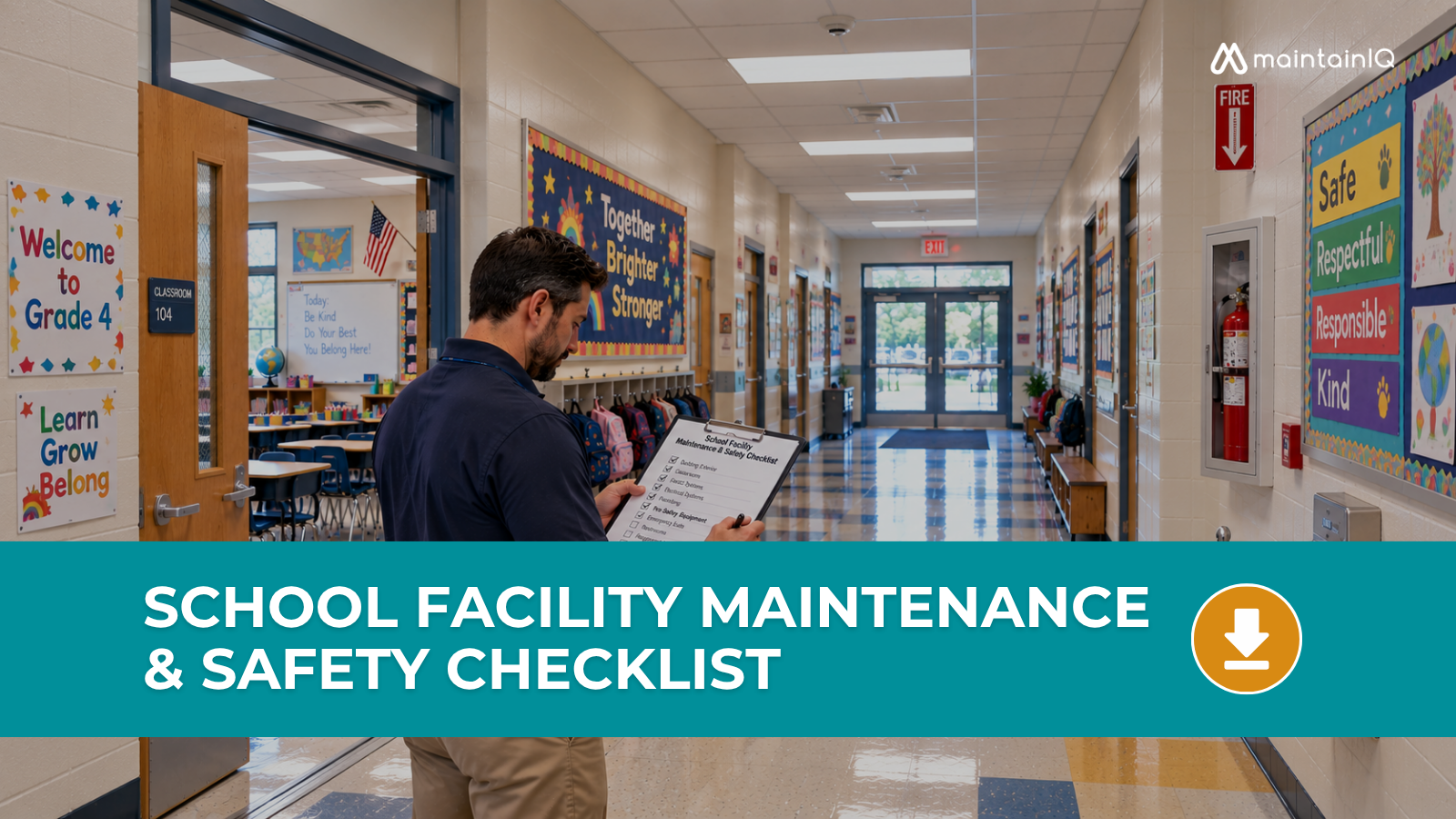
The most common fire-marshal finding in schools isn’t a broken alarm — it’s a drill that happened but was never logged. School safety isn’t one inspection; it’s overlapping obligations across fire code, ADA, playground safety, air quality, and lab chemicals, each with its own documentation. And on the playground alone, the CPSC reports over 200,000 injuries treated in ERs each year for children under 15, with roughly 62% of the serious ones involving equipment failure.
This School Facility Maintenance & Safety Checklist gives K-12 facility teams a documented routine: a daily safety and egress walk, daily playground and grounds checks, weekly and monthly systems and lab safety, and the fire-drill and compliance documentation inspectors expect.
Digitize and automate this checklist with MaintainIQ, your all-in-one maintenance management platform.
What’s Inside This Checklist
- Daily Safety & Egress Walk: Clear exit routes, secured exterior doors, exit signs and emergency lighting, extinguishers, slip/trip hazards, and lighting — across a MON–SUN week.
- Playground & Grounds: Pre-use hazard scan, surfacing depth, fastener and equipment checks, entrapment hazards, and grounds safety.
- Systems, Labs & Weekly/Monthly: Fire panel, HVAC and air quality, electrical safety, science-lab chemical and eyewash checks, cafeteria refrigeration, and ADA.
- Fire Drills, Documentation & Compliance: Monthly fire-drill records, hazard tracking, fire-protection and systems records, and AHERA/lead documentation.
Why School Safety Inspection Matters
- Egress Is Non-Negotiable: Clear exit routes and doors that open from inside are fundamental life-safety requirements (OSHA 1910.36, fire code). Exterior doors stay secured except the controlled entry — safety and security together.
- Playgrounds Carry Direct Liability: With 200,000+ playground ER visits a year for kids under 15 and 62% of serious injuries tied to equipment failure, schools are liable for equipment and surfacing condition. Daily scans, monthly checks, and annual CPSI inspections are the standard of care.
- Drills Only Count If Logged: NFPA 101 and state education codes require monthly fire drills with recorded evacuation times and headcounts. Unlogged drills are the top fire-marshal finding — the drill isn’t done until it’s documented.
- Labs and Air Quality Add Requirements: Science labs need working eyewash/showers, proper chemical storage, and accessible SDS sheets, and ventilation must support indoor air quality. Each is its own compliance domain.
- Records Prove Compliance: When an inspector arrives, the difference between a clean audit and a scramble is whether hazards, drills, and inspections were converted into tracked, timestamped records.
School Safety Quick Reference
| AREA | FREQUENCY | STANDARD |
| Egress & fire safety walk | Daily | OSHA 1910.36 / fire code |
| Playground hazard scan | Daily (pre-use) | CPSC / ASTM F1487 |
| Playground equipment | Monthly | Fasteners, surfacing depth |
| Playground full inspection | Annually | CPSI (NRPA-certified) |
| Fire drill | Monthly | NFPA 101 + state code |
| Surfacing depth | Check | ~12″ loose-fill to 8 ft fall height |
| Entrapment openings | Check | Hazard between 3.5″–9″ |
Sources: NFPA 101, OSHA 29 CFR 1910 (exit routes, electrical), CPSC Public Playground Safety Handbook and ASTM F1487, ADA Standards, and EPA/AHERA. CPSI inspections are issued through the National Recreation and Park Association. Requirements vary by state — confirm your local codes.
How to Use This Checklist
- Daily walk: Custodial or facilities staff check egress, fire equipment, and slip hazards before students arrive.
- Playground page: A trained staff member scans for hazards, debris, and damage each day before children use the equipment.
- Systems/labs page: Maintenance verifies fire panel, HVAC/air quality, electrical safety, and lab safety on a weekly/monthly cadence.
- Or go digital with MaintainIQ — run daily walks and playground scans on a phone with photo capture, auto-generate monthly fire-drill and CPSI inspection records, and convert every hazard into a tracked work order across every building in the district.
Frequently Asked Questions
How often must schools inspect playgrounds?
Best practice is three levels: a daily pre-use visual scan by trained staff, a monthly inspection by maintenance covering surfacing and hardware, and an annual inspection by a Certified Playground Safety Inspector (CPSI). All three should be documented.
What is the required playground surfacing depth?
It depends on the equipment’s fall height and the material. As a common example, CPSC guidelines call for about 12 inches of engineered wood fiber for equipment with a fall height up to 8 feet. Entrapment openings between 3.5 and 9 inches are a hazard because a child can enter head-first but not exit.
How often are school fire drills required?
NFPA 101 and most state education codes require monthly fire drills, documented with the date, routes, full-evacuation time, headcount, deficiencies observed, and administrator sign-off. Missing or incomplete drill records are the most common fire-marshal finding in schools.
What regulations apply to K-12 facility safety?
Several overlap: NFPA 101 and state fire codes, OSHA 29 CFR 1910 for exit routes and electrical safety, CPSC/ASTM F1487 for playgrounds, ADA for accessibility, EPA/AHERA for asbestos and lead, and health codes for cafeterias. Each carries its own documentation.
Go Digital with MaintainIQ
Photocopied inspection forms lose signatures, miss steps, and turn an audit into a scramble across twelve buildings. MaintainIQ replaces them with daily safety walks and playground scans on a phone with mandatory photo capture, automated fire-drill and CPSI inspection scheduling, hazard-to-work-order tracking with owners and due dates, and audit-ready records that prove compliance in seconds. Whether you manage one school or a whole district, MaintainIQ keeps every building safe, every drill logged, and every inspection documented.