A combi oven running 25°F below setpoint produces undercooked protein — a food-safety violation that’s completely invisible without a calibration record. Meanwhile, grease building up in the cavity and on the burners is a direct fire-code violation and a leading cause of kitchen fires. The oven is the hardest-working piece of equipment in the kitchen, and the two things most likely to go wrong with it don’t announce themselves.
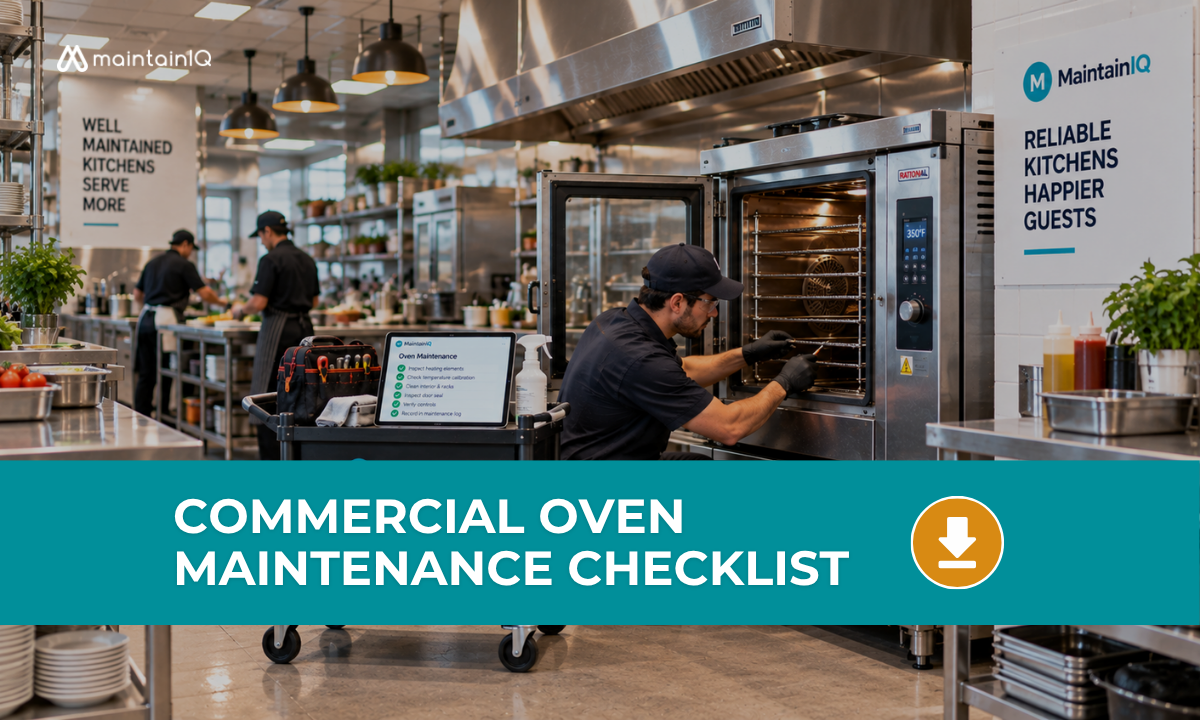
This Commercial Oven Maintenance Checklist gives restaurant operators a routine built around how ovens actually fail: daily cleaning and checks, weekly calibration and gasket care, and the annual gas-safety service that keeps the equipment safe and compliant.
Digitize and automate this checklist with MaintainIQ, your all-in-one maintenance management platform.
What’s Inside This Checklist
- Daily Cleaning & Checks: Interior and burner cleaning, door-gasket inspection, ignition/flame check, gas-odor check, and start/end temperature logging — tracked across a MON–SUN week.
- Weekly & Monthly Maintenance: Thermostat calibration against a reference thermometer, convection-fan cleaning, combi descaling, gas-connector leak testing, and seal checks.
- Annual Professional Service: Gas-valve and safety-shutoff testing, ignition service, combustion check, control calibration, and full descale — by a certified technician.
- Documentation & Compliance: Daily temperature logs, calibration records, descale logs, gas-service reports, and asset tracking.
Why Oven Maintenance Matters
- Calibration Is a Food-Safety Control: An uncalibrated thermostat that runs cold produces undercooked food — a HACCP violation you can’t see without documented calibration. A combi oven 25°F under setpoint is the classic example.
- Grease Is a Fire Hazard: Grease buildup in the cavity and on burners is a direct fire-code violation and a leading ignition source. Daily cleaning is a safety task, not just presentation.
- Gas Safety Is Non-Negotiable: A yellow flame signals incomplete combustion and possible carbon monoxide, and a failed safety-shutoff valve can let unburned gas accumulate — an explosion risk. NFPA 86 calls for documented annual safety testing.
- Bad Gaskets Waste Energy: A degraded door seal causes temperature inconsistency and loses 15–30% of heat, driving up energy cost and producing uneven cooking. Replace any gasket you can slip a finger behind.
- Descaling Prevents Big Repairs: On combi and steam ovens, scale on the heat exchanger leads to a repair that costs more than a full year of descaling. Routine descaling on the water-hardness schedule is the cheap fix.
Oven Maintenance Quick Reference
| TASK | FREQUENCY | TARGET / STANDARD |
| Interior & burner cleaning | Daily | No grease buildup (fire code) |
| Start/end temp log | Daily | Confirm oven reaches setpoint |
| Thermostat calibration | Weekly/monthly | Recalibrate if off >10°F |
| Door gasket check | Weekly | Replace if finger fits behind seal |
| Combi/steam descale | Per water hardness | Prevents heat-exchanger failure |
| Gas leak / connector check | Monthly | Bubble test flex connectors |
| Professional gas service | Annually | NFPA 86 — certified technician |
Source: FDA Food Code 2022, NFPA 86 (ovens and furnaces), NFPA 96 (commercial cooking ventilation — separate hood/duct schedule), and HACCP principles. Always follow the manufacturer’s specifications and your local codes.
How to Use This Checklist
- Daily page: Assign to kitchen staff at open and close. Clean grease before it bakes on, and log start/end temperatures.
- Weekly/monthly page: A kitchen manager or technician verifies calibration against a reference thermometer and checks gaskets and gas connectors.
- Annual page: Schedule a certified technician for gas-valve, safety-shutoff, and combustion service; file the report.
- Or go digital with MaintainIQ — schedule daily, weekly, and annual oven tasks automatically, log calibration and descale records, capture photos of gasket wear, and keep gas-service reports audit-ready across every location.
Frequently Asked Questions
How often should a commercial oven be calibrated?
Verify thermostat calibration weekly to monthly against a certified reference thermometer, and recalibrate any oven that reads more than about 10°F off. A combi oven running 25°F below setpoint produces undercooked protein — a food-safety issue invisible without a calibration record.
How do I know when to replace an oven door gasket?
Replace a gasket showing cracks, compression failure, or visible gaps — a practical test is whether you can slip a finger between the seal and the door. A failed seal causes temperature inconsistency and 15–30% heat loss.
What does an annual professional oven service cover?
A certified technician tests gas-valve operation and the safety-shutoff valve, services the ignition and flame-sensing system, performs a combustion check, calibrates controls, and fully descales combi/steam systems. NFPA 86 calls for documented annual safety testing.
My oven’s flame is yellow — is that a problem?
Yes. The flame should be blue and steady. A yellow or orange flame indicates incomplete combustion and a possible carbon-monoxide hazard. Take the oven out of service and call a licensed technician.
Go Digital with MaintainIQ
Paper oven logs can’t prove the thermostat was calibrated this month, can’t remind you the combi is due for descaling, and won’t produce a gas-service history when an insurer or fire inspector asks. MaintainIQ replaces the clipboard with automated daily, weekly, and annual oven tasks tied to each unit, calibration and descale records captured on a phone, photo documentation of gasket wear, and centralized gas-service reports. Whether you run one oven or kitchens across multiple locations, MaintainIQ keeps every oven safe, accurate, and documented.