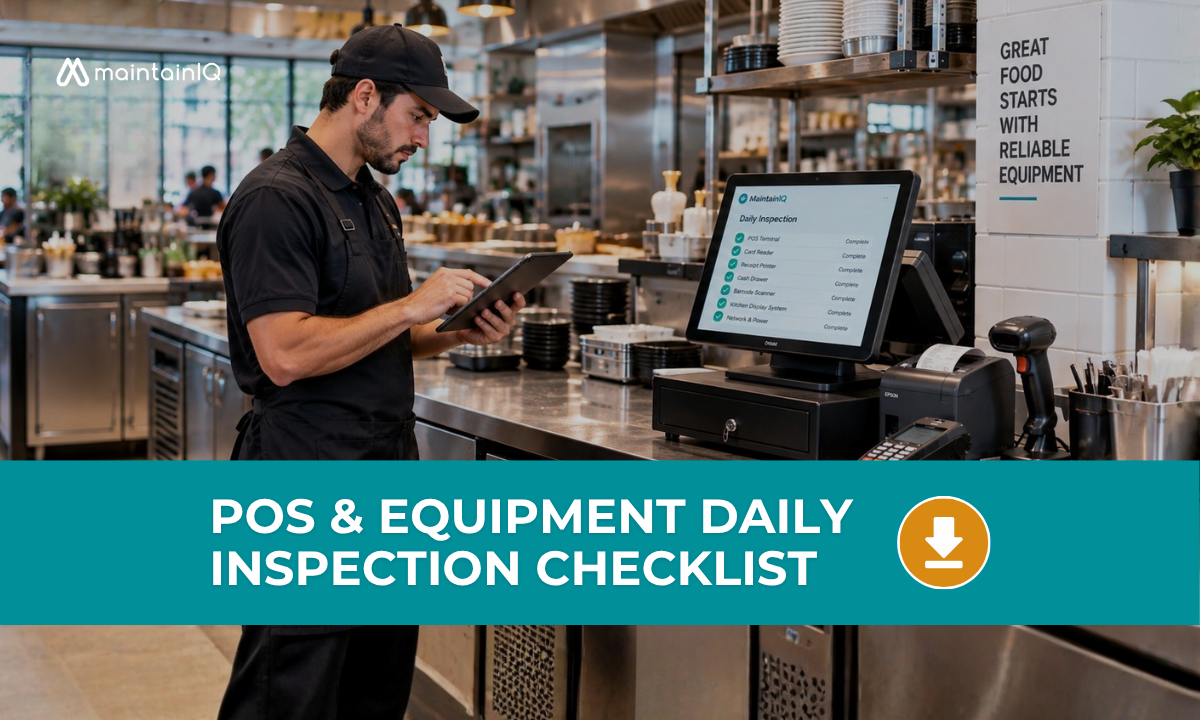
Most point-of-sale failures during business hours are completely preventable — a scanner that needs cleaning, a printer out of paper, a card reader that quietly lost its network connection. A five-minute check before the doors open catches them before they turn into a line of frustrated customers. The higher-stakes problem is quieter still: a skimmer or overlay on a card reader, installed to look like it belongs, stealing card data on every swipe.
This POS & Equipment Daily Inspection Checklist gives multi-location operators one routine that covers both — daily opening, security/tamper, and closing checks, plus weekly maintenance and the PCI DSS documentation that keeps you compliant.
Digitize and automate this checklist with MaintainIQ, your all-in-one maintenance management platform.
What’s Inside This Checklist
- Opening / Startup Check: Terminal boot-up and connectivity, scanner test, receipt paper, cash drawer function, card reader ready-check, and starting-float count — tracked across a MON–SUN week.
- Payment Device Security & Tamper Check (PCI DSS): Skimmer and overlay inspection, seal and screw check, cable verification, serial-number match to inventory, and take-out-of-service procedure — tracked daily.
- Closing / End-of-Day Check: Batch settlement, cash reconciliation and over/short logging, Z-report filing, data backup confirmation, cleaning, and device lockup — tracked daily.
- Weekly & Periodic Maintenance: Device inventory reconciliation, software and firmware updates, deep cleaning, user-access review, endpoint protection, network security, and backup testing.
- Documentation & PCI Compliance: Device inventory, daily tamper log, settlement and reconciliation records, update logs, incident response, and SAQ-supporting documentation.
Why Daily POS Inspection Matters
- Downtime Costs Sales: A POS failure during trading hours means queues, walked customers, and lost revenue. Most causes are trivial and preventable with a short opening check — the cheapest insurance in the store.
- Card Skimmers Are Designed to Blend In: Criminals attach skimmers and overlays to card readers to steal data during normal transactions. PCI DSS requires periodic tamper inspection, and daily checks are best practice because these devices are built to look like they belong.
- A Swapped Terminal Is Invisible Without Inventory: Matching each device’s serial number to a maintained inventory is the only way to catch a substituted or modified reader. No baseline, no detection.
- Unsettled Batches Don’t Get Paid: If the end-of-day batch doesn’t settle, the day’s card sales aren’t funded. Confirming a clean settlement every night protects cash flow, not just tidiness.
- PCI Is the Floor, Not the Goal: Compliance is the minimum bar. A documented device inventory, daily tamper log, and incident-response plan protect customers and limit liability if something does go wrong.
Daily POS Routine Quick Reference
| CHECK | WHEN | FOCUS |
| Startup | Opening | Boot-up, connectivity, scanner, printer, drawer, float |
| Tamper inspection | Daily | Skimmers, seals, cables, serial-number match |
| Settlement & cash | Closing | Batch settle, reconcile drawer, log over/short |
| Backup | Closing | Confirm data synced before shutdown |
| Device inventory | Weekly | Every payment device by serial & location |
| Updates | Weekly | POS software & payment-app / firmware current |
| Access review | Weekly | Remove former staff, no shared logins |
| PCI records | Ongoing | Inventory, tamper log, SAQ, incident plan |
Source: PCI DSS (Payment Card Industry Data Security Standard) requirements for payment-device inventory, tamper inspection, and incident response, plus retail/restaurant operational best practice. PCI DSS is the minimum bar — confirm your merchant level and obligations with your payment processor or a qualified assessor.
How to Use This Checklist
- Opening page: Cashiers or shift leads run the startup check at each register before the first customer. Confirm connectivity, not just power.
- Security page: Inspect every card reader daily for tampering and match serials to inventory. If anything looks off, pull the device and report it.
- Closing page: Settle the batch, reconcile drawers, and confirm the backup ran before shutting down.
- Weekly page: Assign to a manager or IT: reconcile device inventory, apply updates, review access, and test restores.
- Or go digital with MaintainIQ — assign opening, security, and closing checks by register, capture tamper-inspection initials and photos, track device inventory and updates, and keep PCI-supporting records across every location.
Frequently Asked Questions
How often should POS terminals be inspected for tampering?
PCI DSS requires periodic inspection of payment devices for tampering, and daily inspection is widely considered best practice. Check for skimmers and overlays, broken seals, missing screws, altered cables, and any device whose serial number doesn’t match your inventory.
What are the signs a card reader has been tampered with?
PCI DSS requires periodic inspection of payment devices for tampering, and daily inspection is widely considered best practice. Check for skimmers and overlays, broken seals, missing screws, altered cables, and any device whose serial number doesn’t match your inventory.
Why does the end-of-day batch need to settle?
Settling the batch submits the day’s card transactions for funding. If it doesn’t settle, those sales aren’t deposited — so confirming a clean settlement each night, with no open or declined transactions, is what actually gets you paid.
Is PCI compliance enough to keep a POS secure?
Treat PCI DSS as the floor, not the target. It sets the minimum controls — a device inventory, tamper inspection, network segmentation, strong access controls — but merchants remain responsible for identifying and addressing their own risks beyond the baseline.
Go Digital with MaintainIQ
Paper POS checklists don’t prove a card reader was inspected this morning, can’t hold a device inventory that flags a swapped terminal, and won’t give you the tamper-inspection history a PCI assessor asks for. MaintainIQ replaces the clipboard with opening, security, and closing checks assigned by register, tamper-inspection initials and photos captured on a phone, device inventory and update tracking, and centralized PCI-supporting records. Whether you run one store or registers across dozens of locations, MaintainIQ keeps every terminal working, every device inspected, and every day documented.