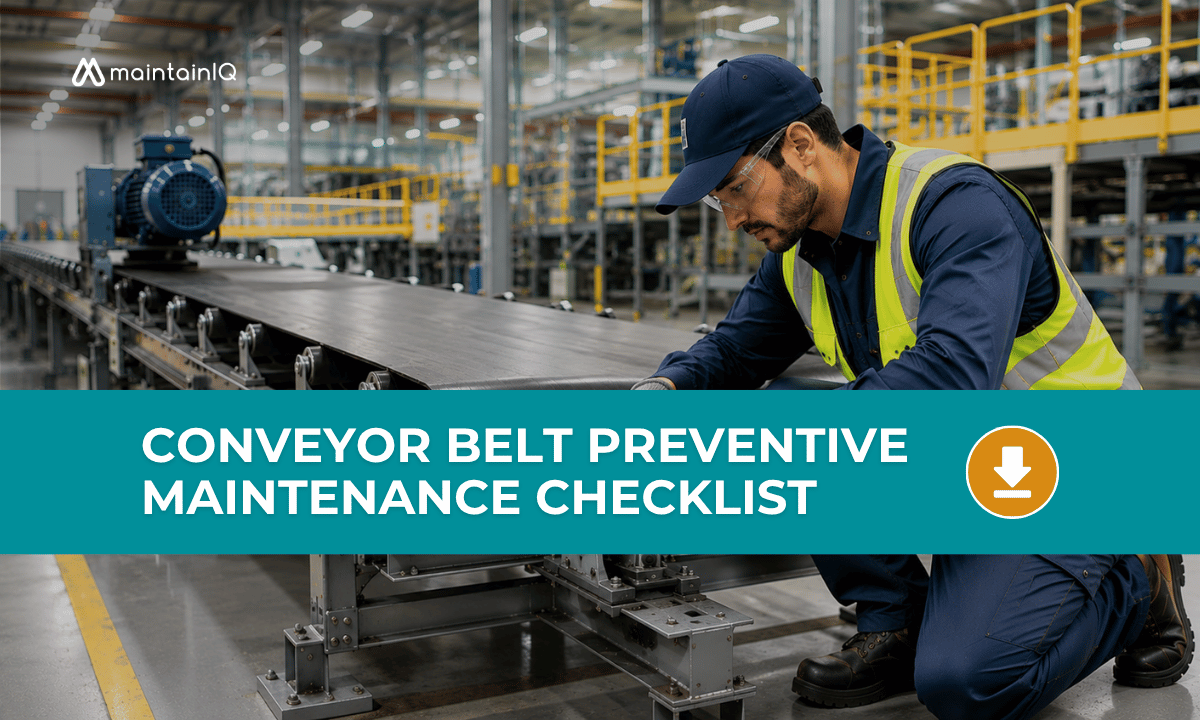
A seized idler, a stretched splice, or a belt drifting an inch off center doesn’t announce itself — it grinds along quietly until the belt tears, the drive strains, or a nip point catches something it shouldn’t. Conveyors run under continuous load, and a minor fault left alone becomes a system-wide failure that shuts down the line.
This Conveyor Belt Preventive Maintenance Checklist gives multi-location operators a structured program built around the cadence conveyor systems actually need: daily visual checks during operation, weekly hands-on inspections under lockout/tagout, monthly comprehensive drive and belt inspections, and a quarterly major assessment with full safety-system testing.
Digitize and automate this checklist with MaintainIQ, your all-in-one maintenance management platform.
What’s Inside This Checklist
- Daily Visual Inspection (During Operation): Belt tracking within an inch of centerline, idler/pulley noise, surface damage, spillage and carryback, pull-cord and guard checks — tracked across a MON–SUN week.
- Weekly Hands-On Inspection (LOTO): Roller and idler spin test, splice and fastener check, belt tension/sag measurement, cleaner and scraper adjustment, lubrication, and e-stop function tests — tracked by week.
- Monthly Comprehensive Inspection: Drive and tail pulleys, motor and gearbox, drive chains and sprockets, bearing temperatures, take-up travel, belt carcass wear, and splice elongation — tracked JAN–DEC.
- Quarterly Major Assessment & Safety System Test: Drift and ripped-belt switch trip tests, full guard audit, structural inspection, electrical inspection, belt-life assessment, and ASME B20.1 labeling checks.
- Documentation & Compliance: Inspection logs, LOTO documentation, trend tracking, safety trip-test records, corrective actions, belt-life records, and OSHA-ready recordkeeping.
Why Conveyor PM Matters
- Worker Safety: Nip points at head, tail, and take-up pulleys are among the most dangerous hazards in a facility. Guards, e-stops, and pull cords have to be verified — and lockout/tagout applied — before anyone touches a conveyor (OSHA 1910.147, 1910.212, 1910.219).
- Preventing Catastrophic Failure: A hydraulic hose or a seized bearing left alone doesn’t stay small. Continuous load turns a worn idler or a stretched splice into a torn belt and a shut-down line. Early detection is the whole point of the daily and weekly rounds.
- Belt Life and Cost: Belts are expensive, and mistracking, over-tension, and carryback all shorten their life. Catching a tracking problem or a bad scraper early protects the single most costly wear component on the system.
- Uptime and Throughput: An unplanned conveyor failure stops everything downstream of it. Tracking belt wear and splice elongation over time lets you replace during planned downtime instead of during production.
- Compliance and Documentation: OSHA requires documented energy control for maintenance, and conveyor guarding is a common citation. A consistent, dated inspection and LOTO history demonstrates due diligence to OSHA and insurers alike.
Conveyor PM Quick Reference
| INSPECTION | FREQUENCY | KEY FOCUS |
| Daily visual | Each shift (running) | Tracking, noise, belt damage, spillage, guards, e-stops |
| Weekly hands-on | Weekly (LOTO) | Rollers, splices, tension, cleaners, lubrication |
| Monthly comprehensive | Monthly (LOTO) | Drive, pulleys, gearbox, bearings, belt carcass |
| Quarterly major | Quarterly (LOTO) | Safety trip tests, structure, electrical, belt life |
| Belt tracking limit | Ongoing | Within ~1 inch of centerline |
| Belt sag between idlers | Weekly | Within 2–3% |
Source: OSHA 29 CFR 1910.147 (LOTO), 1910.212 (machine guarding), 1910.219 (nip-point guarding), ASME B20.1 (Safety Standard for Conveyors), NFPA 652 (combustible dust), CEMA guidance. Verify against OEM specifications and your site’s risk assessment.
How to Use This Checklist
- Daily page: An operator or technician runs the visual check each shift while the belt is moving. Never reach into or step on a running conveyor.
- Weekly page: A qualified technician performs the hands-on inspection under full LOTO, including relieving stored belt tension before touching components.
- Monthly page: Run during scheduled downtime under LOTO. Log belt-carcass wear and splice elongation to trend toward a planned replacement.
- Quarterly page: Prioritize the safety-system trip tests — verify no switch was bypassed and never reconnected.
- Or go digital with MaintainIQ — schedule each cadence automatically, log LOTO and safety trip tests, trend belt wear and bearing temps over time, and keep OSHA-ready records across every line and location.
Go Digital with MaintainIQ
Paper conveyor logs can’t schedule four different inspection cadences on their own, can’t trend a belt’s splice elongation across six months, and won’t produce a LOTO and safety-test history when OSHA or an insurer asks for it. MaintainIQ replaces the clipboard with automated daily, weekly, monthly, and quarterly PM scheduling, mobile inspection logging with photo documentation, trend tracking for tracking/tension/bearing data, and centralized LOTO and safety-test records organized by conveyor and location. Whether you run one line or conveyors across multiple plants, MaintainIQ keeps every belt inspected, every safety device tested, and every record ready.