The FDA classifies ice as food — which means the dark, damp inside of your ice machine is held to the same standard as your prep surfaces. In one published sampling, nearly half of commercial soda-fountain and ice systems tested positive for coliform bacteria, and health inspectors treat visible pink slime or mold inside a bin exactly like mold on a cutting board: a violation, regardless of how clean the ice looks.
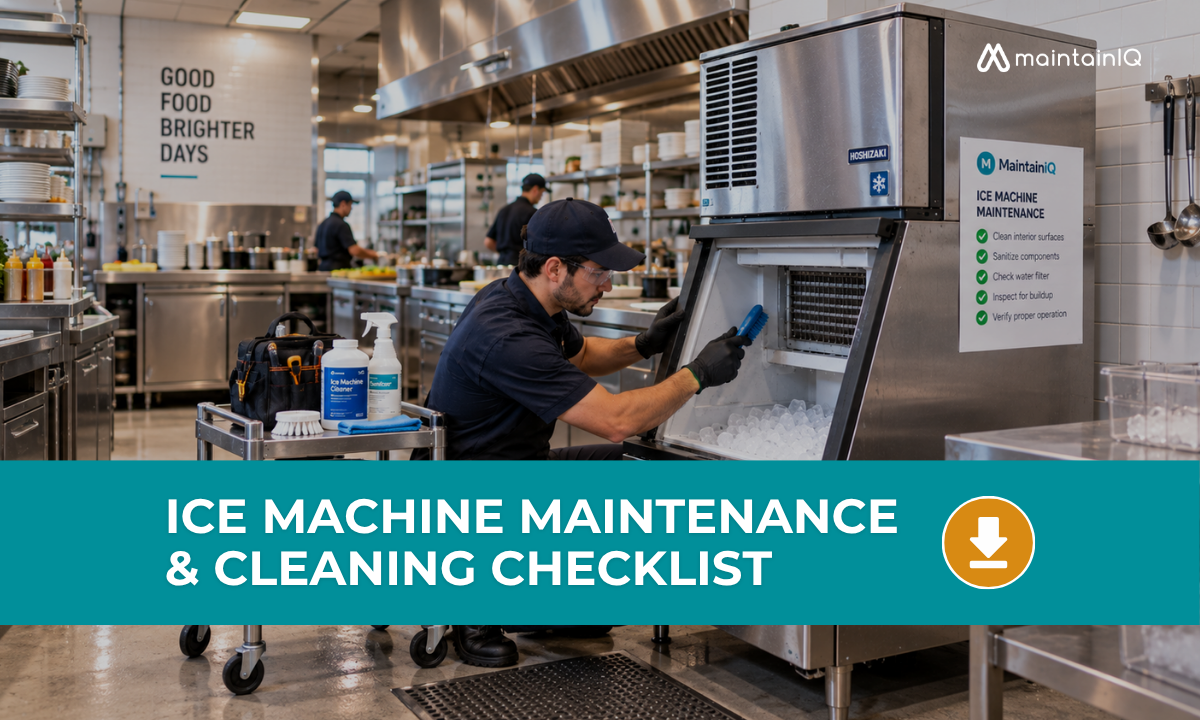
This Ice Machine Maintenance & Cleaning Checklist gives restaurants, hotels, and grocery operators the routine health departments expect: daily visual checks, weekly and monthly upkeep, and the every-six-months deep clean and sanitize that keeps biofilm out of the ice.
Digitize and automate this checklist with MaintainIQ, your all-in-one maintenance management platform.
What’s Inside This Checklist
- Daily Checks: Exterior sanitizing, ice quality check, bin and chute inspection for slime and mold, and proper ice-scoop storage — tracked across a MON–SUN week.
- Weekly & Monthly Care: Bin sanitizing, condenser filter cleaning, gasket and drain inspection, water-line checks, and water-filter tracking.
- Deep Clean & Sanitize: The full every-six-months procedure — disassembly, NSF-certified cleaner then sanitizer, in the correct order, with the safety rules that prevent toxic fumes.
- Cleaning Frequency & Compliance Log: Daily/weekly/monthly records, deep-clean tracking, filter dates, and inspector-ready documentation.
Why Ice Machine Cleaning Matters
- Ice Is Food: The FDA and health departments classify ice as a food product and ice machines as food-contact surfaces. Visible biofilm, pink slime, or mold is a health-code violation — the same as contamination on any prep surface.
- Biofilm Harbors Pathogens: The dark, moist interior is a near-perfect habitat for mold, yeast, and bacteria including E. coli, Listeria, and Salmonella. Surface wiping can’t remove biofilm — only cleaning followed by sanitizing does.
- Violations Are Expensive: An ice-related illness linked to your operation can mean fines, lawsuits, mandatory grade reduction, or closure — and in the review era, a single public food-poisoning mention drives customers away for good.
- Scale Wastes Money: Mineral scale from hard water reduces efficiency, drives up energy costs, and destroys internal components. About 70% of ice-machine performance problems trace back to the water supply.
- Documentation Is Half the Inspection: Ice-machine violations fall into two buckets — sanitation conditions and missing cleaning logs. A current, posted log is what proves the six-month minimum is being met.
Cleaning Frequency Quick Reference
| TASK | FREQUENCY | NOTES |
| Exterior wipe & ice check | Daily | Sanitize surfaces; check for off-taste/odor |
| Bin & chute inspection | Daily | Look for pink slime, mold, black spots |
| Ice scoop storage | Every use | Outside the bin, handle off the ice |
| Bin sanitize | Weekly | Wipe interior, corners, seams |
| Condenser filter | Monthly | Clogged filter pulls in yeast/dust |
| Deep clean & sanitize | Every 6 months min. | Quarterly for high-volume / bars / hotels |
| Water filter | ~Every 6 months | 70% of problems trace to water supply |
Source: FDA Food Code Section 4-601.11 and NSF/ANSI 12 (automatic ice-making equipment). Six months is the minimum, not a target. Always follow your local health department requirements and the machine manufacturer’s cleaning guidance.
How to Use This Checklist
- Daily page: Assign to opening or closing staff. The bin/chute slime check and correct scoop storage are the two most-cited items.
- Weekly & monthly page: A shift lead or technician handles bin sanitizing, filter cleaning, and drain checks.
- Deep-clean page: Follow the clean-then-sanitize order exactly, use NSF-certified products, and never mix the two chemicals.
- Or go digital with MaintainIQ — schedule daily, weekly, and six-month cleaning automatically, capture initials and photos as proof, track filter changes, and keep an inspector-ready cleaning log across every location.
Frequently Asked Questions
How often must a commercial ice machine be cleaned?
The FDA Food Code and NSF International set a minimum of every six months for a full deep clean and sanitize. High-volume operations, bars, hotels, and machines near kitchen exhaust or flour dust should move to a quarterly schedule.
Why does my ice machine grow slime if it only uses clean water?
The slime is biofilm from airborne yeast and fungi — from bread baking, beer taps, and food particles — that the cooling fan pulls into the machine. It multiplies in the dark, damp interior and traps bacteria, which is why sanitizing (not just wiping) is required.
Can I just wipe the bin, or do I have to sanitize?
You must do both, in order: cleaning removes mineral scale, and sanitizing kills the biofilm and bacteria that cleaning leaves behind. Surface wiping alone does not remove biofilm. Never mix the cleaner and sanitizer — the combination produces toxic fumes.
Is a slimy ice bin really a health violation?
Yes. Because ice is a food, FDA Food Code 4-601.11 requires ice-contact surfaces to be clean to sight and touch. Visible biofilm, pink slime, or mold is a violation even if the ice itself looks clean.
Go Digital with MaintainIQ
Paper cleaning charts fall off the wall, don’t prove who sanitized the bin last week, and won’t show a health inspector a six-month history on demand. MaintainIQ replaces the taped-up sheet with automated daily, weekly, and deep-clean scheduling, initials and photo proof captured on a phone, water-filter and service tracking, and an inspector-ready log tied to each machine’s serial number. Whether you run one ice machine or units across dozens of locations, MaintainIQ keeps every machine clean, every task documented, and every inspection covered.