A convenience store handles more moving parts per square foot than almost any retail operation — fuel, foodservice, age-restricted products, cash, and coolers, often with minimal staff on the floor. Equipment problems caught at opening are fixable; the same cooler out of range, found by a health inspector at noon, is a violation. And a single sale of tobacco or alcohol to a minor can bring heavy fines, license suspension, or criminal charges.
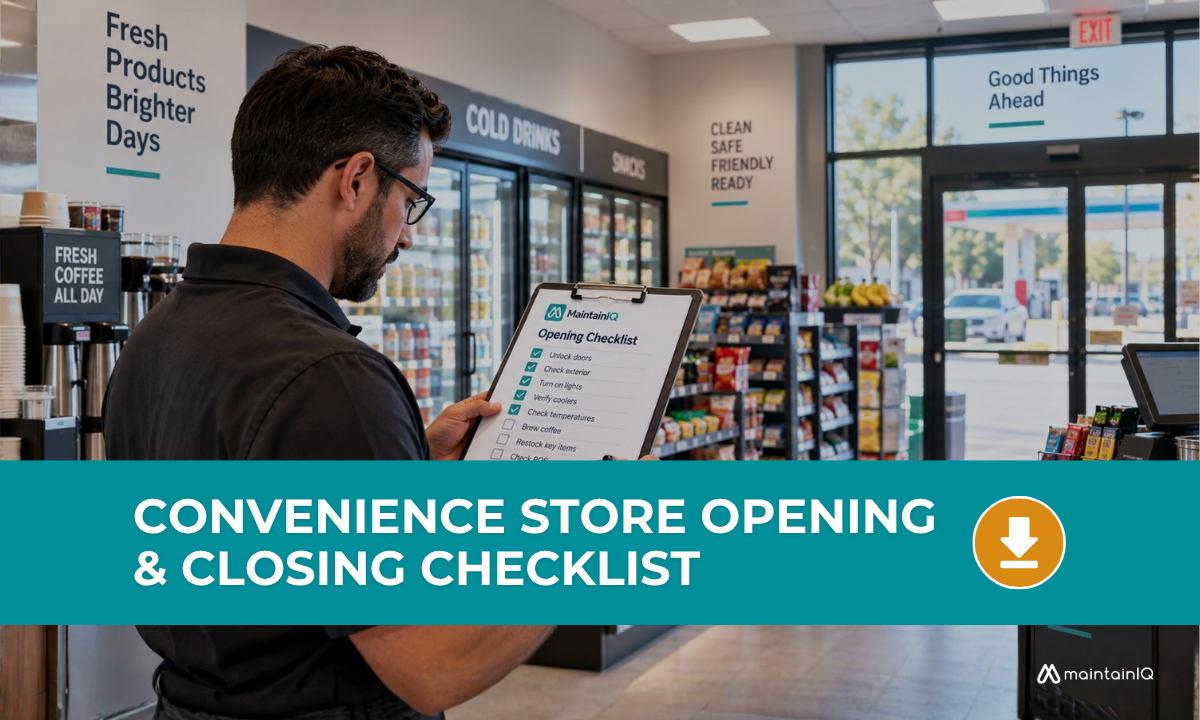
This Convenience Store Opening & Closing Checklist gives multi-site operators one routine across every area of the store: opening, during-shift, and closing procedures, plus an age-restricted-sales and compliance log.
Digitize and automate this checklist with MaintainIQ, your all-in-one maintenance management platform.
What’s Inside This Checklist
- Opening Procedures: Security walk, cash count, POS and fuel console, cooler/freezer temperature logging, hot-holding checks, forecourt and pump inspection, and restocking — across a MON–SUN week.
- During Shift: Interval temperature checks, ID verification on every age-restricted sale, foodservice rotation, restroom checks, restocking, and cash drops.
- Closing Procedures: Foodservice shutdown, final temps, cash reconciliation and deposit, end-of-day reports, restocking, forecourt cleanup, and securing the store.
- Age-Restricted Sales & Compliance Log: License verification, POS age-prompt confirmation, foodservice temperature logs, fuel dispenser status, and incident documentation.
Why an Opening & Closing Checklist Matters
- Age-Restricted Sales Are High-Stakes: Federal law sets tobacco and vape sales at 21+ and alcohol at 21+, with state and local rules on top. Selling to a minor can mean fines, license suspension, and criminal charges — card every customer and never rely on guesswork.
- Foodservice Carries Real Food-Safety Duty: As prepared food grows as a share of c-store revenue, so does the obligation: hot holding must stay at or above 135°F, verified with a probe, and coolers at or below 41°F, logged every few hours.
- Catch Equipment Problems Early: A cooler or hot-holding unit out of range at opening is fixable. The same unit discovered by an inspector during the day is a violation. Opening checks are the difference.
- Protect the Forecourt: Daily pump checks catch damaged card readers and skimmers, keep price signs matched to the POS, and keep the fuel islands safe and clean.
- Cash and Documentation: A consistent count, drop, and deposit cadence limits security exposure, and current temperature and cleaning logs are exactly what inspectors ask for.
C-Store Daily Areas Quick Reference
| AREA | KEY CHECK | STANDARD |
| Coolers / freezers | Temperature log | ≤41°F / ≤0°F |
| Hot foodservice | Hold temp (probe) | ≥135°F |
| Tobacco / alcohol | Card every customer | 21+ (federal floor) |
| Fuel / forecourt | Nozzles, readers, price match | Check for skimmers |
| Cash | Count, drop, deposit | Consistent cadence |
| Restrooms | Clean & stocked | Logged checks |
Sources: FDA Food Code holding temperatures; federal Tobacco 21 and minimum drinking age of 21, with state/local rules layered on top; weights-and-measures for fuel dispensers. Confirm the specific age and licensing rules for your state and locality.
How to Use This Checklist
- Opening page: Openers run the security walk, cash count, temperature logs, foodservice and forecourt checks before the first rush.
- During-shift page: Card every age-restricted sale, log temperatures every few hours, and keep foodservice rotated and restrooms checked.
- Closing page: Reconcile the drawer, prepare the deposit, shut down foodservice, and secure age-restricted and high-value inventory.
- Or go digital with MaintainIQ — assign opening and closing tasks by area, capture temperature logs and forecourt checks on a phone, and keep license and compliance records ready across every store.
Frequently Asked Questions
What are the main areas a c-store opening and closing checklist should cover?
Six areas: forecourt and pumps, foodservice, coolers and refrigeration, tobacco and age-restricted products, cash and register, and restrooms. Each needs opening, mid-shift, and closing tasks to cover the full day.
How often should cooler and foodservice temperatures be checked?
At opening, at closing, and every two to four hours during the shift for hot- and cold-holding equipment. Log each check with the time, the reading, and the name of the person who checked it.
What’s the minimum age for tobacco and alcohol sales?
Under federal law, tobacco and vape products are 21+ and alcohol is 21+. State and local rules add requirements on top, so card every customer, and don’t let anyone bypass the POS age-verification prompt on restricted items.
Why check fuel pumps every day?
Daily pump checks catch damaged or tampered card readers and skimmers, confirm nozzles and screens work, and verify the price on the sign matches the POS. A damaged pump should be bagged off until it’s repaired.
Go Digital with MaintainIQ
Paper c-store checklists don’t prove the cooler was logged this afternoon, can’t confirm the closing deposit was secured, and won’t show an inspector a clean foodservice temperature history. MaintainIQ replaces them with opening and closing routines assigned by area, temperature and forecourt checks captured on a phone, automatic escalation when a task is missed, and license and compliance records in one place. Whether you run one store or a chain, MaintainIQ keeps every location consistent, compliant, and documented.