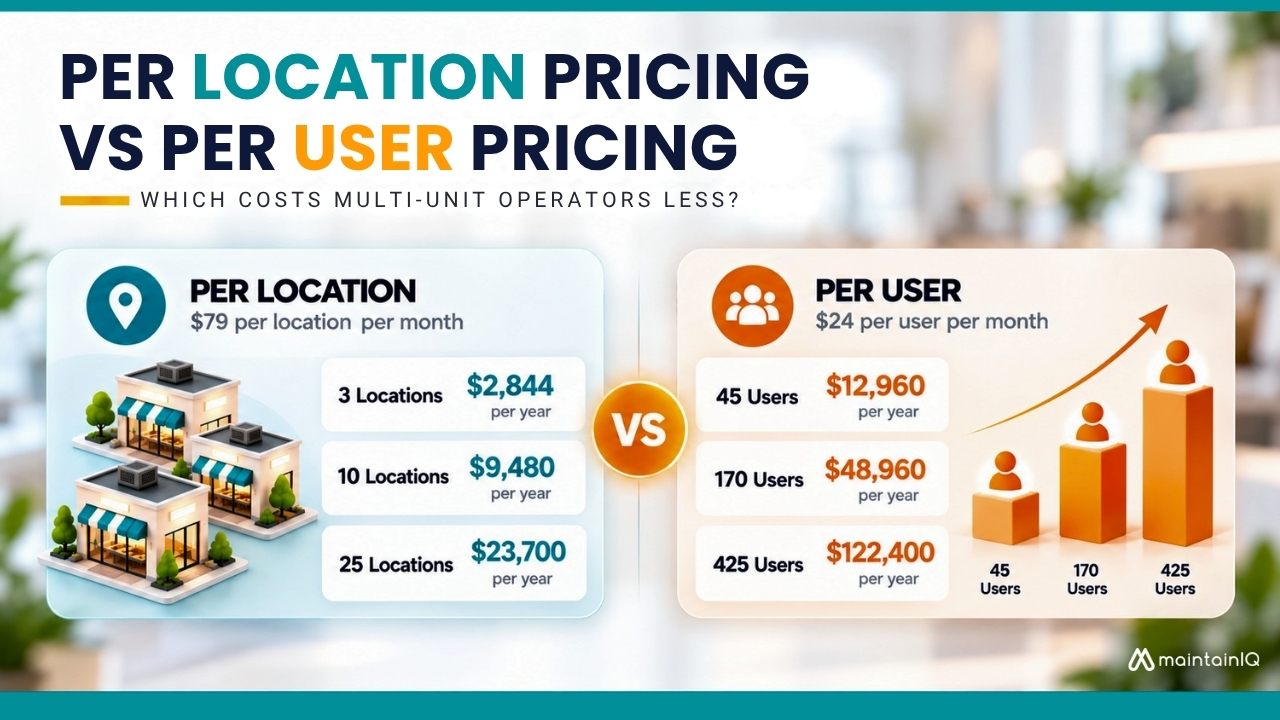
Two software vendors quote you. One says $79 per location per month. The other says $24 per seat per month. The second number is smaller, so it looks cheaper.
It usually is not, and the reason is arithmetic you can do in about ninety seconds.
This article does that arithmetic with real published prices, explains where each model genuinely wins, and gives you the four questions that decide it for your business. We build MaintainIQ, which is priced per location, so weigh the argument accordingly. Every figure below is taken from a vendor’s own live pricing page and dated, so you can check all of it.
All prices checked in September 2026.
Table of Contents
The number that decides it
Per-seat pricing costs you money based on how many people use the software. Per-location pricing does not.
So the only question that matters is how many people you would need to give a login to.
For food service, the answer is much higher than most software pricing assumes. According to the Bureau of Labor Statistics, food services and drinking places had 728,580 establishments in the fourth quarter of 2025 and 12.43 million employees in August 2026. That is an average of roughly 17 employees per location.
A ten-location group is looking at something near 170 people. And these are not big businesses. The National Restaurant Association reports that nine in ten restaurants have fewer than 50 employees, so the headcount that breaks per-seat pricing is sitting inside ordinary independent operations, not just large chains. Not all of them need a login, but if the software is for daily checklists, temperature readings, and shift tasks, a good number of them do, because the whole point is that the person doing the task records the task.
That is where per-seat pricing turns.
The same three businesses, priced both ways
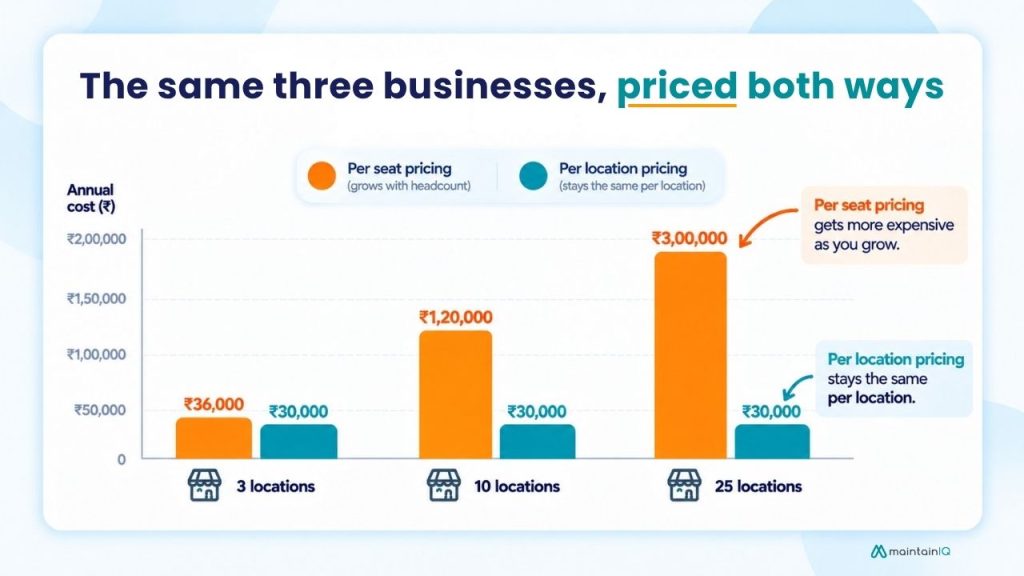
Here are three realistic operations priced against published rates. We have used the annual per-seat rate, which is the cheaper of the two options every per-seat vendor offers, so this is the friendliest possible version of the per-seat number.
| 3 locations, 45 staff | 10 locations, 170 staff | 25 locations, 425 staff | |
| MaintainIQ, $79 per location per month | $2,844 a year | $9,480 a year | $23,700 a year |
| Mitti, $24 per seat per month | $12,960 a year | $48,960 a year | $122,400 a year |
| MaintainX Essential, $20 per user per month | $10,800 a year | $40,800 a year | $102,000 a year |
| MaintainX Premium, $65 per user per month | $35,100 a year | $132,600 a year | $331,500 a year |
The gap is not a discount. It is a different shape. Per-location pricing is flat as your headcount moves. Per-seat pricing is a multiplier, and in an industry where the Bureau of Labor Statistics counts seventeen people per site, that multiplier is large.
A second effect is easy to miss: restaurant turnover is high, so a per-seat plan isn’t a fixed cost — it changes every time someone joins or leaves, and someone has to manage that. Per-location pricing removes the thinking.
Where per-seat pricing is genuinely the right answer
It would be dishonest to pretend the per-seat model is simply worse. It is the correct model for a specific shape of business, and if you are that shape, you should buy it.
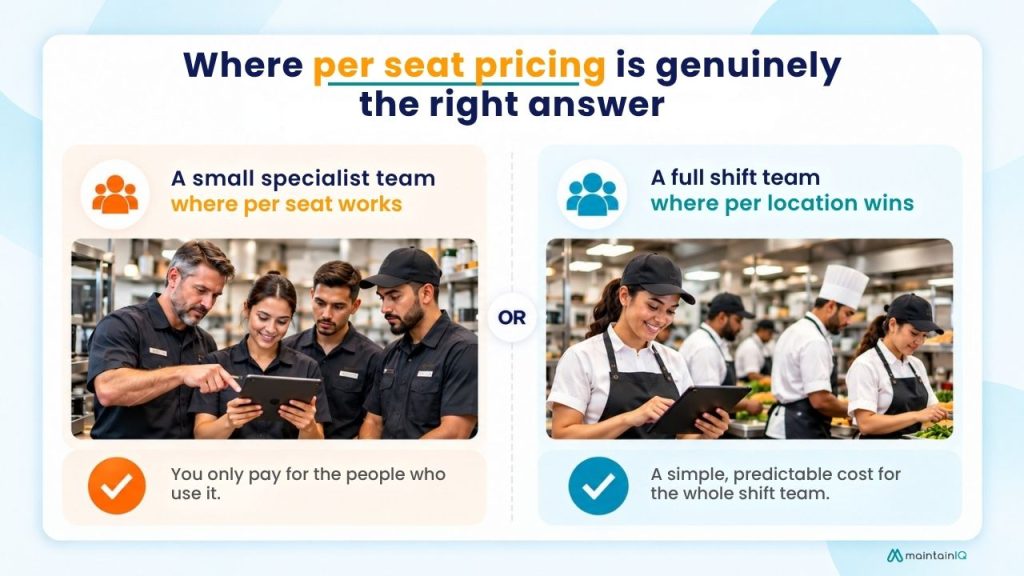
A small number of heavy users. If five maintenance technicians use the software all day and nobody else touches it, per seat is efficient, and you are not paying for capacity you do not use.
One large site rather than many small ones. A single facility with a small specialist team inverts the maths completely. One location paying per location is paying for one licence either way.
Deep, specialized use. Per-seat vendors usually build for a professional user rather than a shift worker, and the product often reflects it. If your users are technicians and engineers rather than line cooks, that depth may be worth the seat price.
The dividing line: if the software is for a team, count the team. If it’s for a site, count the sites.
What to watch for in both models
Neither model is honest by default. Both have places where the quoted number is not the real number.
On per-seat plans, ask what counts as a user. This varies more than you would expect. MaintainX defines a user as “someone who uses the MaintainX app and has a unique login” and states that “Requester accounts are free,” which is a real and meaningful distinction. Ask the same question of every vendor and get the answer in writing, because the difference between “everyone who logs in” and “everyone who submits work” can double or halve your bill.
On per-seat plans, ask what happens at renewal. Seats bought are usually seats paid for whether or not they are filled. Find out whether you can reduce seat count mid-term or only at renewal.
On per-location plans, ask what counts as a location. A ghost kitchen inside an existing site, a commissary, a food truck, and a seasonal unit are all edge cases. Ask before you sign.
On both, ask about the setup fee. A one-time implementation or onboarding fee is common, and it is often not on the pricing page. Ours applies too. Ask for the figure in writing.
On both, ask whether the tier you need is the tier you were quoted. The published entry price frequently excludes the feature you are buying the software for.
The vendors that do not publish a price at all
This is worth its own section, because it is most of the category.
| Vendor | Pricing model | Published |
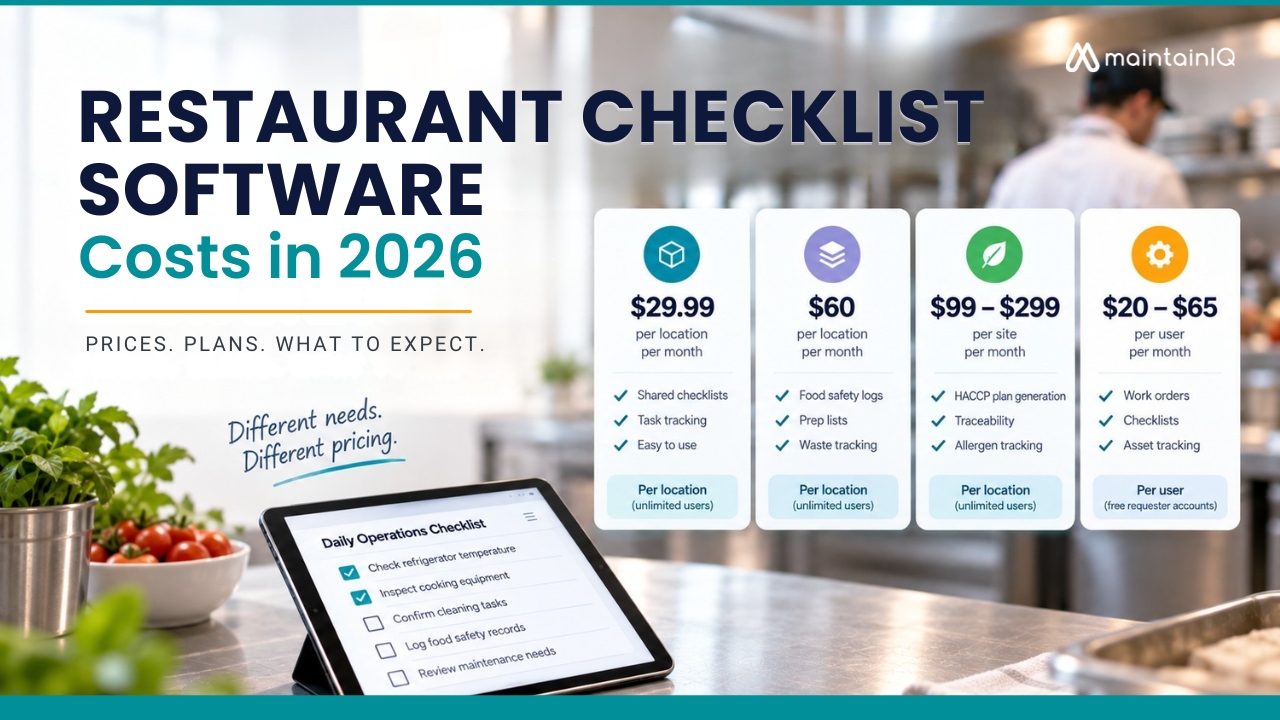
| MaintainIQ | Per location, unlimited users | $79 monthly, $799 yearly |
| FreshCheq | Per location | $60 monthly, $629 yearly |
| FoodDocs | Per site | $99 to $299 monthly |
| Mitti, formerly SafetyCulture | Per seat | $24 per seat monthly on annual, $29 monthly |
| MaintainX | Per user | $20 to $65 per user monthly on annual |
| Bindy | Per inspection | $129 to $499 monthly |
| Xenia | Per location or per user | Not published |
| Jolt, now SmartSense | Not disclosed | Not published |
| Crunchtime Ops Execution | Per user, reported | Not published |
Xenia’s pricing page lists Basic, Pro, and Enterprise, each marked as custom pricing per location, with no figure anywhere. Jolt’s pricing page now redirects to a SmartSense quote request form. Crunchtime has no pricing page.
That is a legitimate way to sell software, and plenty of good companies do it. It is also a legitimate thing to weigh when budgeting, because it means you cannot compare anything until you have sat through a call with each vendor. If you are running six stores and want a number this week, that matters.
Four questions that settle it
Work through these with real numbers from your own business, and the answer usually becomes obvious.
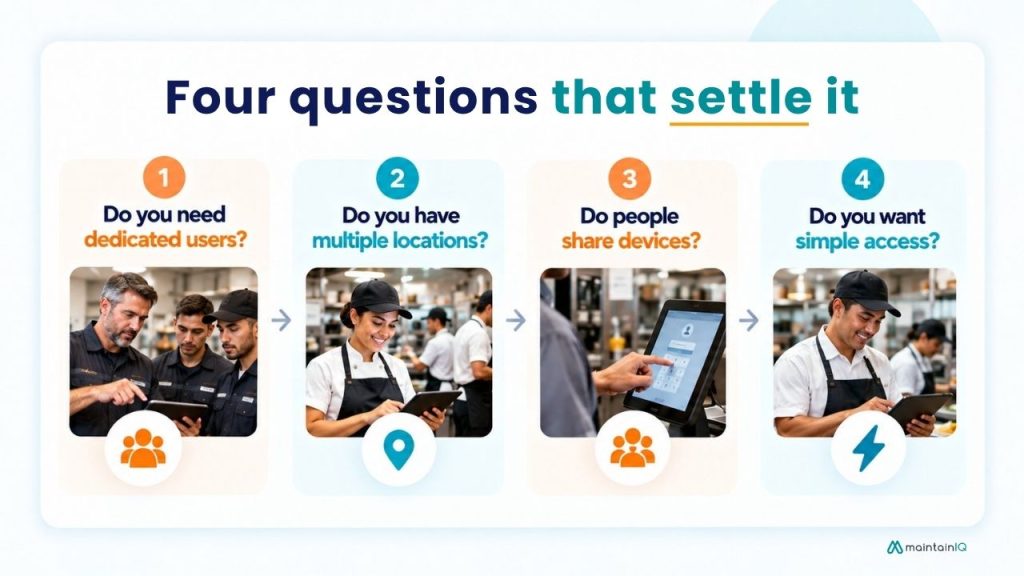
One. How many people would actually get a login? Not how many people work for you. How many need to open the app? If the answer is “everyone on shift”, you are a per-location business.
Two. How much does that number move in a year? High turnover makes per-seat pricing an administrative job as well as a cost.
Three. Are you adding locations or adding people? If you are opening sites, per-location pricing scales predictably with your growth plan. If you are deepening one site, per seat might.
Four. What is the cost of someone not having a login? This is the one operators underestimate. If seats cost money, managers ration them, and the person who actually did the temperature check is not the person who recorded it. At that point you are paying for software and still running on someone else’s memory.
That fourth question is the real argument for unlimited users — not primarily a cost argument. The record is only worth anything if the person who did the work is the person who logged it.
The short version
Count the logins you would actually issue. Multiply by the per-seat rate. Compare that to the per-location rate times your site count. The answer takes two minutes, and it is rarely close.
If it comes out in favour of per seat, buy per seat. If your team is large and your sites are many, you are paying a headcount tax for software that was priced for a different kind of business.
MaintainIQ is $79 per location per month with unlimited users, published, with no call required to find out. If you want to see how it works across your sites, book a demo or read how we compare in our alternatives guide.
Frequently asked questions
Is per location pricing always cheaper?
No. It is cheaper when many people use the software, and more expensive when very few do. At roughly seventeen employees per location (the food service average per BLS), per location is usually well ahead. At three or four users across one site, per seat can win.
How many users can MaintainIQ have?
Unlimited, on both the monthly and annual plan. The price is per location and does not change with headcount.
What does MaintainIQ cost?
$79 per location per month, or $799 per location per year. Both include unlimited users. The annual plan carries a 90-day money-back guarantee. A one-time setup fee applies. Full details are on our pricing page.
Do per-seat vendors offer volume discounts?
Usually, at the enterprise level and by negotiation. That is worth asking for, but note that a negotiated discount is a private number you cannot check or compare, and it typically resets at renewal.
What about tools priced per inspection?
A third model exists. Bindy prices by inspection volume rather than by user or location, at $129 a month for 10 inspections and $499 a month for 70, with unlimited users. That suits an audit programme with steady, predictable volume. It suits daily operational checklists badly, because daily checks across multiple sites will exhaust an inspection quota quickly.
Which model do most restaurant platforms use?
The category is split and the split is not random. Tools built for food service operations tend toward per location. Tools built for industrial maintenance and for enterprise safety teams tend toward per seat, because their original buyer had a small specialist team rather than a whole shift.
Sources
- Bureau of Labor Statistics, Food Services and Drinking Places NAICS 722, establishments Q4 2025 and employment August 2026
- National Restaurant Association industry statistics, 9 in 10 restaurants have fewer than 50 employees
- Vendor pricing pages for MaintainX, Mitti, FoodDocs, FreshCheq, Bindy and Xenia, all checked September 2026