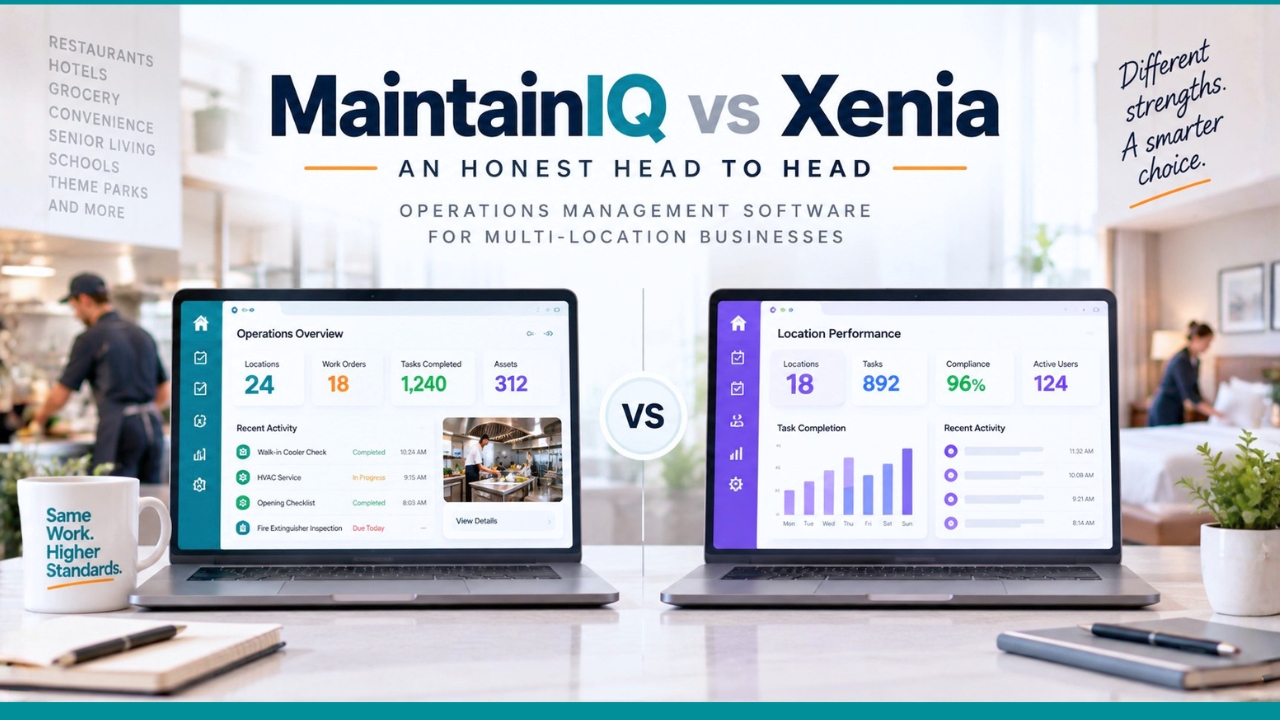
We build MaintainIQ, which competes directly with Xenia. Weigh what follows accordingly.
Xenia also publishes an article about alternatives to us, so you can read both and decide who is being straighter with you. Our attempt at that is to source every price from the vendor’s own live pricing page or mark it as not published, to start with what Xenia does well rather than bury it, and to say plainly where we lose.
All facts verified September 2026.
Table of Contents
What Xenia is, and what it does well
Xenia is a frontline operations platform covering daily checklists, inspections and audits, work orders, preventive maintenance, and temperature monitoring, aimed at businesses with deskless teams. It raised a $12 million Series A led by PSG in November 2025.
Four things it does genuinely well, and these are not throat-clearing.
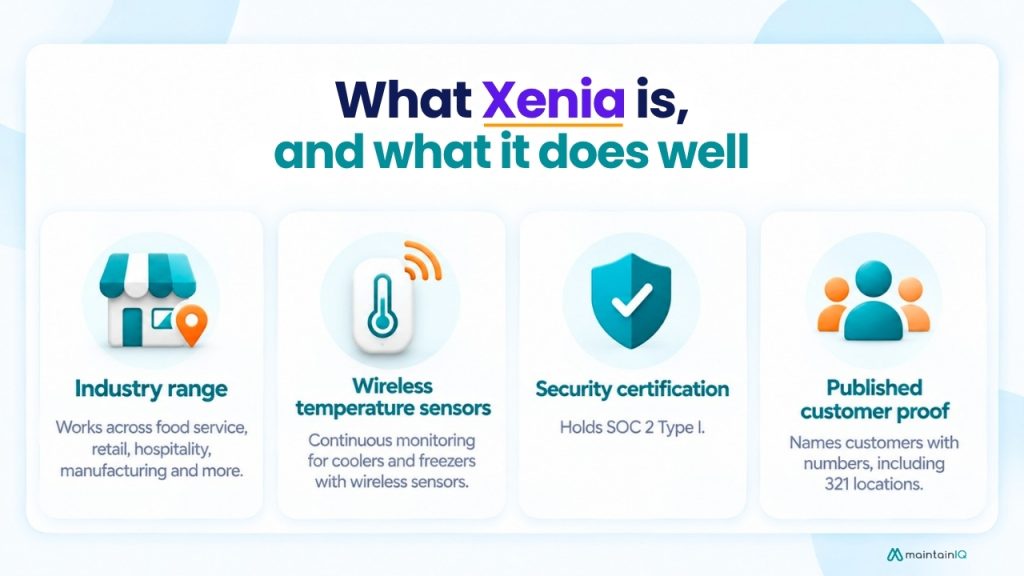
Industry range. Xenia markets to food service, retail, convenience stores, hospitality, manufacturing, and general facilities. If your business spans genuinely unrelated sectors, warehouses and restaurants under one roof, that breadth is real. Most food safety platforms are narrower.
Wireless temperature sensors. Xenia sells continuous monitoring hardware for coolers and freezers, using wireless sensors that report on their own, alongside Bluetooth probe logging. That covers unattended overnight monitoring. It is a genuine capability, and several alternatives in this article, ours included, do not sell it.
Security certification. Xenia holds SOC 2 Type I. If your procurement process requires a certification, that will decide the shortlist before anything else does. Worth noting the distinction, since it comes up in enterprise reviews. Type I attests that controls were designed properly at a point in time. Type II attests that they operated effectively over a period. Xenia publishes Type I.
Published customer proof. They name customers with numbers attached, including Dave’s Hot Chicken at 321 locations. That is more than most competitors in this category put in writing.
Xenia is rated 5.0 out of 5 on G2 from 20 reviews and 4.9 out of 5 on Capterra from 23 reviews.
Why operators look at alternatives anyway
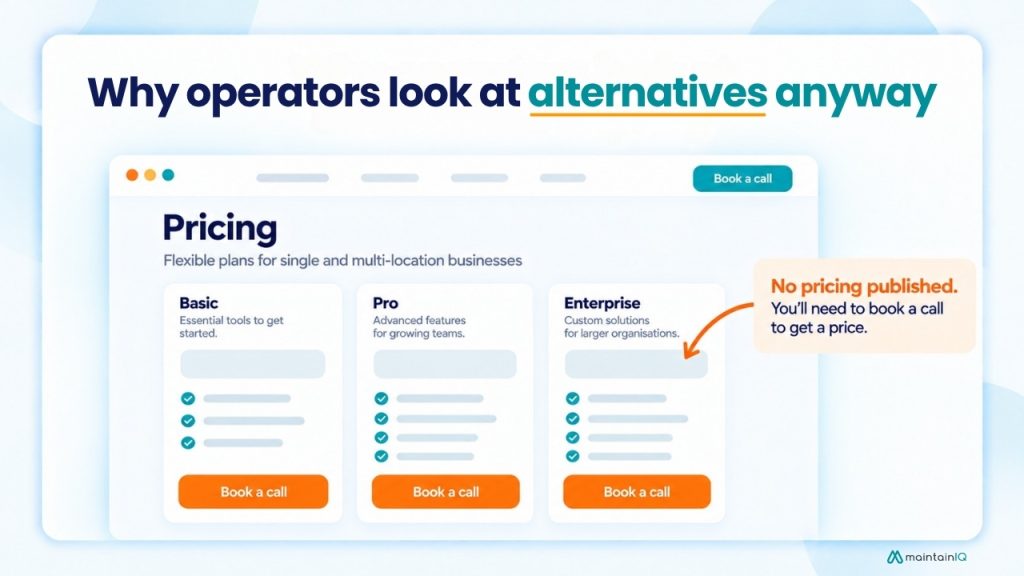
Pricing is not published. Xenia’s pricing page lists Basic, Pro, and Enterprise, and all three read as custom pricing per location with no dollar figure anywhere on the page. Sensors, work order ticketing, asset management, and food prep label printing are listed as add-on modules, also without prices.
This is a legitimate way to sell software, but it is real friction if you run six stores and do not want to run a procurement process just to find out what something costs. Notably, Xenia’s own comparison articles publish exact per-user prices for competitors like Limble, Fiix, and UpKeep while listing nothing for themselves.
Language support. The most repeated request in Xenia’s Capterra reviews is more languages, with several reviewers asking specifically on behalf of their teams. In food service, where a large share of the people doing the work are more comfortable in Spanish, that is not a minor gap.
Small review base. Twenty reviews on G2 and twenty-three on Capterra are a small sample. The scores are excellent, but a 5.0 from twenty reviews tells you less than a 4.6 from three hundred does.
Reviewer complaints, where they exist. Dashboard load delays and occasional freezing, limited integrations, and preventive maintenance depth all appear in Capterra reviews.
Add-on pricing. Several capabilities that a food service operator would consider core, including sensors and work order ticketing, are sold as separate modules. Ask what the bundle actually costs rather than the base tier.
What to work out before you shortlist
- How many people log in? This decides more of your bill than any feature. Xenia offers both per-location and per-user options, so ask which one you are being quoted on.
- Do you need sensors monitoring unattended, or faster logging? These are different products at different prices. A wireless sensor sits in the walk-in overnight and alerts you at two in the morning. A Bluetooth probe means a person takes a reading that records digitally rather than on paper.
- Is your business one sector or several? Xenia’s breadth is its main structural advantage. If you only run food service sites, you may be paying for range you do not use.
- Do your teams need Spanish? Ask for a demonstration in the language your crew actually works in, not a promise.
- What is the all-in price? Base tier plus the add-on modules you need plus hardware plus setup. Get it in writing.
The alternatives
MaintainIQ, if you are food service and want a price you can see
We are the closest direct comparison to Xenia for food service and hospitality, which is why the two names come up against each other.
Digital temperature logs with Bluetooth probe capture, opening and closing checklists, prep lists, line checks, inspections and audits, work orders, preventive maintenance, and vendor and warranty records. Eight industries have dedicated support, which are restaurants, hotels and resorts, grocery stores, convenience stores, senior living facilities, schools, theme parks, and trampoline parks.
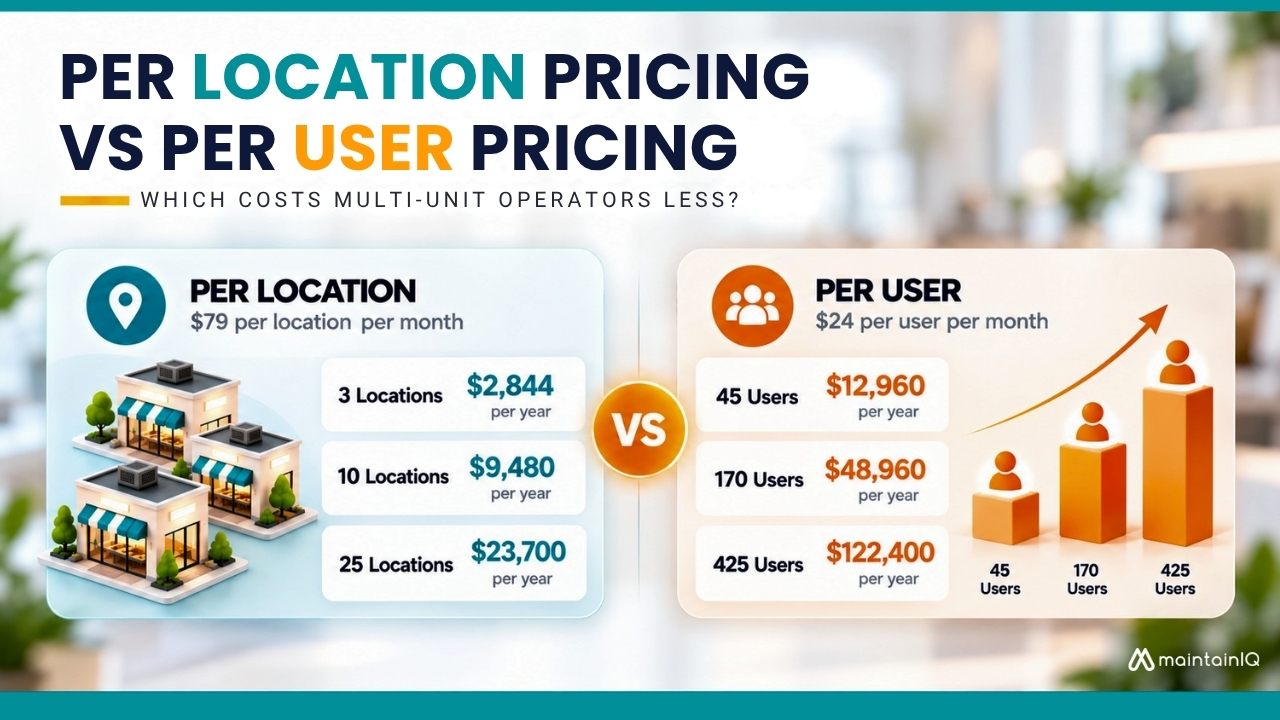
Pricing is published at $79 per location per month or $799 per location per year, unlimited users on both, with a 90-day money-back guarantee on the annual plan. A one-time setup fee applies. Support is based in the United States. The platform runs in English and Spanish, including a full Mexican Spanish version of the site.
Where we lose to Xenia, plainly. We do not sell wireless sensors that monitor unattended. We integrate Bluetooth probes, specifically the Cooper-Atkins and Copeland KwikSwitch BLE 94100-B, the Cooper-Atkins and Copeland Multi-Function Thermometer, and the Comark BT250KC. That is digital capture of a reading a person takes, not overnight coverage. We do not have a published security certification, so if procurement requires SOC 2, Xenia clears that bar and we do not. Our industry range is narrower than theirs, deliberately. And our third-party review footprint is thin, with no G2 profile and very few directory reviews, so ask us for references and call them rather than taking our word for it.
One correction, since it appears in their comparison of us. Xenia’s MaintainIQ article contains a table rating MaintainIQ’s temperature monitoring as manual logging and our template library as none. Bluetooth probe capture is not manual logging, and there are more than sixty free checklist templates published on MaintainIQ that anyone can count. The criticism that we lack unattended wireless sensors is fair, and we make it ourselves above. The two table rows are not.
Jolt, now SmartSense, if labeling and scheduling matter
Jolt was acquired by Digi International in August 2025 and folded into SmartSense. Its strength is date code labeling, with printers rated at up to six labels per second, and it bundles employee scheduling and time clocks, which neither Xenia nor MaintainIQ does. Through SmartSense, it also brings wireless temperature monitoring.
The caution is reliability. App crashes and slow mobile performance are the dominant theme across 313 Capterra reviews, where it holds 4.6 out of 5, alongside reports of slow support and inflexible annual contract terms. Pricing is not published and is quote only.
FreshCheq, if the requirement is food safety logging and nothing else
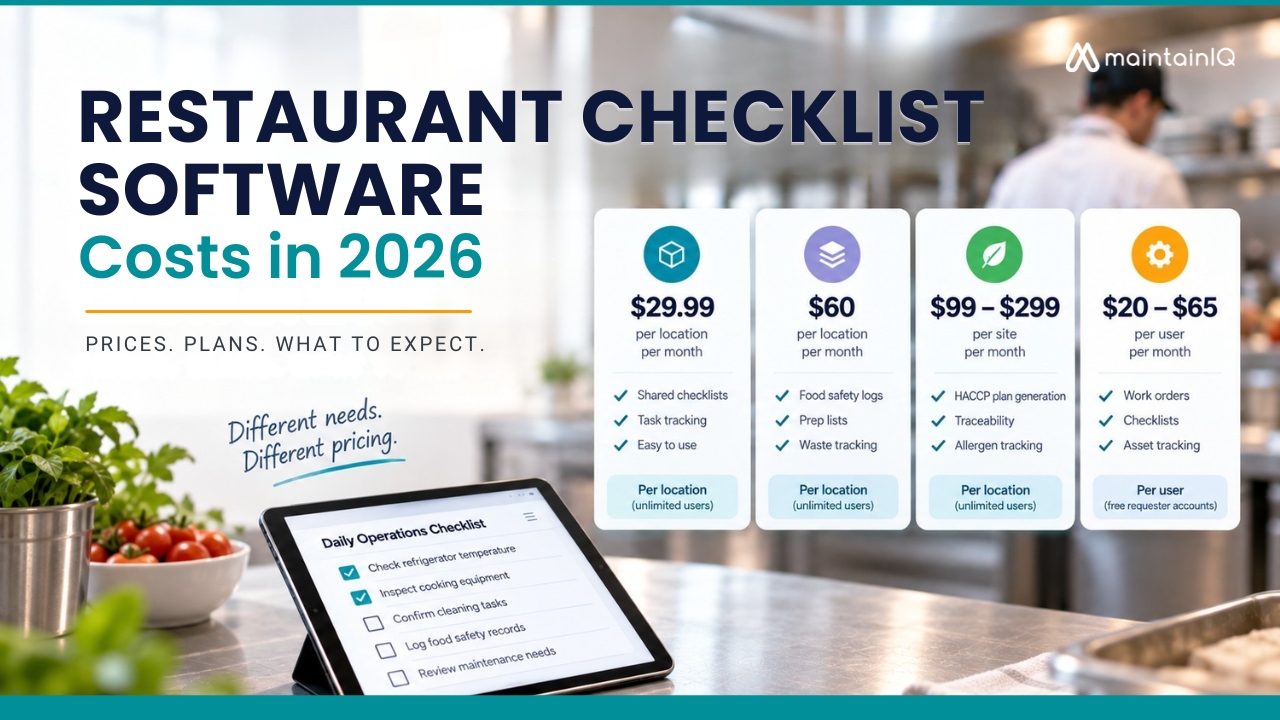
$60 per location per month or $629 per location per year, published, with no setup fee and no required hardware. Temperature logs, cooling logs, checklists, food waste tracking, basic inventories, prep lists, and Bluetooth thermometer sync.
Named customers include Buffalo Wild Wings and Moe’s Southwest Grill. It does not market work orders or maintenance, scheduling, or labels. Rated 4.5 out of 5 on Capterra from 78 reviews.
Crunchtime Ops Execution, if you are enterprise scale
Formerly Zenput, renamed in February 2026. Store execution sits inside a suite covering inventory, labor and scheduling, kitchen management, and training. Crunchtime claims 850 or more brands across 150,000 or more locations.
If you want food cost, labor, and store execution on one contract at 400 units, this is the category Xenia does not really play in. Reviewers cite per-user pricing as a barrier for smaller operators and support responsiveness as the most common frustration. Pricing is not published. Rated 4.6 out of 5 on G2 from 144 reviews.
Mitti, formerly SafetyCulture, if inspections are the whole job
SafetyCulture rebranded to Mitti in August 2026. Pricing is published, which makes it directly comparable in a way Xenia is not. Free for up to 10 seats, Premium at $24 per seat per month billed annually or $29 monthly, Enterprise custom with site-based pricing available.
The free tier is capped at five active templates, which a multi-site operator will exceed almost immediately. Recurring review themes are learning curve, complexity, and cost for small teams. Rated 4.6 out of 5 on G2 from 483 reviews. It is a general-purpose inspection platform rather than something built around a restaurant’s day.
MaintainX or Limble, if maintenance is the real problem
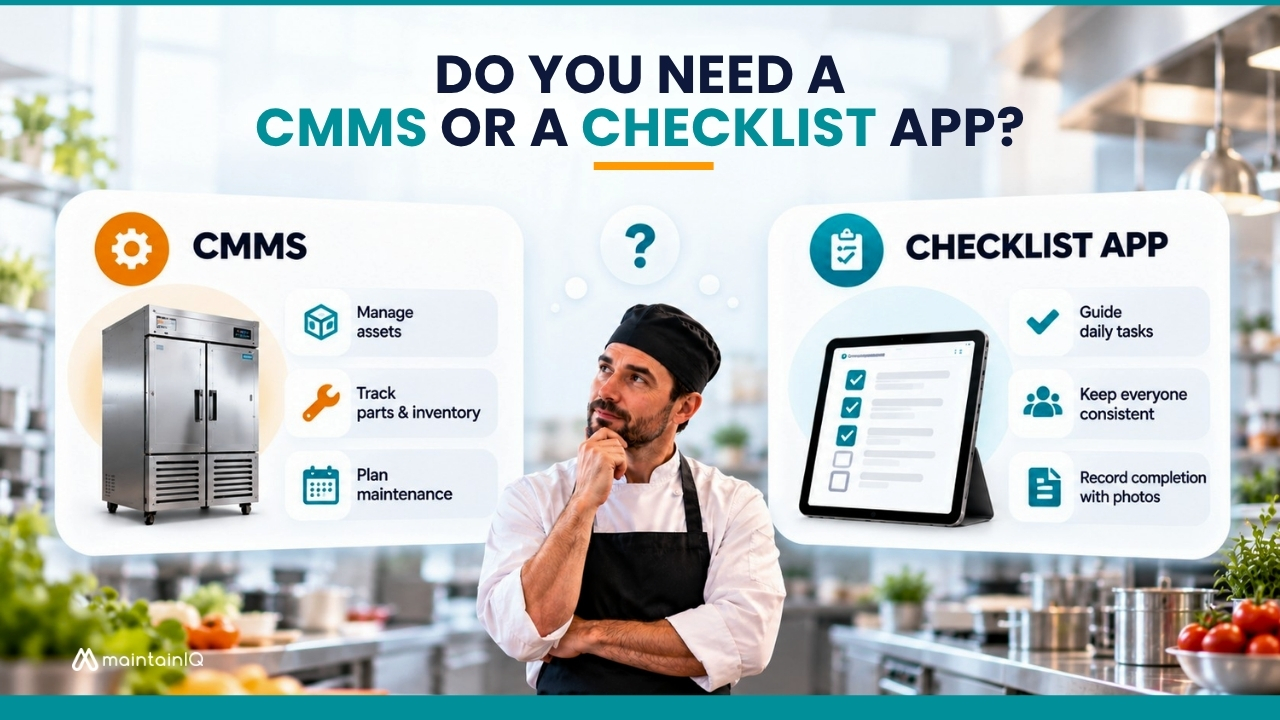
If nobody is logging a cooler temperature and the job is assets, work orders, and maintenance schedules, these go deeper than Xenia does, with parts inventory, purchase orders, and meter-based triggers.
MaintainX, now an Autodesk company after the acquisition completed in August 2026, publishes a free tier, $20 per user per month for Essential, and $65 for Premium on annual billing. Rated 4.8 out of 5 on G2 from 1,555 reviews. Limble lists $28 and $69 per user per month, with implementation and training included. Rated 4.8 out of 5 on G2 from 688 reviews.
Neither is built for daily food safety logs or shift checklists on a shared tablet.
Bindy, if you run a formal audit program
Priced by inspections rather than users, which is unusual and suits some operators very well. Starter at $129 per month for 10 inspections and SMB at $499 per month for 70, both with unlimited users. Unused inspections expire monthly. Rated 4.9 out of 5 on Capterra from 15 reviews.
The alternatives at a glance
| Platform | Best for | Pricing model | Published price | Wireless sensors | Labels | Scheduling | Spanish |
| Xenia | Businesses spanning unrelated industries | Per location or per user | Not published | Yes | Add on | No | Limited, common review request |
| MaintainIQ | Food service and hospitality, lots of hourly staff | Per location, unlimited users | $79 monthly, $799 yearly | No, Bluetooth probes | No | No | Yes, full Spanish site |
| Jolt, now SmartSense | Labeling plus scheduling plus sensors | Not disclosed | Not published | Yes | Yes | Yes | Not stated |
| FreshCheq | Food safety logging only | Per location | $60 monthly, $629 yearly | No | No | No | Not stated |
| Crunchtime Ops Execution | Enterprise chains wanting inventory and labor | Per user, reported | Not published | Via partners | Yes | Yes | Not stated |
| Mitti, formerly SafetyCulture | Inspections and audits at scale | Per seat | Free to $29 per seat | Available | No | No | Yes, many languages |
| MaintainX | Maintenance depth | Per user, free requesters | $20 to $65 per user | Enterprise tier | No | No | Yes |
| Bindy | Formal audit programs | Per inspection | $129 to $499 monthly | No | No | No | Not stated |
| UpKeep | Maintenance and work orders | Per user | $24 to $55 per user | Not stated | Not stated | Not stated | Not stated |
| FoodDocs | Food safety compliance | Per site | $99 to $299 per site | Not stated | Not stated | Not stated | Not stated |
Making the decision
Get a written quote from Xenia early, because you cannot compare anything until you have one, and put two published price alternatives next to it. Ask all of them what happens when a temperature check fails, and have them show you the whole sequence through to the repair being signed off, not the checklist on its own.
If your sites span genuinely different industries, or you need wireless sensors watching coolers overnight, or procurement requires a security certification, Xenia is a strong choice, and we would not pretend otherwise. If you run food service or hospitality, have far more crew than managers, want your teams working in Spanish, and would rather see a price than book a call, MaintainIQ is built for exactly that and we would like to be on the list.
Frequently asked questions
How much does Xenia cost?
Xenia does not publish pricing. Its pricing page lists Basic, Pro, and Enterprise tiers, each described as custom pricing per location, with no dollar figures. Sensors, work order ticketing, asset management, and food prep label printing are listed as add on modules, also without prices. There is a 14 day free trial with no card required. To compare total cost against a published alternative you will need to request a quote.
What is the best Xenia alternative?
It depends on your business. For food service and hospitality on published per-location pricing, MaintainIQ at $79 per location per month with unlimited users. For food safety logging alone on the smallest budget, FreshCheq at $60. For labeling and scheduling in the same tool, Jolt through SmartSense. For enterprise chains that also need inventory and labor, Crunchtime Ops Execution. For inspections above all else, Mitti. For pure maintenance, MaintainX or Limble.
Is Xenia good for restaurants?
Yes. Restaurants are one of its named industries and it publishes restaurant customers including Dave’s Hot Chicken. The question is whether you need the rest of its range. If every site you run is food service, a platform built specifically for that may fit better and cost less. If you run food service alongside retail, manufacturing, or general facilities, Xenia’s breadth is a genuine advantage.
Does Xenia support Spanish?
Language support is the most frequently requested improvement in Xenia’s Capterra reviews, with several reviewers asking for more languages for their teams. Ask for a demonstration in the language your crew works in before you commit. MaintainIQ runs in English and Spanish with a full Mexican Spanish version of the site, and Mitti supports a wide range of languages.
Does Xenia include temperature sensors in its base price?
Sensors and continuous monitoring are listed as an add-on module on Xenia’s pricing page, not as part of a base tier. Since no prices are published, ask specifically what the sensors cost per site, both hardware and any recurring fee, and get it in writing alongside the platform quote.
Is Xenia SOC 2 certified?
Xenia states SOC 2 Type I on its site. Type I attests that controls were designed appropriately at a point in time. Type II attests that they operated effectively over a period, and is what many enterprise procurement processes ask for. If a certification is a requirement for you, confirm which type your process needs.