Most of what is written about this online is a county health department PDF. Accurate, usually, but written for inspectors rather than for the person running a lunch service.
Here is the operator version. What the rule actually permits, what has to be written down before you start, what has to be marked, and the specific mistakes that turn a legal practice into a discarded pan of food.
Everything below is cited to the FDA Food Code 2022, which is the current full edition. The January 18, 2023 version is the one to reference. A Supplement was published on 4 November 2024, and it does not change this section.
Table of Contents
What it is
Normally, you control pathogen growth with temperature. Cold food stays at or below 41°F, hot food stays at or above 135°F, and you check it.
Time as a public health control, usually shortened to TPHC, lets you take food out of temperature control entirely and use the clock instead. After a set number of hours, the food is served or thrown away. Nothing in between.
It is covered by section 3-501.19 of the Food Code. If you work in Ohio or North Carolina, you may know it as TILT, time in lieu of temperature. Same thing, different local vocabulary.
Two versions exist. A four-hour version and a six-hour version, and they are not simply longer and shorter versions of each other.
The four hour version
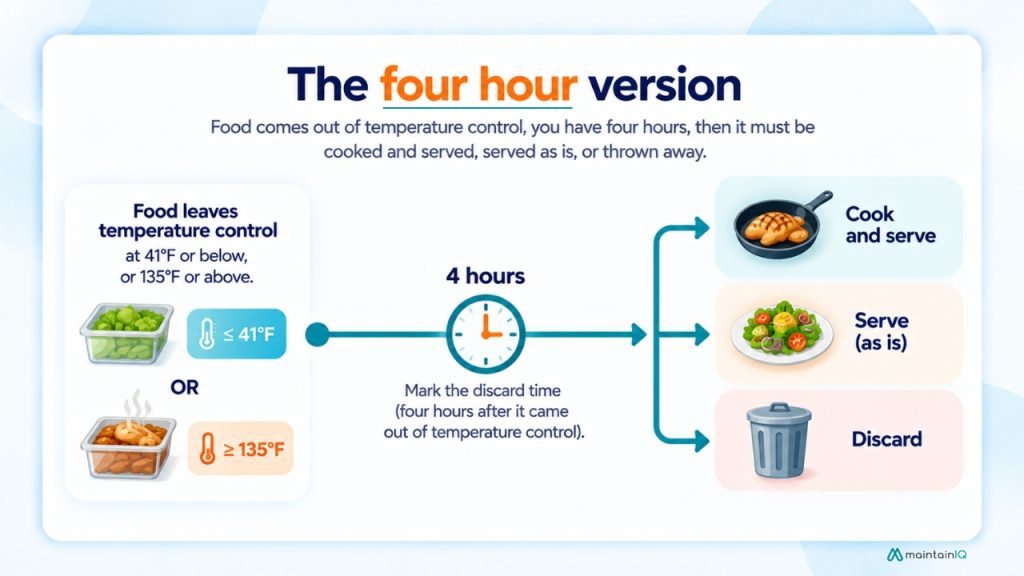
Starting temperature. The food comes out of temperature control at 41°F or below, or at 135°F or above. Cold or hot, either works.
There is a third starting point that is new in the 2022 edition and that most guidance online has not caught up with. Ready-to-eat fruit or vegetables that only become temperature-controlled food once you cut them, and ready-to-eat food in a hermetically sealed container that only becomes temperature-controlled once you open it, may start at 70°F or below, provided the food does not exceed 70°F within the four hours. Cut melon, sliced tomatoes, an opened can of green beans. The clock starts at the cut or the opening, not at removal from a cooler.
Marking. Mark the food with the time four hours after it came out of temperature control. Note that the Code asks for the discard time, not the start time. Plenty of kitchens write down the start time and make the shift do mental arithmetic, which works until it does not.
The end. Within four hours, the food is cooked and served, served as it is if it was already ready to eat, or thrown away. Those are the only three endings the Code offers.
Unmarked food, or food marked past the limit, is thrown away. Worth reading twice, because it is the most common way operators lose product. An unmarked pan is discarded even when everybody knows it went out twenty minutes ago.
The six hour version
This is not the four-hour version with two extra hours. It is a different regime, and it is more work.
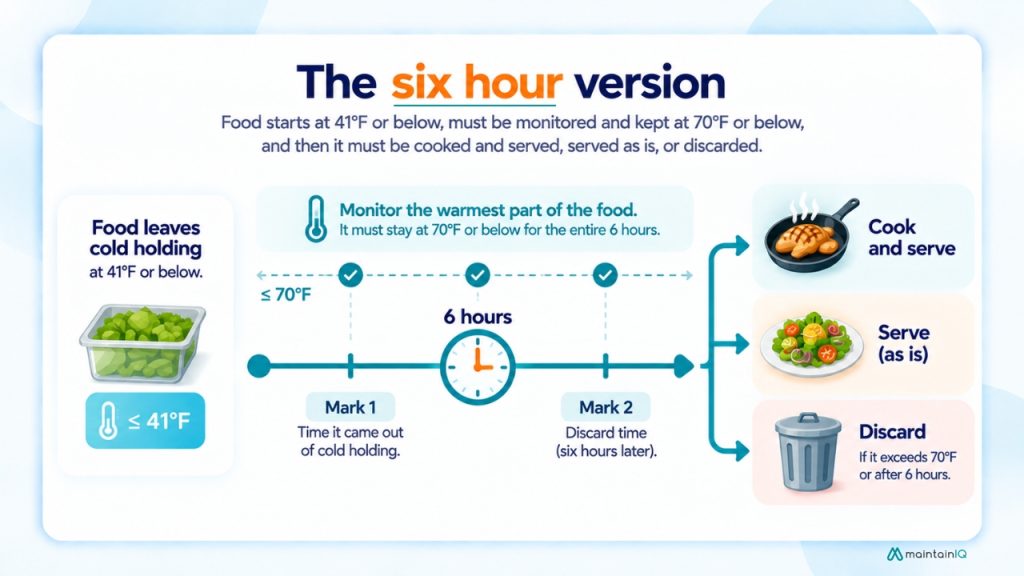
Starting temperature. 41°F or below only. There is no hot-holding option at six hours.
Monitoring. The warmest part of the food must not exceed 70°F at any point. That means somebody is taking readings during the hold, not just at the start. The only exception is a space where ambient air is kept at or below 70°F for the whole hold.
Marking. Two times, not one. The time it came out of cold holding, and the time six hours after that.
The end. Discard if the food exceeds 70°F, whatever the clock says. Otherwise cook and serve, serve, or discard within six hours. Unmarked or overmarked food is discarded.
So the six hour option buys you two extra hours in exchange for an active monitoring duty and a second mark. For a lot of kitchens, the four-hour version is less work and less risk, and choosing it deliberately is a reasonable decision rather than a compromise.
The written procedure, which is where most operators fall down
You cannot use this rule by simply deciding to use it. Section 3-501.19(A)(1) requires written procedures that are prepared in advance, maintained in the establishment, and made available to the regulatory authority upon request.
The procedure has to specify two things. How you comply with the four-hour or six-hour requirements. And how you comply with section 3-501.14, the cooling rule, for any food that was prepared, cooked, and refrigerated before the clock starts.
That second requirement is one many operators miss. If you cook chili on Tuesday, cool it, then put it on the line under time control on Wednesday, your written procedure has to cover how the Tuesday cooling was done properly. Inspectors can cite it.
You do not need prior approval under the model Code. Tennessee’s Department of Health says so plainly: “Pre-approval of written procedures by the Department of Health is not required.” Northern Nevada Public Health agrees, adding that procedures “must be prepared in advance of using TPHC and be available for review during your routine inspection.”
But local rules vary, and in one important case the rule itself is different. California has no six-hour option at all. The California Retail Food Code allows four hours, full stop. An operator in California working from a generic four or six-hour article is out of compliance. New York City runs its own version too, with a 140°F hot holding baseline, a required temperature check at the four-hour mark on six-hour holds, and a ban on using time control in mobile units, vending machines, temporary establishments, and for smoked or vacuum-packed foods.
Check your own jurisdiction before you build the procedure. That is a five-minute phone call, and it decides the whole thing.
What it is actually used for
Health department guidance gives real examples, and they fall into the two categories the Code describes.
A working supply before cooking. Raw bacon staged on a cook line. Waffle batter at a breakfast bar. Raw shell eggs at a brunch station. Rice noodles.
Ready-to-eat food on display or held for service. Sushi rice. Pizza by the slice. Potato salad and pasta salad on a buffet. Cut melon. Spring rolls. Boba.
If you run a cold buffet, a pizza make table, a sushi bar, a condiment counter or a display case, this rule is probably already relevant to you whether or not you are using it.
The six mistakes that get cited
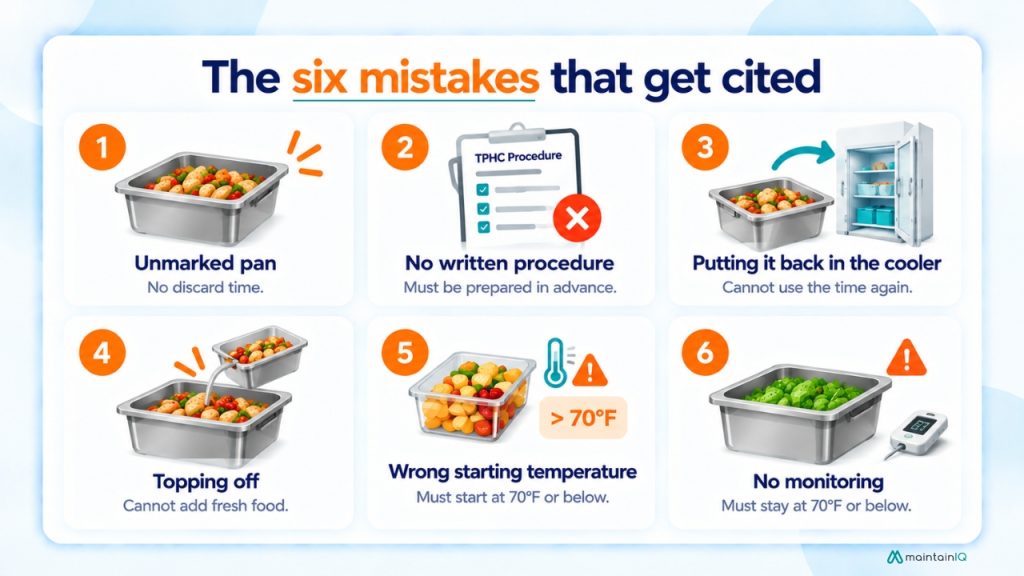
No written procedure. The practice stops immediately, and everything goes back under temperature control.
Unmarked containers. The single most frequently cited failure, and it is a discard trigger rather than a warning.
Putting food back in the cooler. Regulators are uniform on this one. Anchorage: “Once the TPHC has started, food items cannot be returned to temperature controls.” Orange County, California: food under time control “may not be returned to the refrigerator, be reheated, or placed in a warmer for later use.” The Code lists three endings, and refrigerating for tomorrow is not one of them.
Topping off a pan mid-service. This is the one that catches pizza make tables and buffets. Tennessee’s guidance is to use “the earliest time as the time by which to serve or discard all the food” when batches are mixed. In practice, do not mix batches at all. Swap the pan.
Starting at the wrong temperature. Nobody checks the 41°F or 135°F at the start, so the clock was never valid.
Claiming six hours without monitoring. If you are not taking readings, you are on the four-hour rule whether you meant to be or not.
One special case worth knowing
Sushi rice has two compliance routes and they are governed by different sections, with very different amounts of paperwork.
Route one is time control under 3-501.19. Written procedure, marking, four or six hours, then serve or discard. No variance, no HACCP plan.
Route two is acidifying the rice so it is no longer temperature-controlled food at all. That is not this rule. Adding vinegar to change whether a food is temperature-controlled triggers section 3-502.11, which requires a variance from the regulatory authority and a HACCP plan.
If you run a sushi programme and someone tells you acidification is simpler, it is not. It is the route with the variance application attached.
One exclusion
An establishment serving a highly susceptible population may not use time control for raw eggs. That is the only food excluded by name in 3-501.19, at paragraph (D).
Note how narrow that is. It is raw eggs, not a blanket ban, and highly susceptible population has a specific meaning. It requires both that the people are more vulnerable than the general population and that they are getting food at a facility providing custodial care, health care or assisted living.
Examples include a hospital, a nursing home, a child care center, a senior center. A restaurant with a lot of older regulars is not a highly susceptible population facility.
Making it work on a shift
The rule is straightforward. Running it through a busy service, with different people on different days, is the hard part, and it usually fails in the same two places. Somebody forgets to mark a pan. Somebody puts a pan back in the walk-in at the end of the shift because throwing food away feels wrong.
Both are habit problems rather than knowledge problems, and both are what a written daily routine is for. If the marking step is a line on the opening list with a name against it, it gets done. If it lives in somebody’s head, it gets done until the day that person is off.
MaintainIQ handles this as part of the daily routine rather than as a separate compliance exercise. The pans that go under time control are on the checklist for the shift, the person who marked them is recorded, and the temperature readings that start the clock are captured with a Bluetooth probe so the starting temperature is a real number rather than a remembered one. When an inspector asks for the written procedure, it is in the same place as everything else rather than in a binder nobody has opened since the last visit.
You can see how the compliance side fits together, or book a demo and we will walk through your actual stations.
Frequently asked questions
Do I need approval from the health department before using time as a public health control?
Under the model Food Code, no. You need the written procedure to exist before the first item goes out, and you need to produce it when asked. Some jurisdictions add their own step, and California’s time limits are different, so confirm locally.
Can I put the food back in the fridge if it is still within the four hours?
No. The Code gives three endings: cook and serve, serve, or discard, and health departments consistently read that as barring a return to temperature control.
What happens if a pan is not marked?
It is discarded. Section 3-501.19(B)(5) and (C)(5) both say food in unmarked containers is thrown away, regardless of how long it has actually been out.
Does this apply to food in the walk-in or in dry storage?
No. The rule covers a working supply staged before cooking, and ready-to-eat food on display or held for service. Bulk stock in storage is not in scope.
Is the four hour rule the same as the two hour four hour rule I have read about?
No, and this trips people up. The two-hour, four-hour rule is Australian and New Zealand food law. It is a different scheme with different limits. If a page uses that phrasing, it is not describing the US Food Code.
What is the difference between TPHC and TILT?
Nothing. Time as a public health control and time in lieu of temperature are the same rule under different local names. Ohio and North Carolina use TILT.