Every restaurant runs on a stack of documents that most operators only think about when something goes wrong. The business license, the health permit, the liquor license, the certificate of occupancy, the food handler cards, the fire inspection certificate, the equipment warranties, the vendor contracts, the temperature logs, the cleaning records — each one represents either permission to operate or proof that you’re operating correctly.
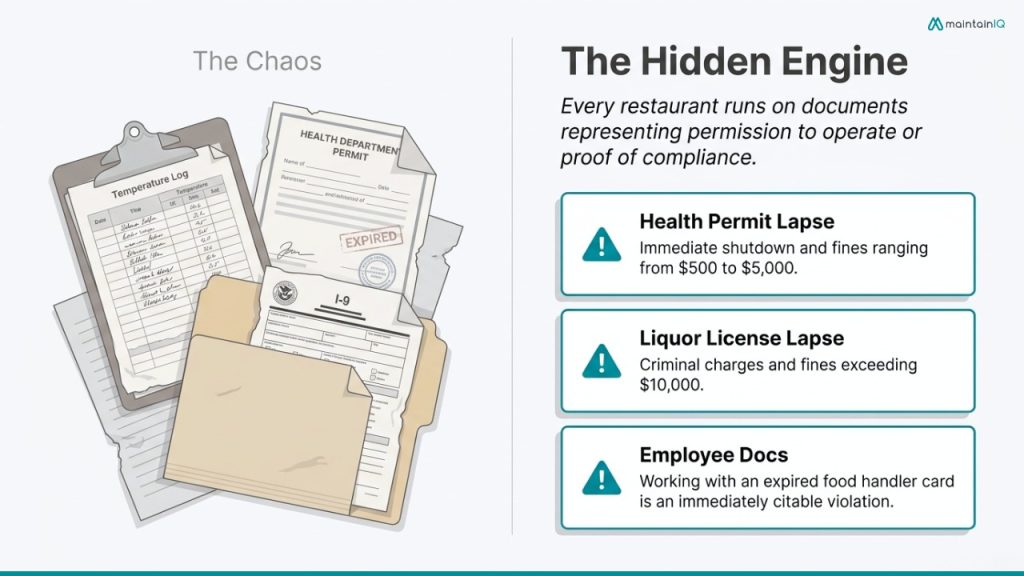
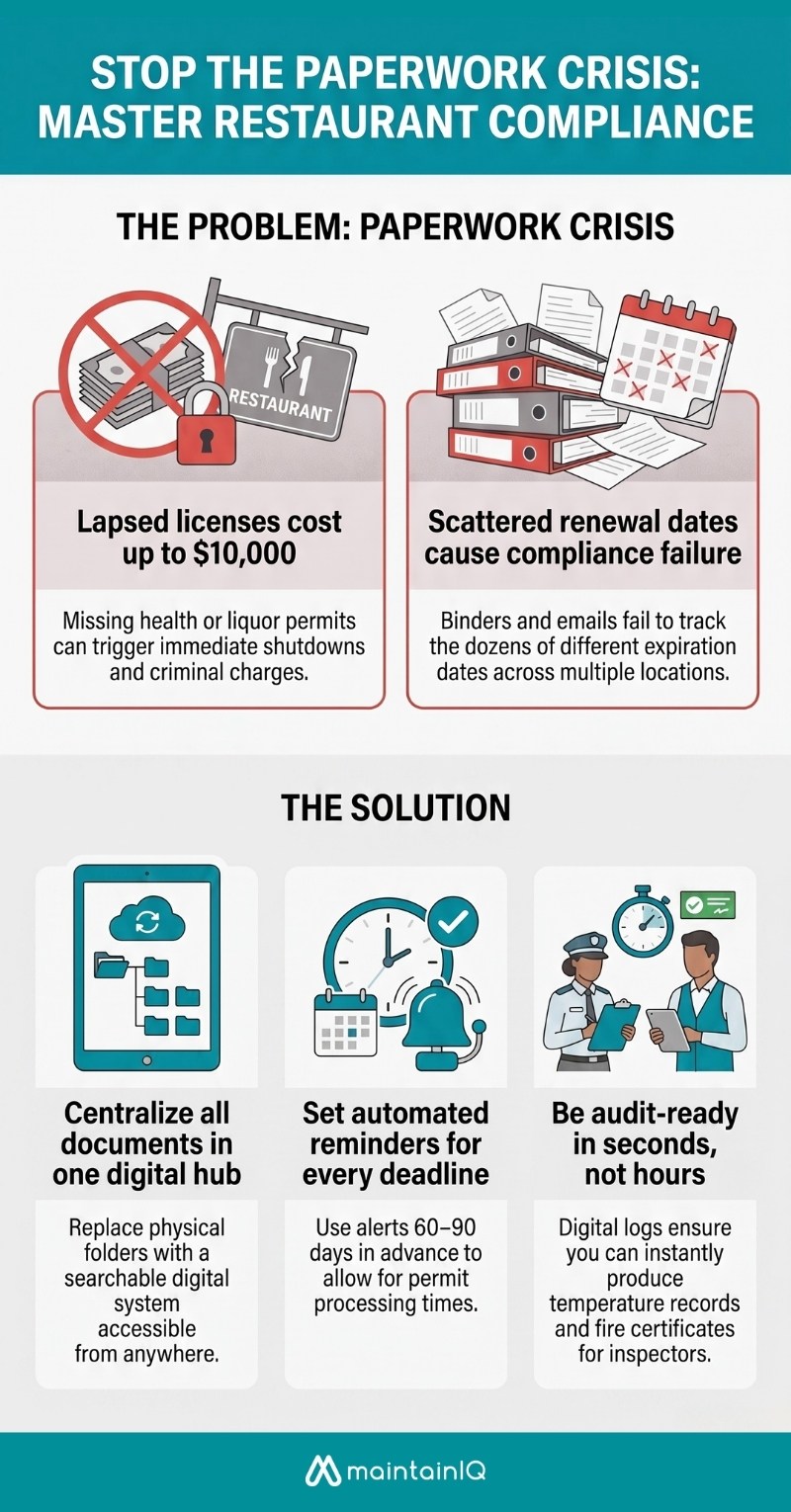
The problem is what happens when those documents aren’t organized. A liquor license lapses because nobody tracked the renewal date, and the restaurant can’t serve alcohol on its busiest weekend. A health inspector asks for 30 days of temperature logs and the manager spends 20 minutes digging through a binder. An employee’s food handler card expired three months ago and nobody noticed until the inspection. Operating without a valid health permit can trigger immediate shutdown and fines ranging from $500 to $5,000, and serving alcohol on a lapsed liquor license can mean criminal charges and fines exceeding $10,000.
These aren’t exotic scenarios. They’re the predictable result of managing critical documents with file folders, email attachments, and memory. This guide covers what documents restaurants must keep, how long to keep them, the renewal deadlines that matter most, and how to organize all of it so nothing lapses and everything is accessible when you need it.
Table of Contents
The Documents Every Restaurant Must Manage
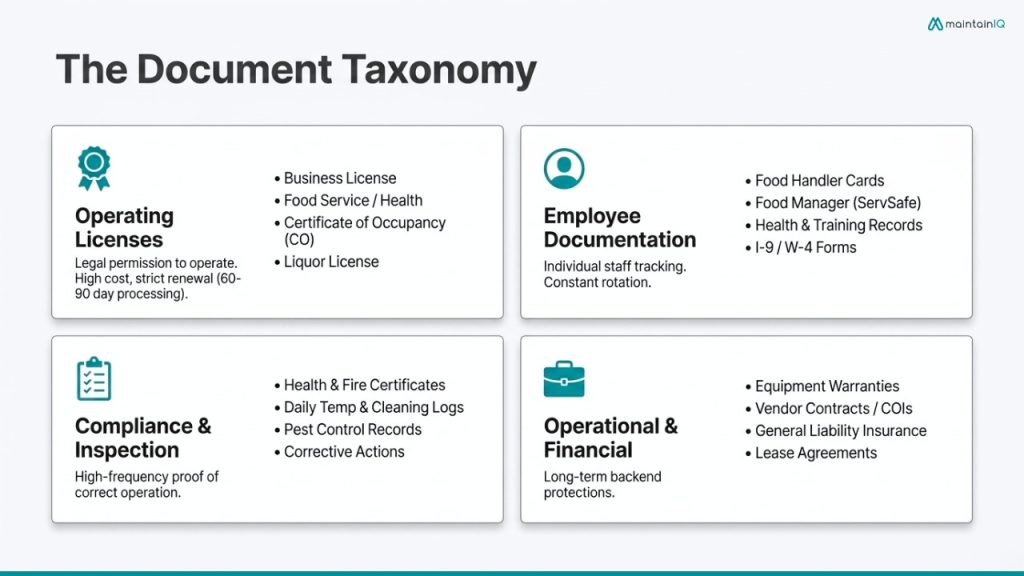
Restaurant documentation falls into a few broad categories, each with its own renewal cycles, retention requirements, and consequences for non-compliance.
Operating Licenses and Permits
These are the documents that grant your legal permission to operate. Without a current one, you may not be able to open your doors.
Business license. The basic license to operate a business in your city or county. Typically renewed annually. Costs commonly range from $50 to several hundred dollars.
Food service/health department permit. Authorizes you to prepare and serve food. Issued by your local county health department (usually not the state), it confirms your establishment meets food safety standards. Renewable annually and tied to passing periodic health inspections. This is the permit whose absence can shut you down immediately.
Certificate of occupancy (CO). Official verification that your premises meet building and safety codes. Required before opening, and often required to be re-verified after renovations. Also frequently required to satisfy insurance and financing conditions.
Liquor license. Required if you serve alcohol, issued through your state’s Alcohol Beverage Control (ABC) board. These are among the most expensive and most tightly regulated licenses — costs range widely, processing can take 60–90 days, and in some jurisdictions the number of available licenses is capped. A lapsed liquor license is one of the most financially damaging documentation failures a restaurant can make.
Building health permit. Focuses on structural and infrastructural compliance — ventilation, pest control, waste disposal. Separate from the food service permit in many jurisdictions.
Sales tax permit/seller’s permit. Authorizes you to sell taxable goods and collect sales tax. Issued by your state’s tax authority.
Sign permit, music license, and other local permits. Depending on your location and operation, you may need a sign permit, a music license (required by federal law for playing recorded or live music), an outdoor seating permit, a valet permit, and others.
Employee Documentation
Food handler/food worker cards. Many jurisdictions require food service employees to hold current food handler certifications. These expire and must be renewed — and an employee working with an expired card is a citable violation.
Food manager certification. Most jurisdictions require at least one certified food protection manager (often ServSafe-certified) on staff. The certification has an expiration date.
Employee health records. Documentation related to illness reporting policies and any health-related requirements for food handlers.
Training records. Documentation that employees have completed required food safety, alcohol service (where applicable), and workplace safety training.
Employment eligibility and tax forms. I-9 forms, W-4s, and related employment documentation have their own federal retention requirements.
Compliance and Inspection Records
Health inspection reports. Records of past health department inspections, including any violations cited and the corrective actions taken.
Fire inspection certificates. Documentation of fire marshal inspections, fire suppression system service (NFPA 17A), hood cleaning (NFPA 96), and fire extinguisher maintenance (NFPA 10).
Temperature logs. Daily records of cold holding, hot holding, cooking, cooling, and receiving temperatures. Health inspectors routinely ask for these going back weeks or months.
Cleaning and sanitation logs. Records demonstrating that cleaning schedules are followed.
Pest control records. Service records from your pest control vendor, plus any in-house monitoring documentation.
Corrective action records. Documentation of problems identified and how they were resolved — a core component of any food safety management system.
Operational and Financial Documents
Equipment warranties and service records. Warranty documents, service contracts, and maintenance history for every major piece of equipment.
Vendor contracts and certificates. Supplier agreements, certificates of insurance from vendors, and food safety certifications from suppliers.
Insurance policies. General liability, property, workers’ compensation, and liquor liability policies, with their renewal dates.
Lease and property documents. The property lease, any amendments, and related agreements.
Retention: How Long to Keep Each Document
Different documents carry different retention requirements, driven by tax law, employment law, health regulations, and liability considerations. While requirements vary by jurisdiction, and you should verify with your accountant and attorney, general guidance includes:
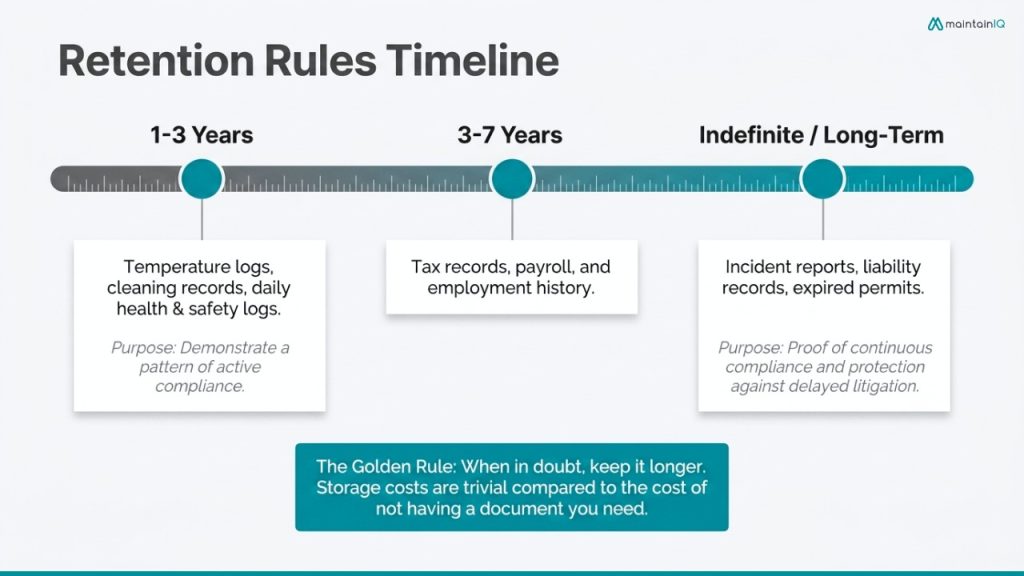
Tax records — the IRS generally recommends keeping records that support tax returns for at least three years, though some situations call for longer (up to seven years for certain claims).
Employment records — federal law sets various retention periods; I-9 forms must be retained for a specific period after employment ends, and payroll records have their own requirements.
Health and safety records — temperature logs, cleaning records, and inspection documentation should be retained long enough to demonstrate a pattern of compliance. While daily logs may only need to be kept for a defined period (often one to three years), retaining them longer provides protection in the event of a foodborne illness claim.
Incident and liability records — any documentation related to an injury, illness, or incident should be retained well beyond standard periods, because litigation can arise years after the event.
Licenses and permits — keep current versions accessible at all times, and retain expired versions as a record of continuous compliance.
The practical principle: when in doubt, keep it longer, and keep it organized. Storage costs are trivial compared to the cost of not having a document you need.
The Renewal Problem: Why Documents Lapse
The single most common — and most preventable — documentation failure is the lapsed renewal. A license or certification expires because no one was tracking the deadline.
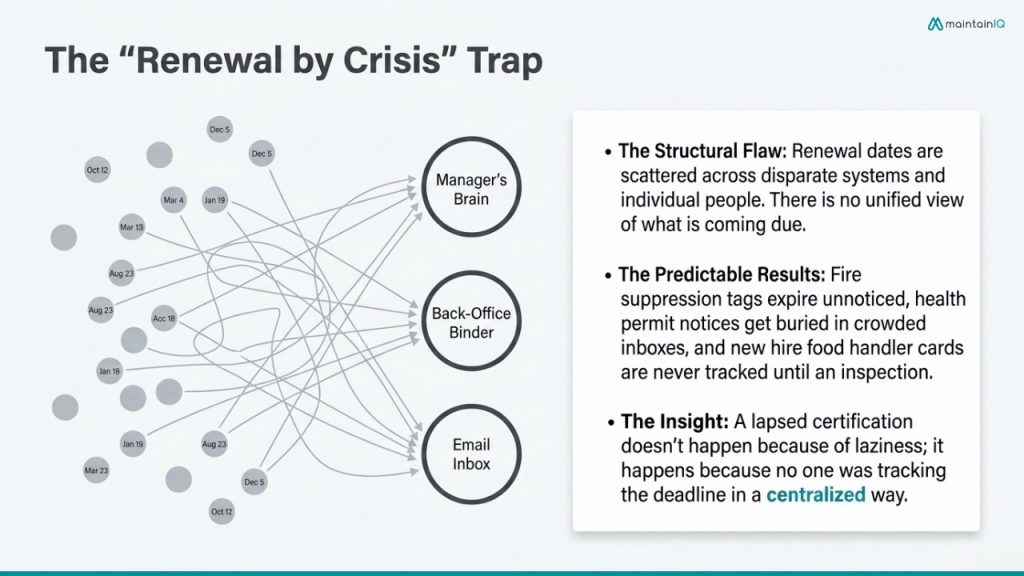
This happens for a structural reason: renewal dates are scattered. The business license renews on one date, the health permit on another, the liquor license on another, each food handler card on its own employee-specific date, fire suppression service on its own schedule, and insurance policies on theirs. No single person holds all these dates in their head, and when they live in separate files, emails, and folders, there’s no unified view of what’s coming due.
The result is renewal-by-crisis. The fire suppression system’s service tag expired months ago, and nobody caught it until the fire marshal did. The health permit renewal notice got buried in the email. A new hire’s food handler card was never tracked, and it surfaces during an inspection.
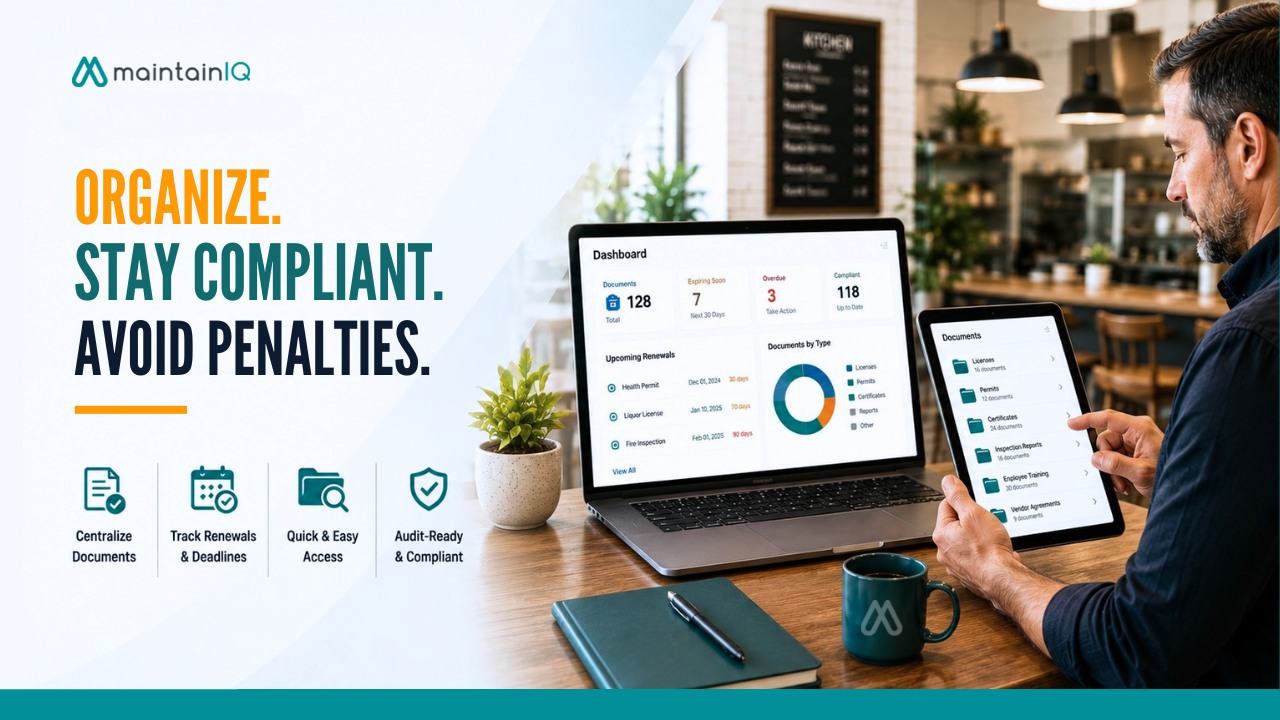
A proper document management system solves this by centralizing every document and its renewal date in one place, with automated reminders well before each deadline. Instead of relying on someone to remember dozens of scattered dates, the system tracks them and alerts the responsible person in advance — turning renewal from a recurring crisis into a routine task.
Why Paper and Email Fail at Document Management
Most restaurants manage documents the way they always have: a binder or filing cabinet for the physical licenses, an email folder for the digital ones, and a manager’s memory for the renewal dates. This works until it doesn’t — and the failure modes are predictable.
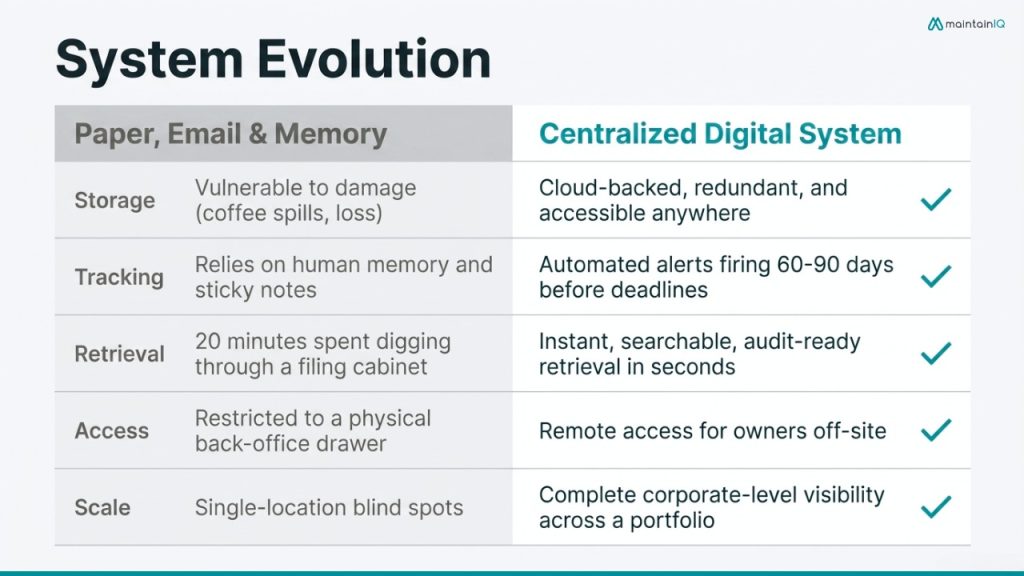
Documents get lost or damaged. A binder in a back office gets coffee-stained, misplaced, or thrown out. The single physical copy of a permit disappears, and replacing it means a trip to a government office and a delay.
Renewals lapse. With no centralized tracking and no automated reminders, deadlines slip. The cost of a single lapsed liquor license or health permit dwarfs the cost of any document system.
Retrieval is slow. When a health inspector or insurance auditor requests records, finding them in a filing cabinet or email archive means time spent searching instead of running the restaurant.
There’s no multi-location view. For operators running several restaurants, paper and email make it impossible to see document status across locations. Is every location’s health permit current? Are all food handler cards up to date at every site? Without centralization, the only way to know is to check each location individually.
Access is restricted to one place. A paper file is only accessible where it physically sits. so when the owner is off-site and the document is in a drawer, nobody can access it remotely.
Building a Document Management System That Works
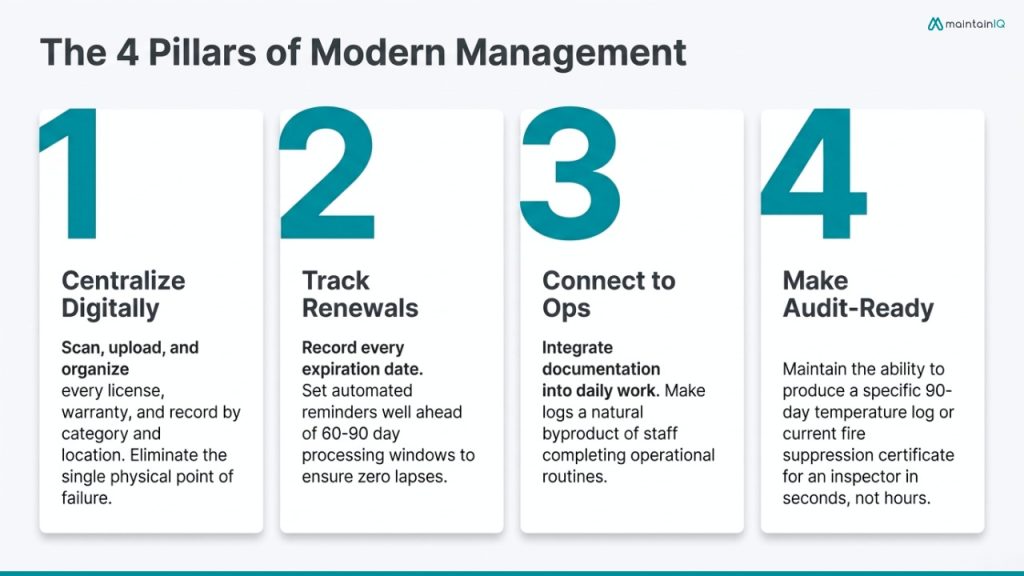
An effective restaurant document management system does four things: centralizes storage, tracks renewals, controls access, and produces records on demand.
Centralize Every Document Digitally
Every license, permit, certification, contract, warranty, and compliance record should be stored in one digital system — scanned, uploaded, and organized by category and location. This eliminates the lost-document problem and means there’s always a backup of every critical record. Digital document management keeps everything in one place, accessible from anywhere, with no single physical copy to lose.
Track Renewals With Automated Reminders
Every document with an expiration date should have that date recorded in the system, with automated reminders that fire well before the deadline — far enough ahead to allow for processing time, which for some licenses can be 60–90 days. This is the single highest-value function of document management: ensuring nothing lapses.
Connect Documents to Operations
Document management is most powerful when it’s connected to the operations that generate compliance records. A food safety program that uses digital checklists and temperature monitoring generates compliance documentation automatically — every completed check, every temperature reading, every corrective action becomes a time-stamped record. Instead of maintaining temperature logs as a separate documentation task, the logs are a byproduct of doing the monitoring digitally.
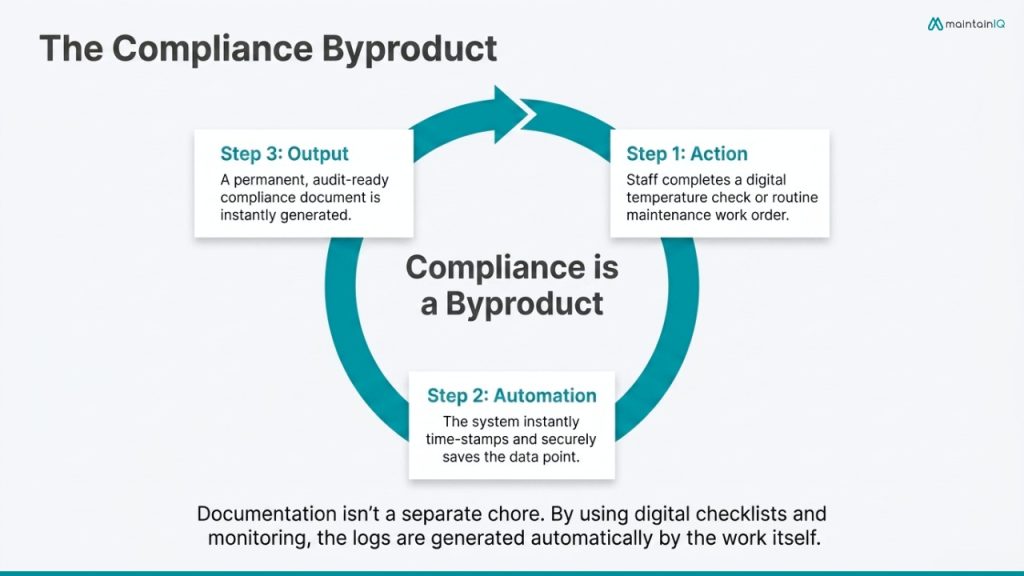
Similarly, equipment maintenance and work order systems automatically build service history and warranty documentation as maintenance gets performed. The documentation isn’t a separate chore — it’s generated by the work itself.
Make Records Audit-Ready
When a health inspector, fire marshal, or insurance auditor asks for documentation, you should be able to produce it in seconds, not hours. A digital system with organized, searchable, time-stamped records means the answer to “show me your last 90 days of temperature logs” or “produce your current fire suppression service certificate” is immediate — not a scramble through filing cabinets.
Multi-Location Document Management
For operators running multiple restaurants, document management complexity multiplies. Each location has its own business license, health permit, certificate of occupancy, fire certificates, and employee certifications — and each renews on its own schedule.
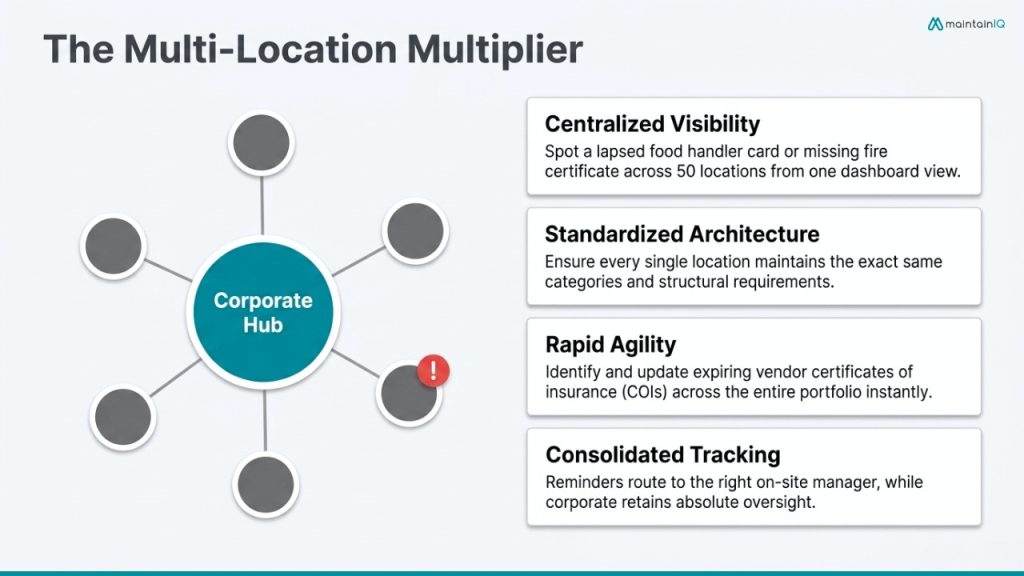
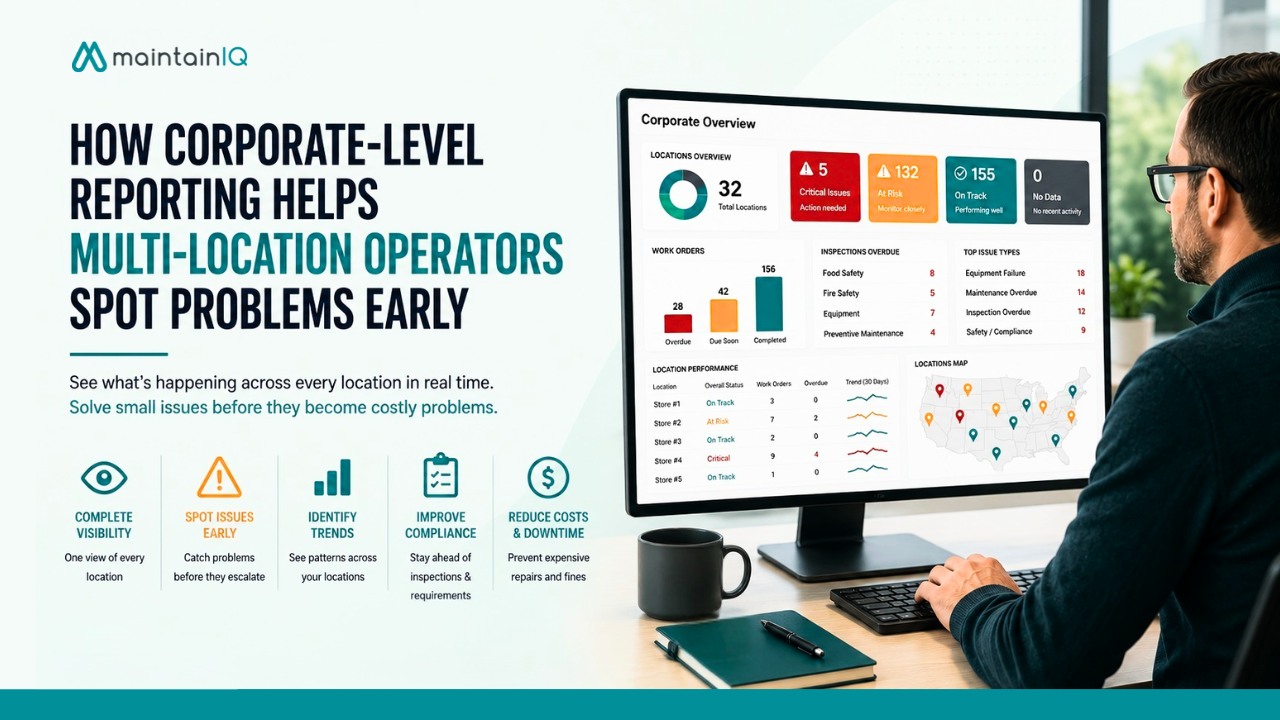
Centralized visibility across all locations. Corporate-level reporting lets you see document and compliance status across every restaurant from one view. Which locations have permits coming due? Which have lapsed food handler cards? Which are missing a current fire inspection certificate? This visibility is impossible with paper or location-specific files.
Standardized document requirements. Every location should maintain the same categories of documents, organized the same way. Standardization makes it possible to verify completeness across the portfolio — and to identify quickly when a location is missing something it should have.
Consolidated renewal tracking. Instead of each location tracking its own renewals independently (and inconsistently), a centralized system tracks every renewal date across every location, with reminders routed to the right person at each site and visibility for corporate oversight.
Faster response to issues. When a new regulation requires a document update, or a vendor’s certificate of insurance expires, you can identify every affected location immediately and address it across the portfolio — rather than discovering the gap one location at a time.
Getting Started
Start by inventorying every document your restaurant must maintain — every license, permit, certification, contract, and recurring compliance record — along with its renewal or expiration date. This inventory alone often surfaces documents that are closer to expiration than anyone realized.
Then centralize everything digitally. Scan and upload physical documents, organize them by category, and record every renewal date with automated reminders. Connect your operational systems — checklists, temperature monitoring, maintenance — so compliance records generate automatically. And for multi-location operators, build corporate-level visibility so document status across every restaurant is always in view.
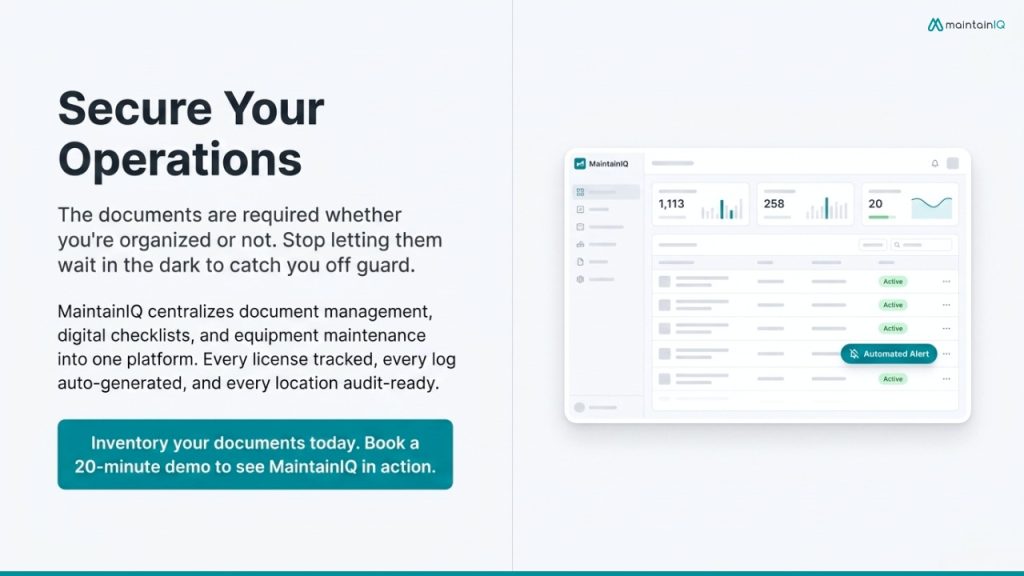
MaintainIQ brings document management, digital checklists, temperature monitoring, equipment maintenance, and corporate reporting into one platform — so every license is tracked, every compliance record is generated and stored automatically, and every document is audit-ready across every location.
Book a 20-minute demo to see how it works for restaurant document management.
Conclusion
The documents that keep a restaurant legal and compliant are easy to ignore — right up until the moment one of them is missing, expired, or impossible to find. A lapsed permit, an expired certification, or a stack of temperature logs that can’t be located turns a routine inspection or renewal into a crisis that costs money, time, and sometimes the ability to operate.
Organized document management isn’t about being tidy. It’s about protecting the restaurant from entirely preventable failures — the lapsed renewals, the lost records, the documentation gaps that surface at the worst possible moment. When every license is tracked, every renewal is flagged in advance, and every compliance record is generated automatically and stored where you can find it, document management stops being a source of risk and becomes one less thing that can go wrong.
The documents are going to be required whether you’re organized or not. The only question is whether they’re working for you — or waiting to catch you off guard.