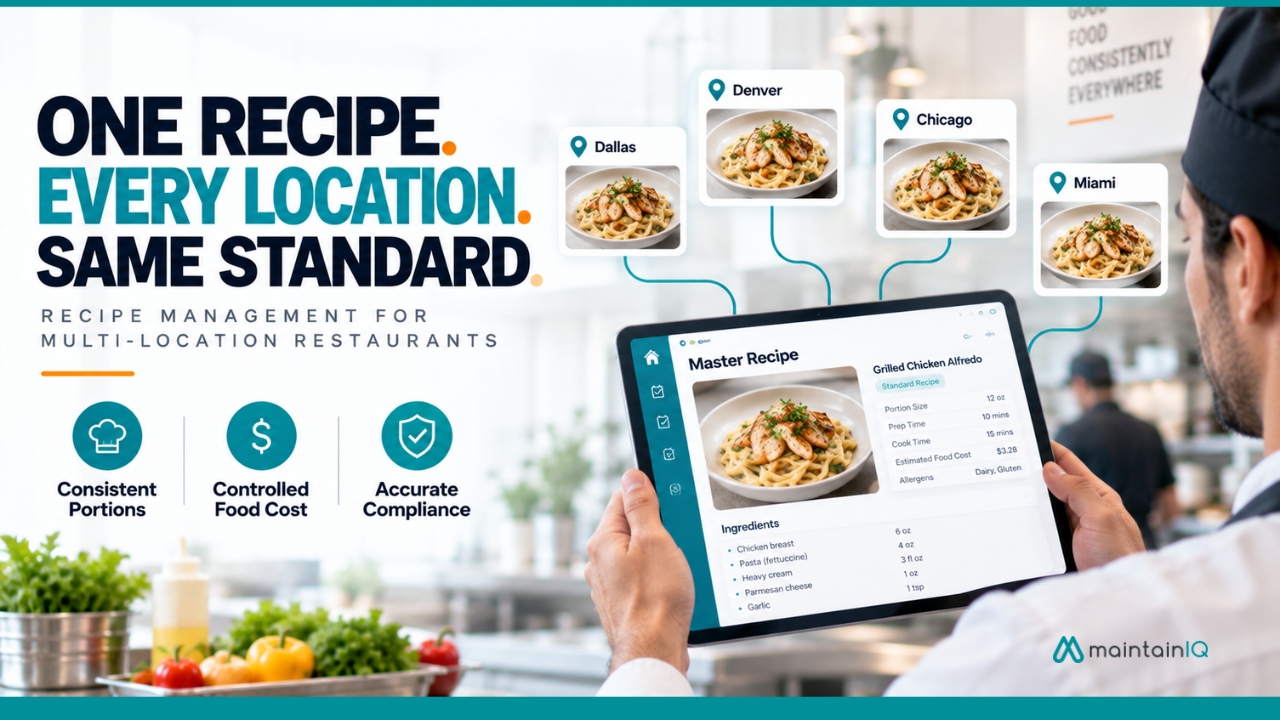
A regular orders their favorite dish at your Dallas location on Monday and the same dish in Denver on Friday, and gets two noticeably different plates — bigger here, saltier there, plated another way entirely. That small gap is the multi-location problem in miniature, and it’s more expensive than it looks.
When you ran one kitchen, consistency was a person: the chef standing over the line, catching the plate that wasn’t right. At twenty kitchens, that person can’t be everywhere, so consistency has to live in a system instead — and the foundation of that system is the recipe. When the recipe is a laminated binder in one location, a shared doc in another, and muscle memory in a third, three things quietly break at once: your brand, your food cost, and your compliance.
Here’s how recipe management holds all three together as you scale, and what a system built for multiple locations actually needs to do.
Table of Contents
The real enemy is drift
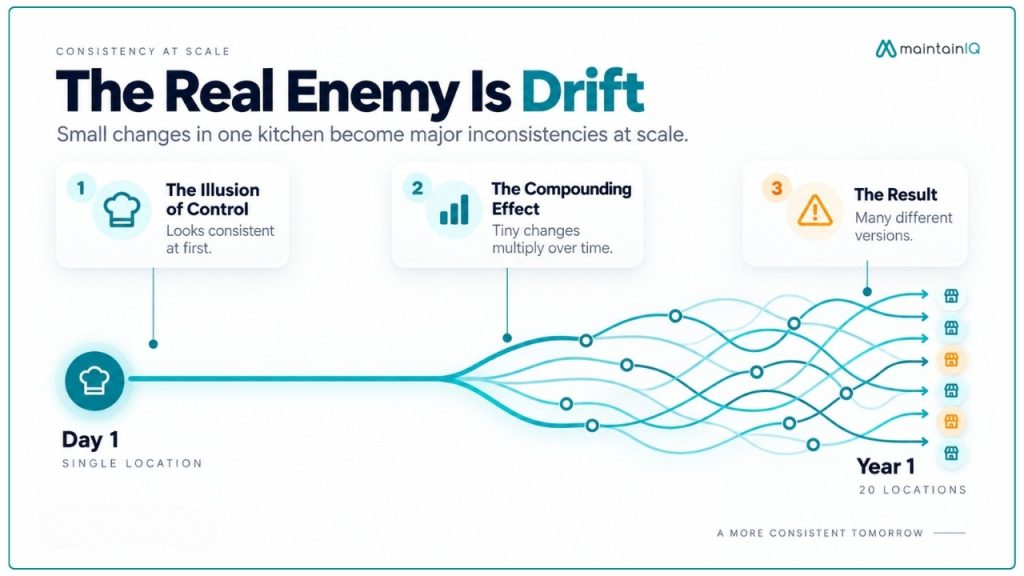
The biggest threat to consistency in a multi-unit operation isn’t one bad cook — it’s drift: small, untracked changes in process and preparation that accumulate over time. One location swaps a supplier. A cook starts adding “a little extra” of something. A recipe gets tweaked in one kitchen and never updated in the others. None of these register as a problem on the day they happen. A year later, you have twenty kitchens making meaningfully different versions of the same dish and no record of how they got there.
A single restaurant absorbs drift because someone notices and pulls it back. A chain can’t — the drift compounds silently across sites until a guest, a franchisee, or an auditor points it out. This is exactly what a standardized recipe is built to prevent. It’s a control tool that locks in consistent quality, consistent quantity, and a reliable cost, regardless of who’s on the line. The processes worth standardizing are the ones that drive cost and guest experience: ingredient measurements, portion sizes, prep methods, cook times, plating, and holding procedures. Even small deviations in any of these move food cost and quality at every location.
Consistency is a brand promise, not a nicety
The entire value of a multi-location brand is the promise of sameness. A guest who loved a dish in one city expects to walk into your restaurant in another and get exactly what they remember. That predictability is what builds loyalty — and every off-spec plate quietly spends the brand equity you’ve worked to build.
A written, standardized recipe makes that promise keepable — it guarantees the guest gets the same product whether the executive chef or a brand-new line cook prepared it. Without it, quality depends on who’s working that shift, not a foundation you can scale a brand on.
The largest chains lean on central kitchens to protect this — producing signature sauces, stocks, and rubs in one place and shipping them out, which strips variability out of the most flavor-critical items. That works, but it’s a heavy investment most growing multi-unit operators don’t have. Recipe management software is how those operators get the same discipline without a commissary: the standard is enforced through a shared, controlled recipe rather than centralized production, so every kitchen starts from the same specification even when it’s making the dish from scratch.
Recipes are where food cost is actually controlled — or lost
Every restaurant tracks its food cost percentage. Far fewer track the number that actually explains it: the gap between theoretical food cost (what your recipes say a period of sales should have cost) and actual food cost (what your inventory and purchases show you really spent). That gap — the variance — is the cleanest measure of how tightly a kitchen executes its own standards. Well-run operations keep it under about 2%; anything above 5% usually signals a systemic problem like over-portioning, waste, or recipe data that no longer reflects reality.
The dollars add up fast. On $1 million in annual sales, a 4% food cost variance is $40,000 in lost profit — money gone without a single additional sale, and without anything looking obviously wrong. That’s the insidious part: over-portioning is nearly invisible. A 6-ounce spec that drifts to 7 ounces is a 17% overage on that ingredient, and nobody catches it because the plate still looks right. Multiply a few of those across a full menu and every location, and the leak is enormous.
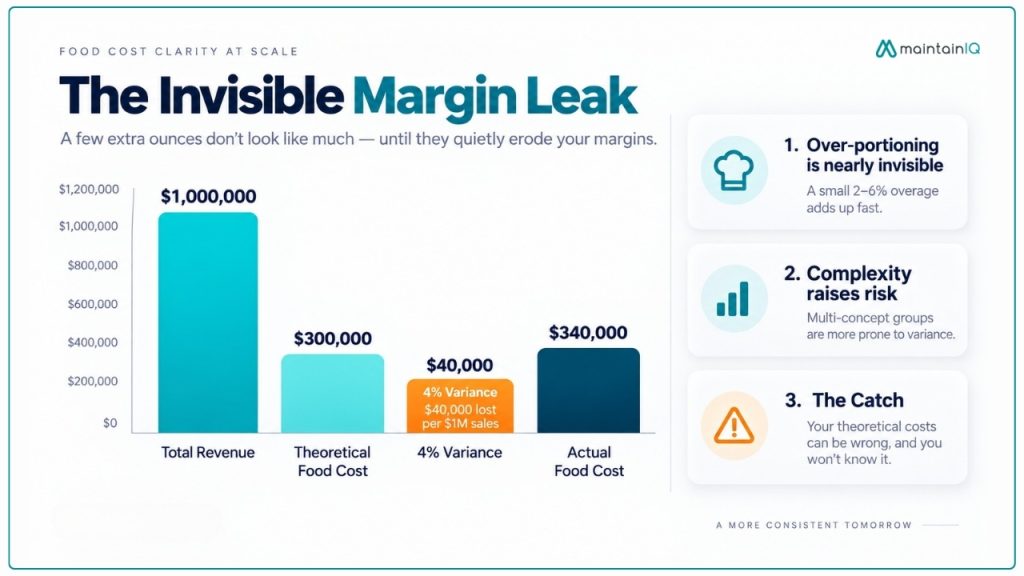
The tolerances tighten as complexity grows. Quick-service concepts, with limited menus and high volume, typically run 1.5–3% variance; fast casual sits around 2–4%; full service, with larger menus and more prep, runs 3–5%. Multi-concept groups operating without strong controls can drift to 2–6% — complexity raises the risk exponentially, which is precisely why the operators who hold it down rely on systems rather than vigilance. Recipe management is the first of those systems, because it sets the theoretical baseline everything else is measured against.
Here’s the catch: your theoretical cost is only as accurate as your recipe data. If ingredient prices or yields have changed since the recipe was last updated, your benchmark is wrong, and your variance number is fiction. Recipes in binders and personal docs don’t get updated — which is why complexity creates variance, but systems eliminate it. A recipe library that’s costed, current, and identical across sites is the difference between knowing where your margin goes and guessing.
At 20+ locations, recipe accuracy becomes a legal matter
Cross 20 locations and recipe accuracy stops being only a quality-and-cost issue and becomes a compliance one. Under the FDA’s menu labeling rule, chains with 20 or more locations operating under the same name and offering substantially the same menu must post calorie information on menus and menu boards, with full nutrition details available on request. Those calorie counts are derived from your recipes. If a location’s recipe has drifted from spec, the number you’ve printed for the public is wrong — and it’s now a regulatory exposure, not just an inconsistency.
Allergens raise the stakes further. Federal law recognizes nine major allergens — milk, eggs, fish, crustacean shellfish, tree nuts, peanuts, wheat, soybeans, and sesame, the last added by the FASTER Act effective January 2023 — and the current Food Code requires foodservice operations to give accurate allergen information for the unpackaged food they serve. Roughly 33 million Americans have food allergies, so an undocumented ingredient swap at one location isn’t just off-brand; it can be a mislabeled allergen with real consequences. This is where recipe accuracy connects directly to food safety.
And the requirements are expanding. California’s Allergen Disclosure for Dining Experiences Act — the first state law of its kind — requires chains with 20 or more locations to provide written notification of the major allergens in each menu item, on the menu or via QR code, with compliance due by July 1, 2026. Industry guidance in response is consistent: build a single central system that stores recipes, ingredients, supplier data, and allergens in one place, so an update pushes out everywhere at once instead of being re-entered menu by menu. That single source of truth is a recipe management system.
The same accuracy protects you internally. Franchised brands audit their locations against recipe and brand standards, and a franchisee cooking off-spec is both a quality problem and a franchise-agreement one. Whether the audit comes from a regulator, a franchisor, or your own QA team, a documented, current recipe is the evidence that a location is doing what it’s supposed to — and the fastest way to correct it when it isn’t.
Your recipes are also your best training tool
Training is the hardest part of multi-unit consistency. Teaching complex dishes across many locations multiplies the chances that staff interpret steps differently — and restaurants run on high turnover, so you’re training constantly.
Standardized recipes flip that from a liability into an asset: new employees get specific, identical instructions, onboarding time drops, and training cost falls because everyone learns one process that applies everywhere.
It also removes key-person risk. When the recipe lives in a veteran cook’s head, the standard walks out the door the day they leave. When it lives in a system that’s accessible at the line and tied to day-to-day execution, the standard stays put no matter who’s on shift — which is the whole point of running a repeatable operation.
Where multi-location recipes break down
Most operators don’t decide to run inconsistent kitchens — the inconsistency creeps in through a handful of predictable gaps. If any of these sound familiar, drift is already costing you:
- Different formats in different kitchens. A binder here, a spreadsheet there, laminated cards at a third — with no way to know which version is current or correct.
- Updates that reach some sites, not all. A recipe changes at headquarters or a flagship, but the update never fully propagates, so half your locations are cooking last quarter’s spec.
- Undocumented substitutions. A location swaps an ingredient for availability or preference, and nothing records it — quietly changing taste, cost, and allergen profile.
- Recipes that were never costed. Without current ingredient prices and yields, there’s no reliable theoretical cost, so variance analysis is guesswork.
- Standards that live in people. The recipe is really “how the lead cook does it,” so quality and cost swing whenever staffing changes.
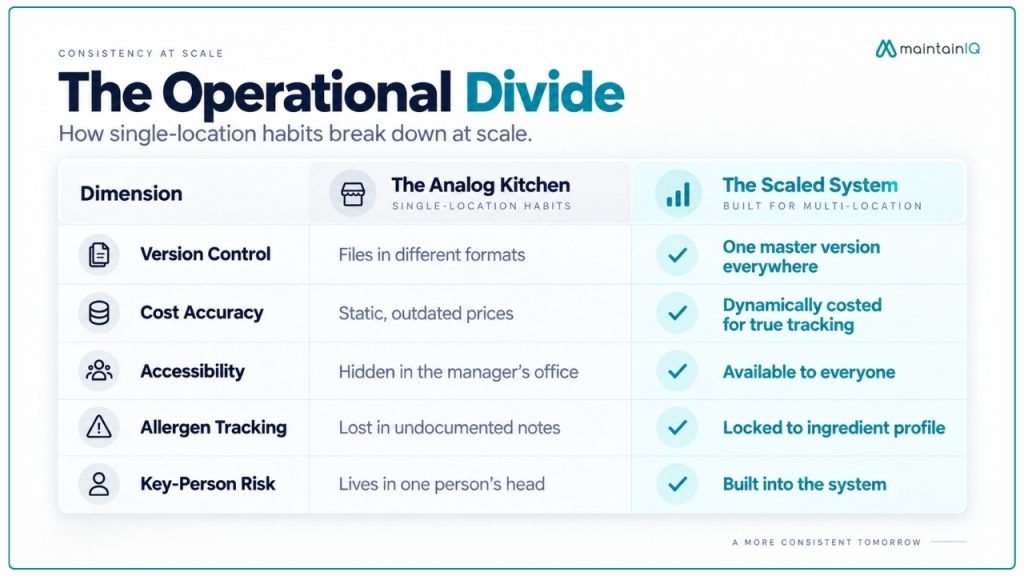
Every one of these is a symptom of the same missing piece: a single, current, shared source of truth for what each dish is supposed to be.
What recipe management at scale actually requires
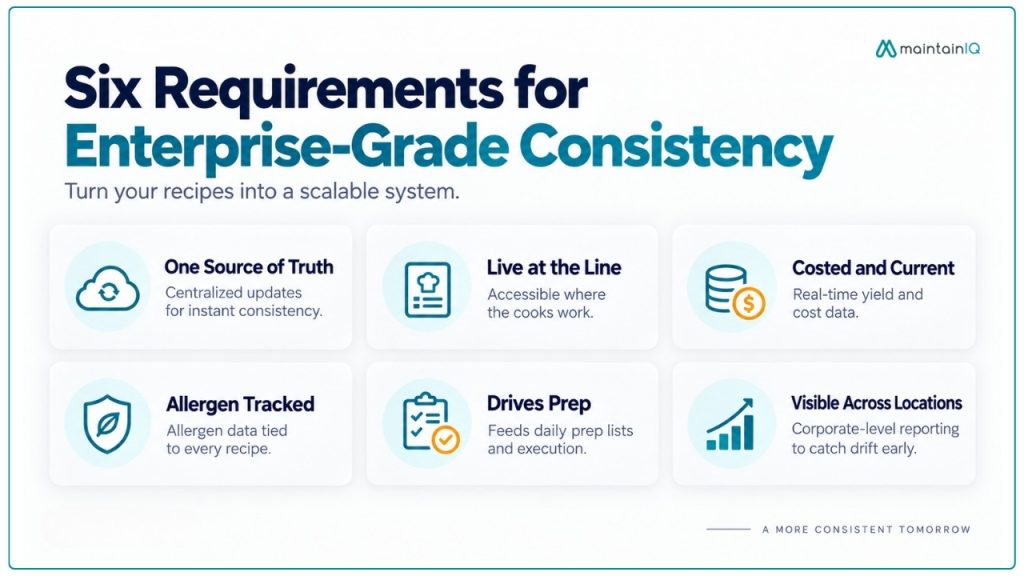
A recipe binder isn’t recipe management. A system that genuinely holds consistency across locations needs to do six things:
- Be one source of truth. Every recipe in one place, in one current version, updated centrally and reflected everywhere — never a different edit per kitchen.
- Live at the line. Cooks need the current recipe where they actually work, not in a binder in the manager’s office that nobody opens mid-shift.
- Stay costed and current. Ingredient costs and yields kept up to date so your theoretical food cost — and therefore your variance analysis — reflects reality.
- Carry allergen and nutrition data. Each recipe should hold its own allergen and nutrition profile, so menu labeling and allergen disclosures stay accurate when a recipe changes.
- Drive prep and execution. Recipes should feed your prep lists and your line-check checklists, so the standard is enforced in daily work rather than sitting in a document.
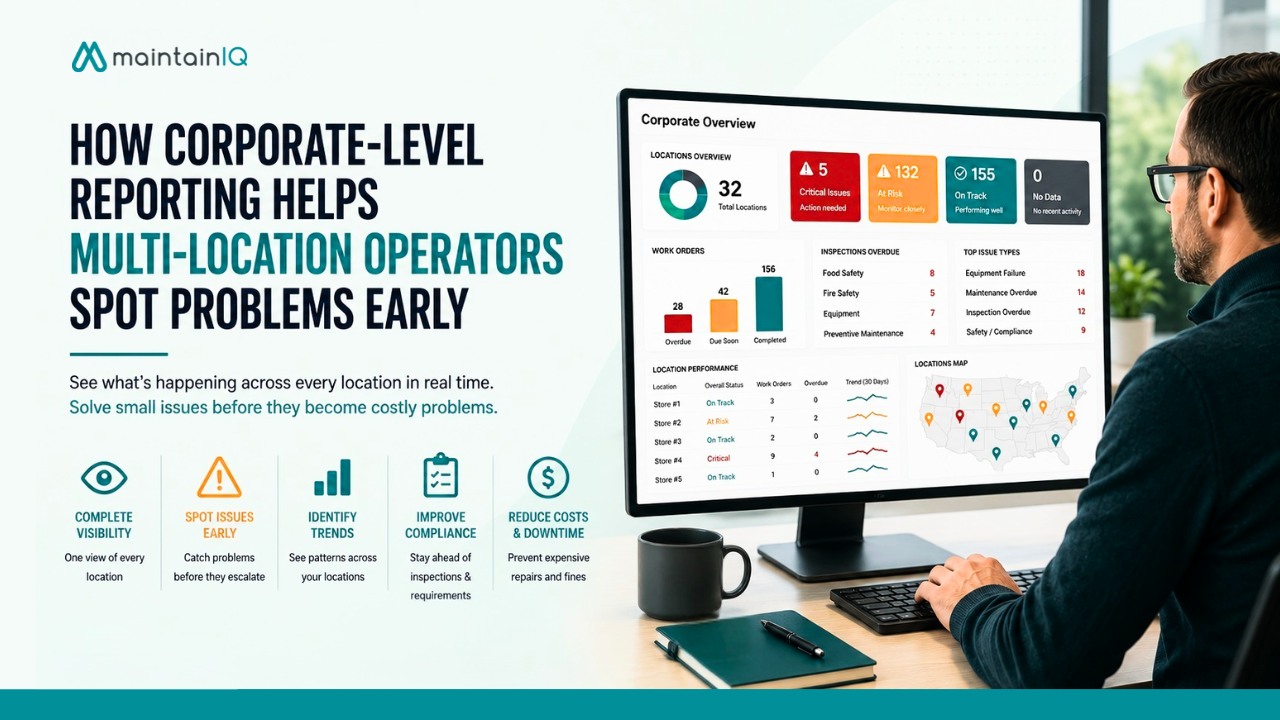
- Be visible across locations. Leadership needs to see which sites are on-spec through corporate-level reporting, so drift is caught in weeks, not at year-end.
Managing recipes at scale with MaintainIQ
This is what MaintainIQ’s recipe management software is built for. Instead of binders and one-off docs that drift apart location by location, MaintainIQ gives you a single recipe library that’s standardized, kept current, and accessible to every kitchen. With it, you can:
- Maintain one master version of each recipe and apply updates across every location at once
- Put current, spec-accurate recipes in front of cooks at the line, not in an office binder
- Feed those recipes straight into prep lists and daily checklists so the standard is enforced in the work itself
- Keep portion, allergen, and nutrition details attached to each recipe for consistency and compliance
- See on-spec execution across the group through corporate-level reporting, so drift is caught early
Because recipes live in the same platform as your prep lists, checklists, food safety logs, and reporting, they’re not one more disconnected tool — they’re the standard the rest of your operation runs on. The payoff is the thing every multi-location brand is really selling: the same plate, at the same cost, with the same accurate information, in every location you operate.
If your recipes are scattered across binders, spreadsheets, and a few people’s memories, it’s worth seeing what a single source of truth looks like. Book a 20-minute demo, and we’ll walk through how recipe management would work across your locations.
Frequently asked questions
How does recipe management improve consistency across locations?
It replaces per-kitchen binders and docs with one standardized recipe library. Every location works from the same current version, with the same portions and methods, so a dish comes out the same regardless of who prepares it or where — which is the core brand promise of a multi-location operation.
Can recipes be updated in one place and applied to all locations?
Yes. In MaintainIQ, you maintain a master version of each recipe and update it centrally, so a change — a new spec, a price update, an ingredient swap — is reflected everywhere at once instead of being re-entered kitchen by kitchen.
Can recipe management help with allergen and nutrition information?
Yes. Keeping allergen and nutrition data attached to each recipe means that when a recipe changes, the associated information stays accurate — which matters for the calorie and allergen disclosures chains with 20 or more locations are increasingly required to provide.