Save Money Every Year With Simple Cleaning of Your Condenser Coils
How to clean refrigerator and freezer condenser coils in 8 simple steps, and why doing it every 2 months saves money on energy and helps prevent breakdowns.
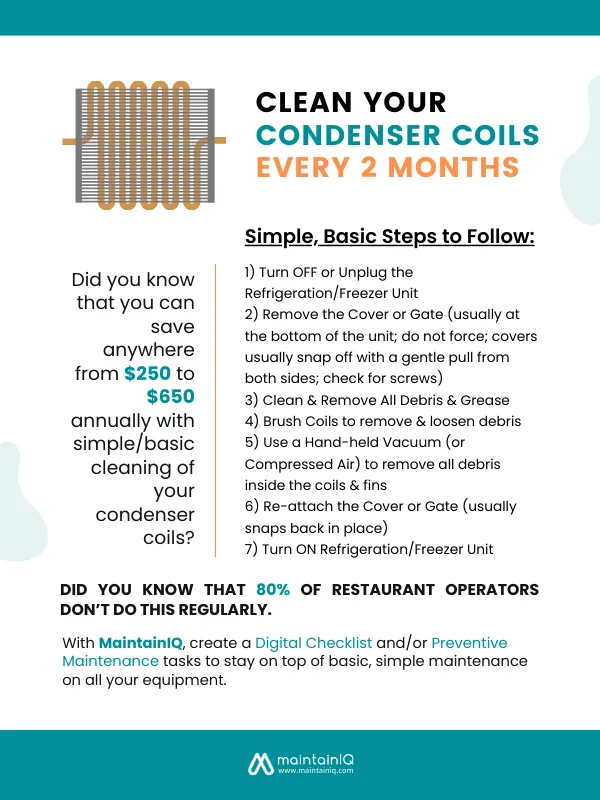
Download the free PDF
PDF · 1 page · 51 KB · No email required
Key takeaways
- Clean the condenser coils on every refrigerator and freezer at least every 2 months to keep each unit running efficiently.
- Turn off or unplug the unit before you remove the cover, and never force a cover that seems stuck, because it may be held by screws.
- Brush the coils to loosen dirt, then use a hand-held vacuum or compressed air to clear debris from between the coils and fins.
On this page
Cleaning the condenser coils on your refrigerators and freezers at least every 2 months is one of the cheapest ways to cut your energy bill. Dust and grease on the coils trap heat, so the compressor runs longer to keep the unit cold. That uses more electricity and wears out parts sooner. The job takes a few minutes per unit with a brush and a vacuum.
How to clean condenser coils in 8 steps
- Clean the condenser coils at least every 2 months.
- Turn off or unplug the refrigerator or freezer unit.
- Remove the cover or grille (usually at the bottom of the unit). Do not force it: covers usually snap off with a gentle pull from both sides, but check for screws.
- Clean and remove all debris and grease.
- Brush the coils to loosen and remove debris.
- Use a hand-held vacuum (or compressed air) to remove all debris from inside the coils and fins.
- Re-attach the cover or grille (it usually snaps back in place).
- Turn the refrigerator or freezer unit back on.
Not sure where the coils are on your equipment? Our guide to identifying and cleaning condenser coils shows the common locations and what to look for.
Why it is easy to skip, and why it matters
Many restaurant operators don’t clean their coils regularly, because the coils are out of sight and the unit keeps working until the day it doesn’t. Adding the task to your walk-in cooler maintenance checklist and your commercial refrigerator maintenance checklist keeps it from being forgotten. Regular upkeep like this is one of the simplest ways to lower your restaurant’s energy bills.
If the coils are damaged, or you notice oil or refrigerant leaks, stop and call a certified technician: refrigerant handling is covered by the EPA’s Section 608 rules. And when an old unit needs replacing, ENERGY STAR lists more efficient commercial refrigerators and freezers.
With MaintainIQ, you can add coil cleaning to a digital checklist or set it up as a preventive maintenance task with a service frequency for each unit, so you can see when it was last done and when it is due next.
Frequently asked questions
How often should you clean refrigerator condenser coils?
Clean the condenser coils on every refrigerator and freezer at least every 2 months.
Why does cleaning condenser coils save money?
Dust and grease on the coils trap heat, so the compressor runs longer to keep the unit cold. That uses more electricity and wears out parts sooner.
What do you need to clean condenser coils?
A brush and a hand-held vacuum or compressed air. Turn off or unplug the unit, take off the cover without forcing it, brush the coils to loosen dirt, then clear the debris from between the coils and fins.
When should you call a technician about condenser coils?
Stop and call a certified technician if the coils are damaged or you notice oil or refrigerant leaks. Refrigerant handling is covered by the EPA's Section 608 rules.