We build MaintainIQ. Weigh what follows accordingly.
Most pages ranking for this search are written by software companies who want the same thing we do, which is for you to buy their product instead. We are no different in motive. Where we have tried to be different is in method. Every price below is either taken from the vendor’s own live pricing page or marked as not published. Every ownership change is dated and sourced. And there is a section near the top listing the things MaintainIQ does not do at all.
If one of these platforms fits your business better than ours, finding that out now saves us both a sales cycle.
All facts verified September 2026.
Table of Contents
Read this first, because four of these companies changed
If you are comparing this software using an article written before 2026, and almost everything ranking today was, you are reading about companies that no longer exist under those names.
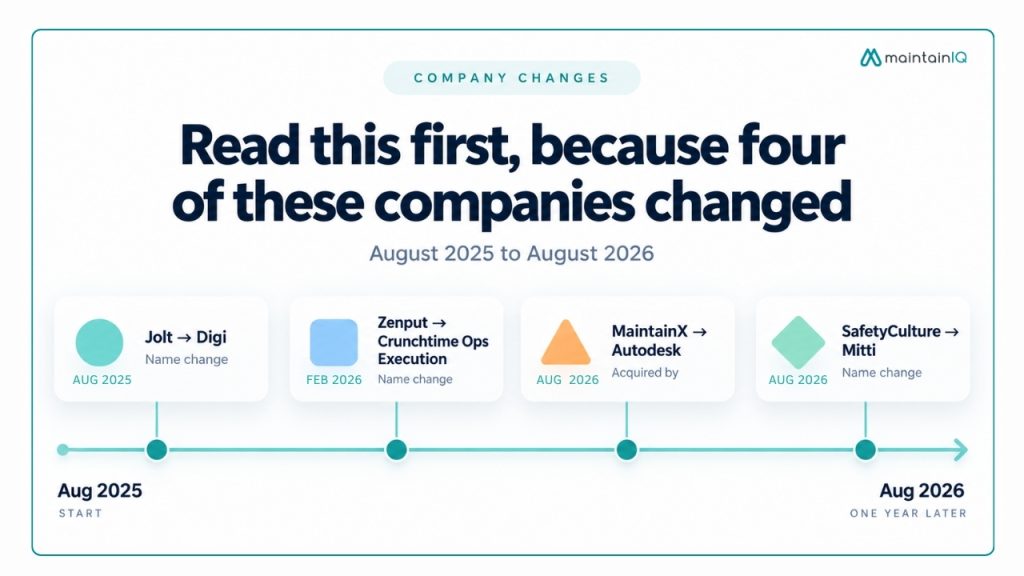
Jolt was acquired by Digi International in August 2025 for roughly $145.5 million and folded into Digi’s SmartSense business. The old jolt.com pricing page now redirects to a SmartSense quote request form.
Zenput became Crunchtime Ops Execution in February 2026. Crunchtime bought Zenput back in 2022 and has now retired the name. You will still see Zenput in older case studies on Crunchtime’s own website, which is legacy content rather than a live product.
Autodesk completed its acquisition of MaintainX on 3 August 2026. G2 now lists the seller as MaintainX, an Autodesk company. Autodesk has not published any plans for the product or its pricing.
SafetyCulture rebranded to Mitti in August 2026. The product is now styled Mitti by SafetyCulture, and safetyculture.com redirects to mitti.com. The older iAuditor name is two rebrands out of date.
None of this makes any of those products worse. An acquisition can mean more engineering resource, not less. It does change who you are signing a contract with, who picks up the phone when something breaks, and what the roadmap looks like in eighteen months. Ask each of them about it directly.
What MaintainIQ does not do
This is at the top rather than buried, because it will disqualify us faster than any feature list will qualify us.
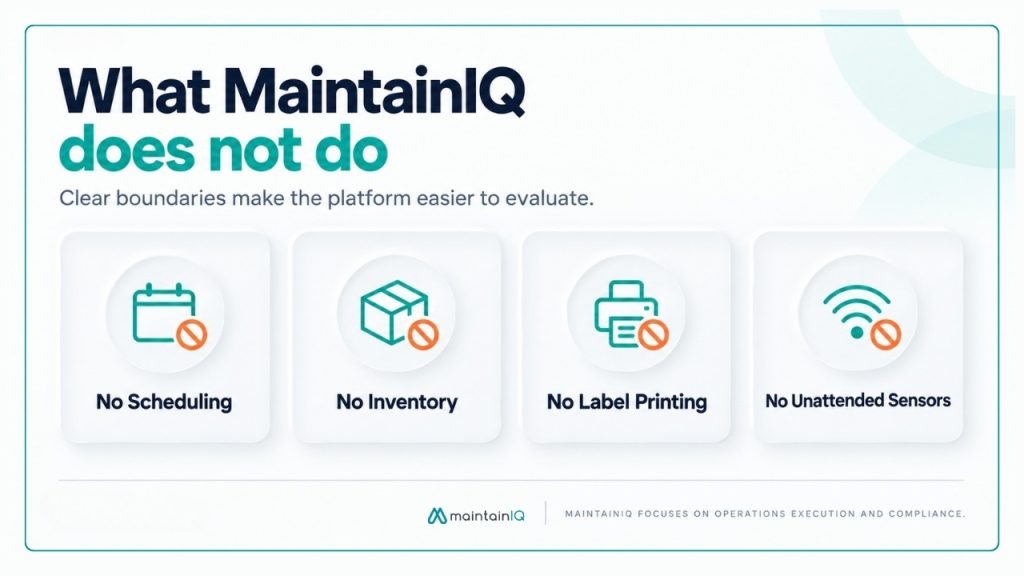
We are not a scheduling or payroll system. No shift scheduling, no time clock, no labor forecasting. We say so on our own workforce page. If you want checklists and scheduling from one vendor, Jolt and Crunchtime both do that and we do not.
We do not do inventory or food cost. No stock counts, no theoretical versus actual variance. Crunchtime is built around exactly this. We are not.
We do not print date code labels. No label printers, no shelf life label hardware. Jolt, now SmartSense, sells a printer line and is genuinely good at it. If prep labeling is a high-volume daily job in your kitchen, that is a real reason to look elsewhere or to run two systems.
We do not sell wireless sensors that monitor unattended. We integrate Bluetooth handheld probes. That means a person takes a reading with a probe that records digitally instead of on paper. It is not a sensor sitting in your walk in reporting every fifteen minutes overnight. Xenia and SmartSense both sell that continuous coverage. If overnight cooler monitoring is the requirement, buy it from someone who sells it.
Our third-party review footprint is thin. As of publication we have no G2 profile and very few reviews on the major software directories, while Jolt has over 300 on Capterra and MaintainX has over 1,500 on G2. We are working on it. In the meantime, do not take our word for our own reliability. Ask us for references and call them.
Who MaintainIQ is built for
Food service and hospitality operators who need the same daily work done the same way, and need to be able to prove it was done. That applies whether you run one location or two hundred, though the value compounds as sites are added.
We fit best when:
- Your problem is getting the work done and having a record of it. Temperature logs, opening and closing checklists, line checks, prep lists, cleaning tasks, inspections, and the repair tickets that come out of them.
- You have far more staff than managers, and per-user pricing is punishing you for it.
- A health inspector, a franchisor, or your own corporate team needs to see a clean record on demand.
- Your teams work in English, Spanish, or both.
We publish our pricing. It is $79 per location per month, or $799 per location per year, with unlimited users on both. The annual plan carries a 90-day money-back guarantee. A one-time setup fee applies. Support is based in the United States.
We have dedicated support for eight industries, which are restaurants, hotels and resorts, grocery stores, convenience stores, senior living facilities, schools, theme parks, and trampoline parks.
The alternatives, by what you actually need
If you operate across genuinely unrelated industries, look at Xenia
Xenia is the closest direct competitor to what we do and the name that comes up against us most often.
Where Xenia is stronger. Their industry range is wider than ours. They market to manufacturing and general facilities alongside food service and retail, and if you run warehouses and restaurants under one roof, that breadth is real. They sell wireless sensors for continuous freezer and cooler monitoring, which covers unattended logging that we do not. They hold a SOC 2 Type I certification and we have no published security certification, so if your procurement process requires one, that decides it before anything else does. They raised a $12 million Series A led by PSG in November 2025, so they are well funded. And they publish named customer results, including Dave’s Hot Chicken at 321 locations.
Where we would argue we are stronger. Xenia does not publish prices. Their pricing page lists Basic, Pro, and Enterprise, each marked custom per location, with no figure anywhere — you have to book a call to find out what it costs. That is a legitimate way to sell software, and a legitimate thing to weigh if you run six stores and do not want a procurement cycle just to get a number.
The other one is language. The most repeated complaint in Xenia’s Capterra reviews is language support, with several reviewers asking specifically for more languages for their teams. MaintainIQ ships in English and Spanish, with a full Mexican Spanish version of the site. In an industry where a large share of the people doing the work are more comfortable in Spanish, that is not a footnote.
Two claims in their comparison worth checking yourself. Xenia publishes an article titled Top 7 MaintainIQ Alternatives. Inside it is a table headed Comparing Xenia Directly to MaintainIQ. Two rows in that table are checkable and wrong.
The table lists MaintainIQ’s temperature monitoring as “Manual logging.” MaintainIQ integrates Bluetooth temperature probes, specifically the Cooper-Atkins and Copeland KwikSwitch BLE 94100-B, the Cooper-Atkins and Copeland Multi-Function Thermometer, and the Comark BT250KC. A reading taken on one of those probes is captured digitally, time-stamped, and attached to the log without anyone writing a number down. That is not manual logging. It is a fair criticism that we do not offer unattended wireless sensors, and we say so ourselves above. It is not accurate to describe probe capture as manual.
The table also lists MaintainIQ’s template library as “None.” More than sixty downloadable checklist templates are published on maintainiq.com, free and ungated, covering equipment maintenance, food safety, opening and closing routines, and inspections by industry. Count them yourself.
The same table lists our industry flexibility as “Restaurants Focused.” We publish eight industry pages, including senior living, schools, and grocery.
We are not going to pretend they said things they did not, either. Nothing on that page claims we lack probe integration by name. The table simply rates the capability as manual, which is the claim we are correcting.
Xenia pricing is not published and is quote-only. There is a 14-day free trial with no card required. Xenia is rated 5.0 out of 5 on G2 from 20 reviews and 4.9 out of 5 on Capterra from 23 reviews.
If date code labeling is central to your kitchen, look at Jolt, now SmartSense
Jolt built its reputation on prep labeling, and that reputation is deserved. The label printers, now sold as the SmartSense JPS 1000, JPS 2000, and JPS 1000 xl, are rated at up to six labels per second. If your kitchen produces hundreds of date-coded labels a shift, that hardware is the product, and we have no answer to it.
Jolt also bundles employee scheduling and time clocks, which we do not do at all, and SmartSense brings Digi’s wireless temperature monitoring.
The honest caution. The dominant theme across Jolt’s 313 Capterra reviews is reliability — app crashes, glitches, and slow mobile performance come up repeatedly. Reviewers also report difficulty getting a response from support, and frustration with annual contract terms. That is a large enough sample to take seriously. Ask hard questions about uptime and support response times, and ask directly what the Digi acquisition means for your contract and the Jolt platform’s roadmap.
Jolt pricing is not published and is quote-only through SmartSense. Capterra lists a starting figure of $89.99 per month, but that number does not appear on any vendor page and may predate the acquisition, so treat it as unverified. Jolt is rated 4.6 out of 5 on Capterra from 313 reviews.
If food safety logging is your whole requirement and budget is tight, look at FreshCheq
FreshCheq is the cheapest credible option in this category and is refreshingly clear about its scope. Temperature logs, cooling logs, checklists, food waste tracking, basic inventories, prep lists, and Bluetooth thermometer sync.
FreshCheq publishes its pricing at $60 per location per month or $629 per location per year, with no setup fee and no required hardware. It is a single tier, with no plan ladder to climb. Named customers include Buffalo Wild Wings and Moe’s Southwest Grill.
Where it stops. FreshCheq does not market work order or maintenance management, labor scheduling, or label printing. If your problem is genuinely only getting food safety logs off paper, it is $19 a month cheaper than us per location, and worth looking at seriously. The line between the two products is what happens next — if a failed reading needs to become a tracked repair, assigned to a person, with a photo attached and a record that it was fixed, that is the part FreshCheq does not cover.
FreshCheq is rated 4.5 out of 5 on Capterra from 78 reviews.
If you are a large chain that wants inventory and labor in the same suite, look at Crunchtime
Crunchtime is genuinely enterprise software. Their site claims 850 or more brands across 150,000 or more locations. Ops Execution, the product formerly called Zenput, sits inside a suite that also covers inventory management, labor and scheduling, kitchen management, and training.
If you run 400 units and want food cost, labor, and store execution under one contract on one data model, we are not the right vendor and Crunchtime probably is.
The trade-off. Reviewers describe per-user pricing as a barrier for smaller operators. The most common complaint is support responsiveness, with long waits and communication gaps after updates. One recurring request in Zenput era reviews was for unlimited locations. Under roughly fifty locations, you will likely find this heavier and more expensive than the problem warrants.
Crunchtime pricing is not published and is quote-only. Crunchtime Ops Execution is rated 4.6 out of 5 on G2 from 144 reviews.
If your problem is maintenance only, look at MaintainX, Limble, or UpKeep
If nobody in your business is logging a cooler temperature, and the actual job is assets, work orders, and maintenance schedules, you want a proper maintenance management system. These three lead that category and they are deeper on pure maintenance than we are, with parts inventory, purchase orders, meter based triggers, and detailed asset hierarchies.
MaintainX, now an Autodesk company, publishes a free tier, Essential at $20 per user per month and Premium at $65 per user per month on annual billing. Requester accounts are free, which matters, because it materially softens the per-seat cost for staff who only need to raise a ticket. Rated 4.8 out of 5 on G2 from 1,555 reviews.
Limble lists Standard at $28 per user per month and Premium+ at $69 per user per month on its cost guide page, though its main pricing page now shows a calculator with no figures on it. Licenses include implementation, training, and support at no extra cost, which is a genuine differentiator. Rated 4.8 out of 5 on G2 from 688 reviews.
UpKeep publishes Essential at $24 per user per month and Premium at $55 per user per month, with higher tiers quoted only. Implementation is billed separately starting at $500. Rated 4.5 out of 5 on G2 from 1,099 reviews.
Where this breaks down for food service. These are maintenance systems. None of them is built around a daily food safety log, a shift checklist completed by a crew member on a shared tablet, or a health inspection record. And the pricing model is the crux. A twenty-location operator with 300 hourly staff pays per seat for all three. Do that arithmetic against $79 per location with unlimited users before you decide. Do it honestly, though, including MaintainX’s free requester accounts, which change the answer for some operations.
If inspections and audits are your main workflow, look at Mitti, formerly SafetyCulture
Mitti is the biggest name in inspections, with a claimed 80,000 or more organizations using it. The template library and the inspection engine are excellent, and the free tier is genuinely usable rather than a demo.
Pricing is published. Free for up to 10 seats, Premium at $24 per seat per month billed annually or $29 billed monthly, and Enterprise on custom pricing with site-based pricing available at that tier.
Read the free tier carefully. It is capped at five active templates. For one site running a handful of forms, that is fine. If you run opening, closing, line check, cleaning, receiving, and equipment forms across several locations, you will hit that ceiling in the first week. The seat count is not the constraint. The template cap is.
The recurring themes in Mitti’s G2 reviews are learning curve, complexity, and cost for small teams. It is a powerful general-purpose inspection platform rather than something shaped around a restaurant’s day.
Rated 4.6 out of 5 on G2 from 483 reviews.
Three more worth knowing about
FoodDocs is HACCP first. It generates HACCP plans and handles traceability, batch tracking, recall data, and allergen tracking. Priced per site with unlimited users at $99 per month for Lite, $199 for Standard, and $299 for Professional, with a discount for annual billing. If a regulator or a customer requires a formal documented HACCP plan and you do not have one, this solves a problem we do not. Rated 4.9 out of 5 on Capterra from 28 reviews.
Bindy does audits for multi unit retail and hospitality on an unusual model, priced by inspections rather than users. Starter is $129 per month for 10 inspections and SMB is $499 per month for 70, both with unlimited users. Unused inspections expire at the end of each month. Predictable if your audit volume is steady, awkward if it spikes. Rated 4.9 out of 5 on Capterra from 15 reviews.
Zip Checklist is the budget floor at $29.99 per location per month. Shared checklists and task tracking, part of the HubWorks suite. Genuinely basic, and its website is dated enough that we would confirm the price is current before relying on it.
The alternatives at a glance
| Platform | Best for | Pricing model | Published price | Wireless sensors | Work orders | Scheduling | Labels |
| MaintainIQ | Food service and hospitality operators who need the work done and recorded | Per location, unlimited users | $79 monthly, $799 yearly | No, Bluetooth probes | Yes | No | No |
| Xenia | Operators spanning unrelated industries | Per location or per user | Not published | Yes | Yes | No | Add on |
| Jolt, now SmartSense | High volume date code labeling | Not disclosed | Not published | Yes | Yes | Yes | Yes |
| FreshCheq | Food safety logging only, tight budget | Per location | $60 monthly, $629 yearly | No | No | No | No |
| Crunchtime Ops Execution | Large chains wanting inventory and labor together | Per user, reported | Not published | Via partners | Yes | Yes | Yes |
| MaintainX | Maintenance depth | Per user, free requesters | $20 to $65 per user | Enterprise tier | Yes | No | No |
| Limble | Maintenance depth with onboarding included | Per user | $28 to $69 per user | Integrations | Yes | No | No |
| UpKeep | Maintenance depth | Per user plus credits | $24 to $55 per user | Integrations | Yes | No | No |
| Mitti, formerly SafetyCulture | Inspections and audits at scale | Per seat | Free to $29 per seat | Available | Follow ups | No | No |
| FoodDocs | Formal HACCP documentation | Per site, unlimited users | $99 to $299 monthly | No | No | No | No |
| Bindy | Multi-unit audit programs | Per inspection | $129 to $499 monthly | No | Follow ups | No | No |
How the pricing models actually differ
This matters more than the headline number, because the model decides what happens to your bill when you grow.
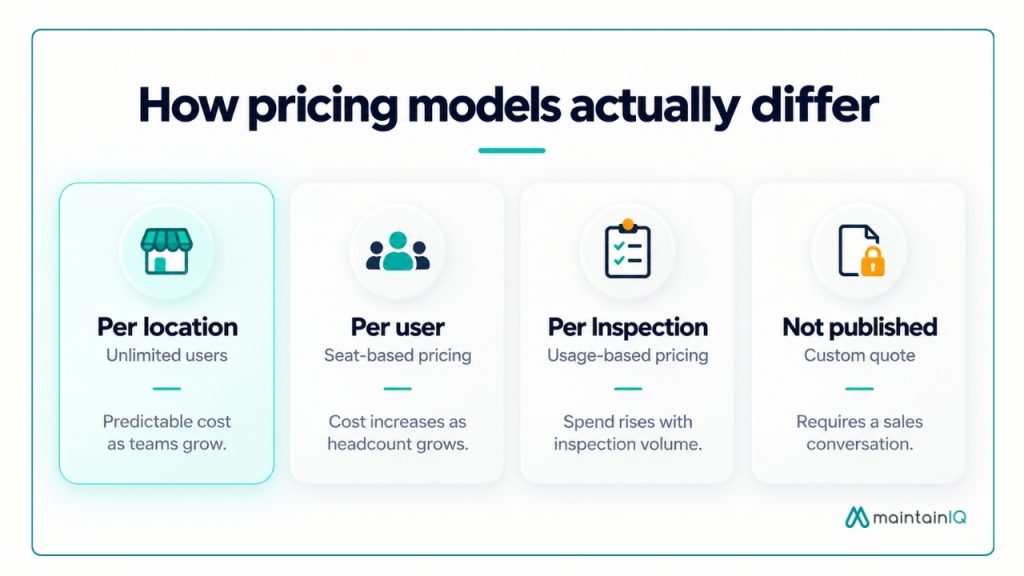
Per location with unlimited users. MaintainIQ, FreshCheq, FoodDocs, and Zip Checklist. Your cost tracks how many sites you have. Adding a crew member costs nothing. This suits businesses with a lot of hourly staff and normal turnover.
Per user or per seat. MaintainX, Limble, UpKeep, Mitti, and Crunchtime by reviewer report. Your cost tracks how many people log in. That is fine for a maintenance team of eight technicians. It gets expensive when the people doing the work are 300 hourly employees across twenty stores. Always check whether view-only or requester accounts are free, because MaintainX’s are and that changes the math.
Per inspection. Bindy. Cost tracks audit volume rather than headcount or number of sites.
Not published. Xenia, Jolt and SmartSense, and Crunchtime are all quote-only. This is not a criticism of the products. Enterprise software is sold this way for real reasons. It does mean you cannot compare total cost without booking calls, so ask early rather than late.
One note on our own transparency. We publish $79 and $799 on our pricing page. We also charge a one-time setup fee, and at the time of writing the amount is not on that page. That is a fair thing to hold against us, and we would rather say it here than have you discover it on a quote.
About those review scores
Every star rating in this article is real, and none of them are comparable to each other. Any article that lines them up in a column without saying so is misleading you.
Xenia’s 5.0 on G2 comes from 20 reviews. MaintainX’s 4.8 comes from 1,555. Those are not the same claim. A perfect score on a small base tells you a handful of happy customers wrote reviews. A 4.8 across fifteen hundred tells you the product survives contact with a very wide range of businesses.
Read the one-star and three-star reviews of anyone you are seriously considering, including ours if you can find them. The complaint patterns tell you far more than the average does.
Five questions to ask every vendor, including us
1. Does the pricing model match how my headcount behaves? If you have 300 hourly staff and the vendor charges per user, get the real number for all of them, not just for managers. Ask specifically whether view-only accounts are free.
2. What is the total first-year cost? Subscription plus setup or implementation plus hardware plus training. UpKeep bills implementation separately starting at $500. Limble includes it. We charge a setup fee. Ask for the all-in figure in writing.
3. What happens when a check fails? A temperature reading outside range should create something. A task, a repair ticket, an alert to someone senior. Not just a red mark on a report nobody opens. Ask them to demonstrate that whole loop, not the checklist on its own.
4. Will my whole team actually use it? Ask about languages, what happens when the walk-in has no signal, whether several people can share one tablet, and how long it takes to train a new hire. The best-designed platform in this category is worthless if the closing crew works around it.
5. Who owns this company, and what changed recently? Four of the vendors in this article changed name or owner in the last thirteen months. Ask what that means for your contract, your renewal price, your support team, and the roadmap.
Where MaintainIQ fits
We suit a food service or hospitality operator whose real problem is that the same work needs doing the same way every day, and someone needs to be able to prove it happened.
Cost is predictable. You know it before you talk to us, and it does not move when you hire. A failed check becomes a tracked repair rather than a note. Bluetooth probes make temperature logging fast and hard to fudge. English and Spanish are both properly supported. Eight industries have purpose-built support, so hotels, grocery, convenience stores, schools, and senior living are not restaurant features with the labels changed. Support is based in the United States, and the reason people tend to stay is that the interface is simple enough that a new hire picks it up without a training session.
We are the wrong fit if you need shift scheduling, inventory and food cost, high-volume date code labeling, unattended overnight sensor monitoring, industrial maintenance depth, or a vendor who can hand you a security certification today.
Making the decision
Shortlist two or three platforms and ask all of them the same five questions. What does this cost all in for year one, what happens when a check fails, will the closing crew actually use it, and who owns the company now?
If you run a food service or hospitality operation, need the daily work done and recorded, and want a price you can see before you talk to anyone, we would like to be on that shortlist. If what you actually need is scheduling, inventory, labels, or overnight sensors, one of the platforms above will serve you better, and we would rather you found that out here than four months into a contract.
Frequently asked questions
What is the best MaintainIQ alternative?
It depends entirely on what you are solving. For operators spanning genuinely unrelated industries, or who need wireless sensors monitoring unattended, Xenia is the closest comparable platform. For food safety logging alone on the tightest budget, FreshCheq at $60 per location per month. For large chains wanting inventory and labor in the same suite, Crunchtime Ops Execution. For pure maintenance with no food safety component, MaintainX or Limble. There is no single best alternative, and any article claiming there is one is selling it to you.
How much does MaintainIQ cost compared to the alternatives?
MaintainIQ is $79 per location per month or $799 per location per year, with unlimited users and a one-time setup fee. FreshCheq is cheaper at $60 per location per month with a narrower feature set. Zip Checklist is cheaper still at $29.99 and considerably more basic. FoodDocs starts at $99 per site per month. Per-user platforms, which are MaintainX at $20 to $65, Limble at $28 to $69, UpKeep at $24 to $55, and Mitti at $24 to $29, can work out cheaper or dramatically more expensive depending on how many people log in. Xenia, Jolt, SmartSense, and Crunchtime do not publish pricing.
Is MaintainIQ only for restaurants?
No. MaintainIQ has dedicated support for eight industries, which are restaurants, hotels and resorts, grocery stores, convenience stores, senior living facilities, schools, theme parks, and trampoline parks. Restaurants and convenience stores are where the company started and where the largest share of customers sit, but the others are supported products rather than adaptations.
Does MaintainIQ do temperature monitoring, or just manual logs?
MaintainIQ integrates Bluetooth temperature probes, including the Cooper-Atkins and Copeland KwikSwitch BLE 94100-B, the Cooper-Atkins and Copeland Multi-Function Thermometer, and the Comark BT250KC. Readings taken on those probes are captured digitally and time-stamped without anyone writing a number down. MaintainIQ does not sell wireless sensors that monitor coolers unattended overnight, which is a different capability. Xenia and SmartSense both offer that.
Can MaintainIQ replace a maintenance management system?
For food service and hospitality, usually yes. Work orders, maintenance schedules, equipment records, and vendor and warranty tracking are all covered. For industrial maintenance that needs parts inventory, purchase orders, and meter-based triggers, no. MaintainX, Limble, and UpKeep are built for that and we would point you to them.
Does MaintainIQ work in Spanish?
Yes. MaintainIQ is available in English and Spanish, including a full Mexican Spanish version of the site. Those are the two languages supported, and we are not going to claim broader coverage than we have.
Did Jolt, Zenput, and SafetyCulture change names?
Yes, all three, and MaintainX changed ownership. Jolt was acquired by Digi International in August 2025 and now sits within SmartSense. Zenput was renamed Crunchtime Ops Execution in February 2026. SafetyCulture rebranded to Mitti in August 2026. Autodesk completed its acquisition of MaintainX in August 2026. Any comparison article still using the old names has not been updated in more than a year.