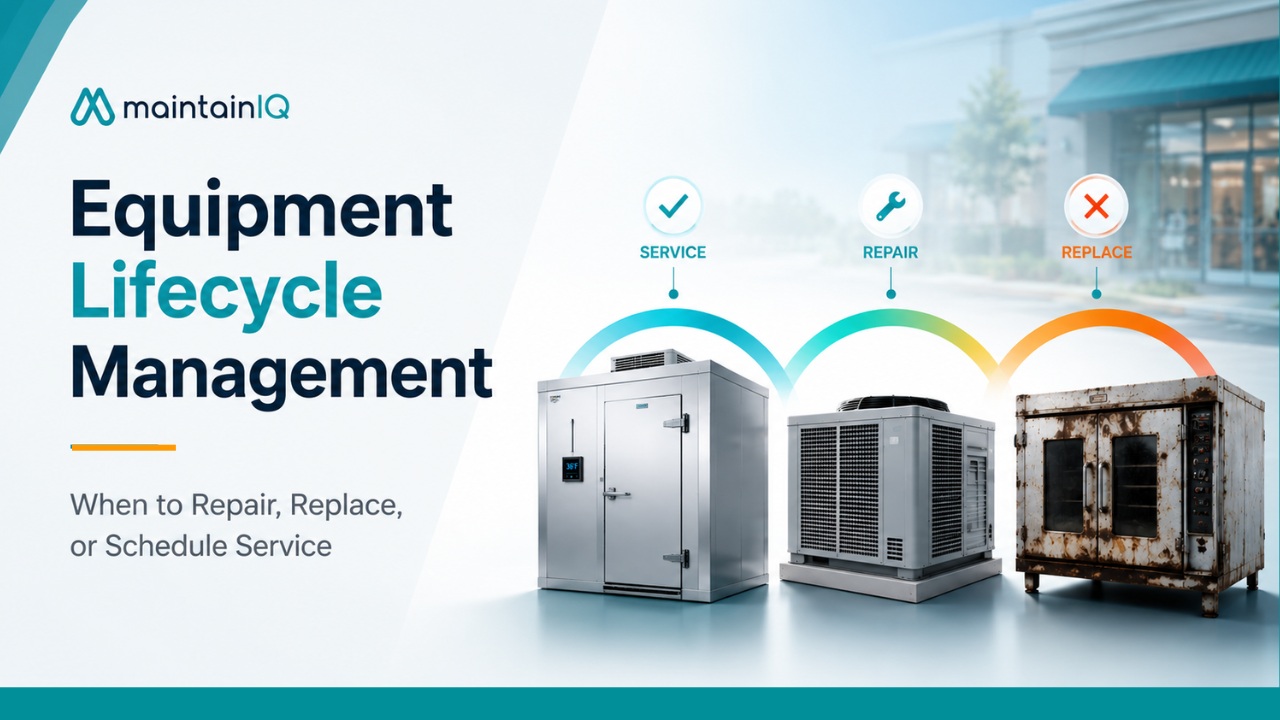
Every piece of equipment in your operation has a lifespan. A commercial walk-in cooler that was installed eight years ago is in a different place than one installed fifteen years ago — even if both are running today. The question isn’t just “is it working?” It’s whether the money you’re about to spend on it is going toward an asset with years of life left, or one that’s going to fail again in six months.
Equipment lifecycle management is the discipline of tracking where each asset sits in its useful life and making repair, replace, or service decisions based on data rather than gut instinct. For multi-location operators managing dozens or hundreds of assets across restaurants, hotels, grocery stores, or facilities, this isn’t optional — it’s how you control your R&M spend, prevent service disruptions, and stop paying emergency rates for problems that were predictable.
This guide covers the expected lifespans of common commercial equipment, the decision frameworks that tell you when to repair versus replace, how scheduled service extends equipment life, and how to build a tracking system that makes the right call obvious.
Table of Contents
How Long Commercial Equipment Actually Lasts
Equipment lifespan varies significantly based on type, usage volume, and how well it’s maintained. Industry data from equipment manufacturers, CHD Expert, and ASHRAE provides general benchmarks, but the range for any given asset can shift by years depending on whether it received consistent preventive maintenance.
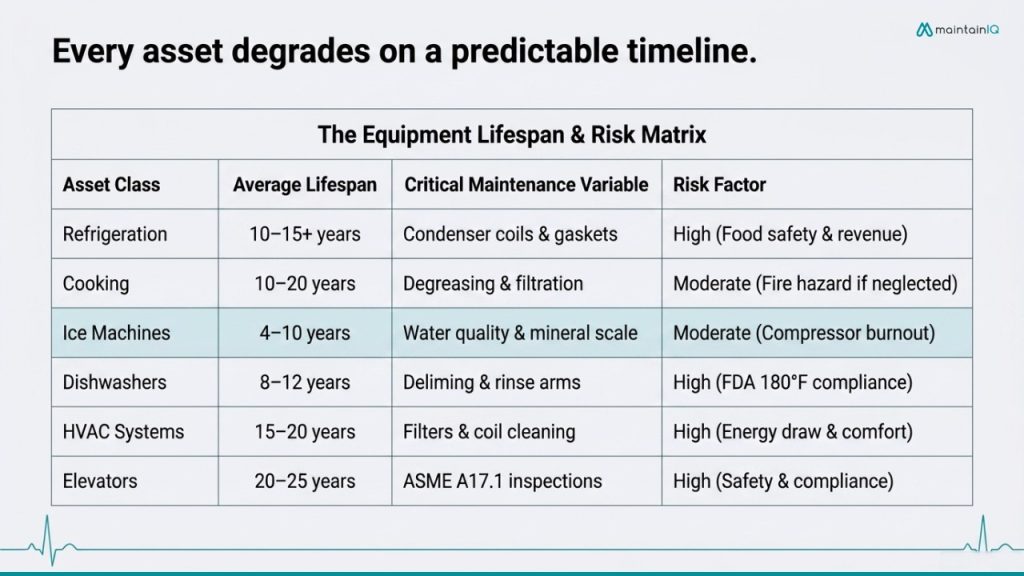
Refrigeration is the backbone of any food-related operation. Walk-in coolers and freezers typically last 15 years or more with proper maintenance — clean condenser coils, intact door gaskets, and consistent temperature monitoring. Reach-in refrigerators average 10–15 years. Without maintenance, those numbers can be cut in half.
Cooking equipment lifespans vary by type. Commercial ovens last 10–20 years depending on usage and cleaning frequency. Convection ovens trend toward 10–12 years. Pizza conveyor ovens can reach 15–20 years with regular part replacement. Ranges and grills last 10–15 years with consistent degreasing and burner inspection. Deep fryers last 15–20 years if oil is filtered properly and thermostats are maintained — neglect accelerates grease buildup and creates fire hazards.
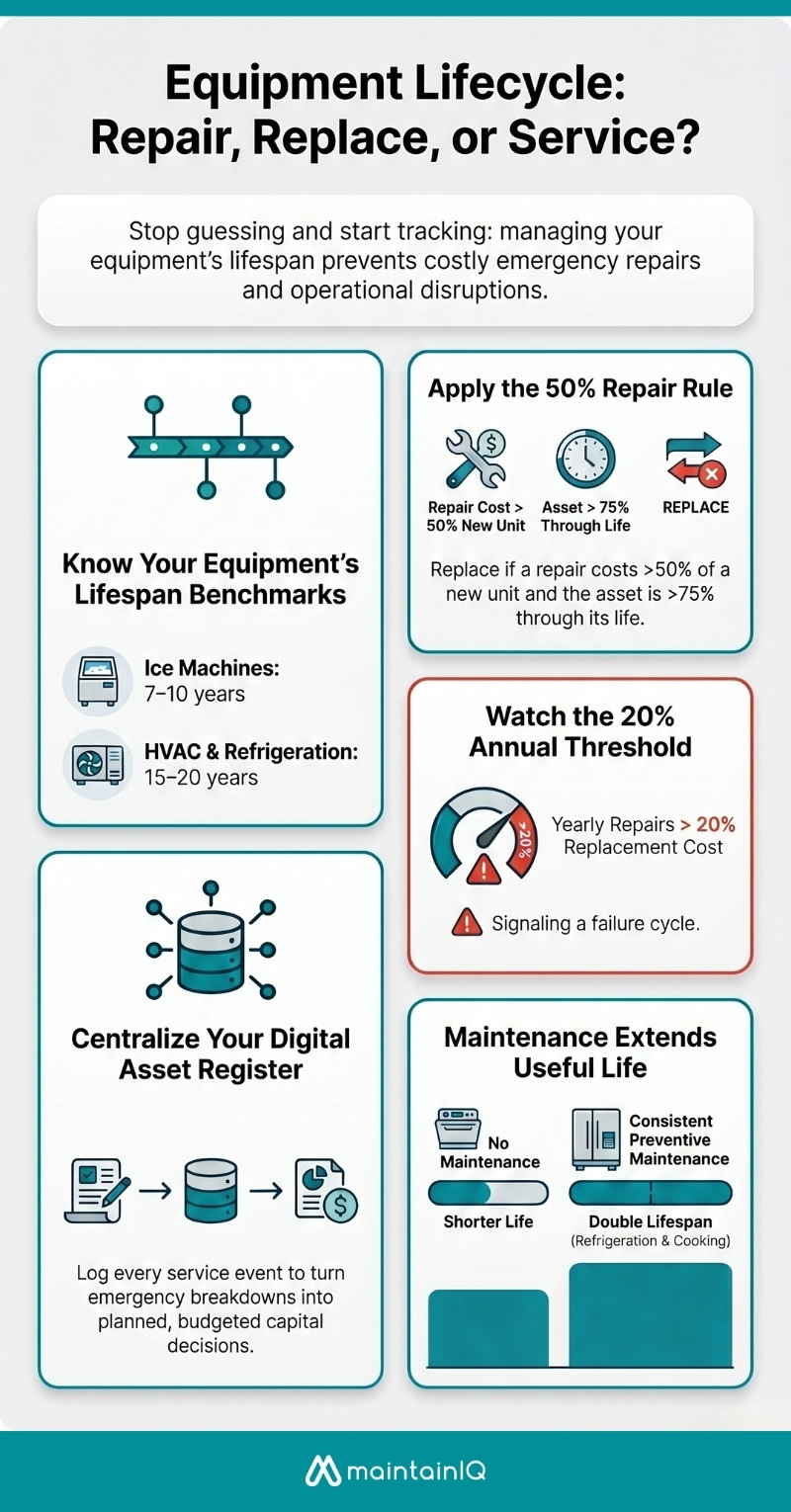
Ice machines have one of the shortest lifespans in a commercial kitchen: 4–10 years, with industry consensus around 7–10 years. Water quality is the single biggest variable. Hard water causes mineral scale on evaporator plates, forcing the compressor to overwork. Proper water filtration and quarterly cleaning can add years to the unit’s service life.
Commercial dishwashers average 8–12 years. Deliming, rinse arm maintenance, and verifying final rinse temperatures (180°F for high-temp machines per FDA Food Code) keep them running efficiently. Neglected dishwashers fail sooner and may not hit sanitizing temperatures — creating both an equipment problem and a compliance problem.
HVAC systems last 15–20 years in commercial applications. Monthly filter changes, quarterly coil cleaning, and semi-annual professional service are the baseline. Systems in restaurants face additional stress from kitchen heat, grease-laden air, and heavy cooling demand during service hours.
Elevators have the longest lifecycle — 20–25 years for the mechanical components, though modernization of controls and safety systems may be needed earlier. Annual certified inspections per ASME A17.1 are required regardless.
These are averages, not guarantees. The variable is always maintenance — which is why tracking service history is the foundation of lifecycle management.
The Decision Framework: Repair, Replace, or Schedule Service
When equipment breaks down or shows signs of degradation, the decision often gets made reactively: “What’s the cheapest way to get it running again today?” That’s the wrong question. The right question is: “What’s the most cost-effective decision over the remaining life of this asset?”
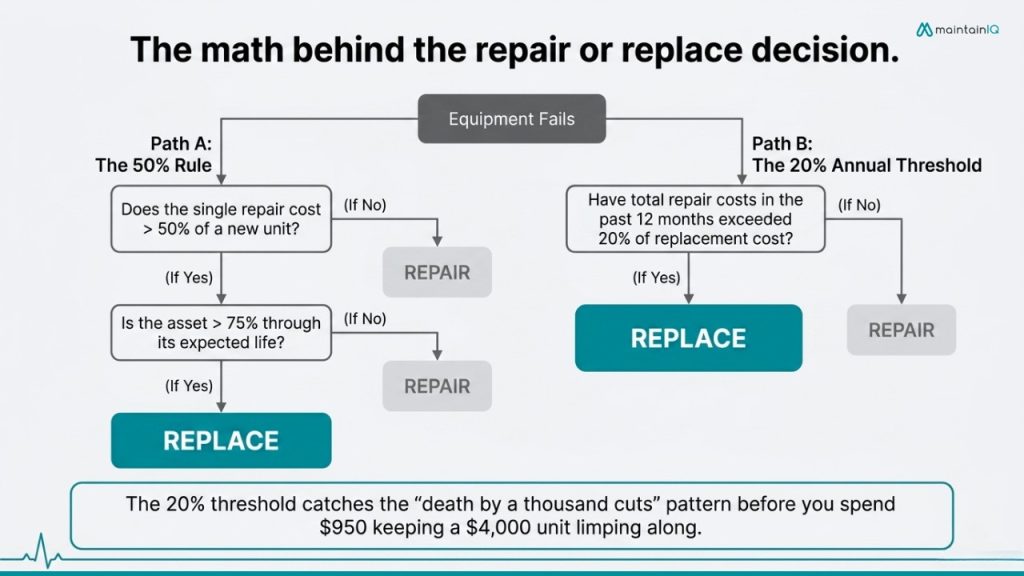
Three established decision rules help answer that.
The 50% Rule
This is the most widely cited guideline, referenced by ASHRAE and used across facility management. If the cost of a single repair exceeds 50% of the cost of replacing the unit — and the equipment has reached roughly 75% of its expected lifespan — replacement is typically the better investment.
The logic is straightforward. Late-life equipment that needs a major repair is likely to need another major repair soon. You’re paying half the price of new equipment to keep an aging asset running for what may be only another year or two before the next failure.
Example: A 12-year-old reach-in refrigerator (expected life: 15 years) needs a $2,000 compressor replacement. A new comparable unit costs $3,500. The repair is 57% of replacement cost, and the unit is at 80% of its expected life. Replace.
The 20% Annual Threshold
If total repair costs in the past 12 months exceed 20% of the replacement cost, the equipment is signaling that it’s entering a failure cycle — even if no single repair crossed the 50% line.
This rule catches the “death by a thousand cuts” pattern: a $300 gasket replacement in March, a $400 thermostat in June, a $250 fan motor in October. Each repair seems reasonable in isolation. But $950 in one year on a unit worth $4,000 new means you’ve spent nearly 24% of its replacement cost just to keep it limping along.
This is where maintenance records become essential. Without a complete service history, you can’t see the cumulative spend pattern. You just see each repair as a one-time decision — and you keep approving them until the unit finally dies.
The Criticality Assessment
Not all equipment carries the same operational impact. A broken ice machine is an inconvenience. A failed walk-in cooler during a Friday dinner service is a crisis.
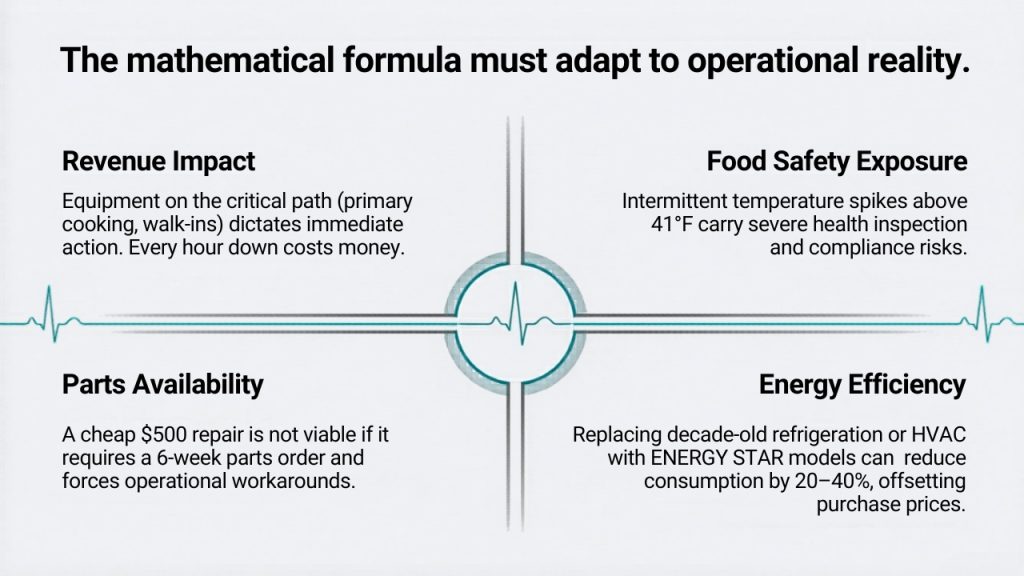
When evaluating repair vs. replace, factor in:
- Revenue impact of downtime. Equipment on the critical path — primary cooking equipment, walk-in refrigeration, dishwashers — carries a higher replacement urgency because every hour it’s down costs money.
- Food safety exposure. Refrigeration and hot holding equipment that can’t maintain safe temperatures creates compliance risk beyond the repair cost. A walk-in cooler that intermittently spikes above 41°F isn’t just unreliable — it’s a potential health inspection violation and a food safety hazard. Temperature monitoring data helps quantify this risk.
- Parts availability. A $500 repair requiring a 6-week parts order means 6 weeks of workarounds and disruption. The repair bill may be reasonable; the total cost of downtime often isn’t.
- Energy efficiency. Older refrigeration and HVAC frequently runs far less efficiently than current ENERGY STAR models. The Department of Energy estimates energy-efficient replacements can reduce consumption by 20–40% compared to decade-old units — savings that can offset a significant portion of the purchase price over time.
When the Answer Is “Schedule Service” — Not Repair or Replace
Not every equipment problem is a binary repair-or-replace decision. Many issues are caught early enough that the right answer is scheduled preventive service — addressing the condition before it becomes a failure.
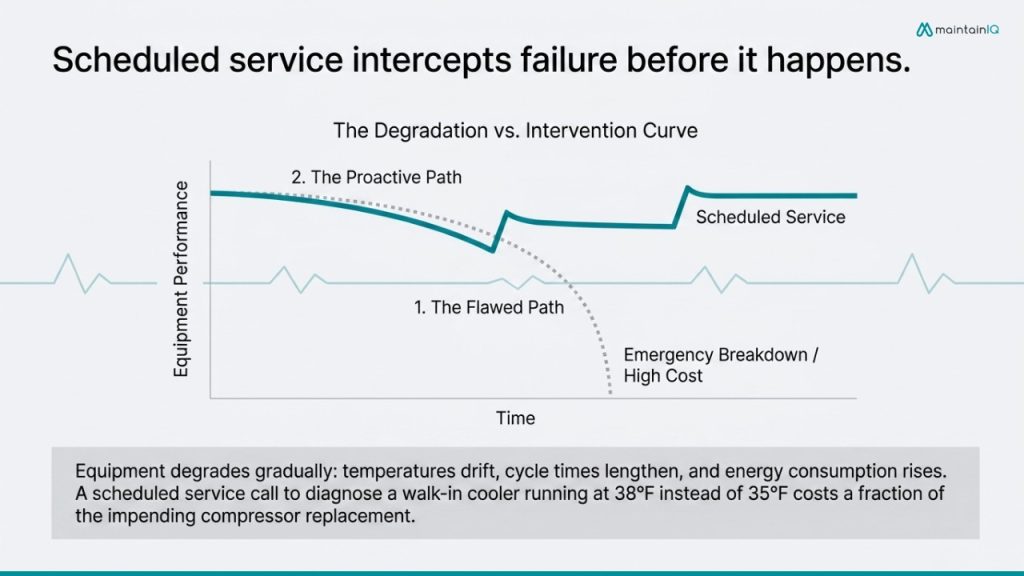
This is the space between “it’s running fine” and “it just broke.” Equipment doesn’t typically fail without warning. It degrades gradually: temperatures drift, cycle times lengthen, noise levels increase, energy consumption rises. The operators who catch these signals early spend less on both repairs and replacements.
Trending temperature data is the clearest signal. A walk-in cooler that consistently reads 38°F when it used to hold at 35°F isn’t broken — but it’s working harder than it should. Dirty condenser coils, a failing fan motor, or a slow refrigerant leak could be the cause. A scheduled service call to diagnose and address the drift costs a fraction of the emergency compressor replacement that’s coming if you ignore it.
Rising energy bills without operational changes often point to equipment that’s working harder to deliver the same output. HVAC systems, refrigeration, and water heaters are the most common culprits. A professional service visit can identify the cause — clogged filters, worn components, improper calibration — before efficiency degrades to the point of failure.
Manufacturer-recommended service intervals exist for a reason. Equipment makers know which components wear and when. Following their recommended PM schedule — and documenting it — protects both the equipment and your warranty coverage. Skipping scheduled service is the fastest way to void a warranty claim when a major component fails.
The connection between scheduled service and lifecycle management is direct: every PM task completed on time extends useful life and pushes the replacement date further out. Every skipped task accelerates degradation and brings the replacement decision forward. Preventive maintenance scheduling automates this so nothing slips.
Building the Tracking System
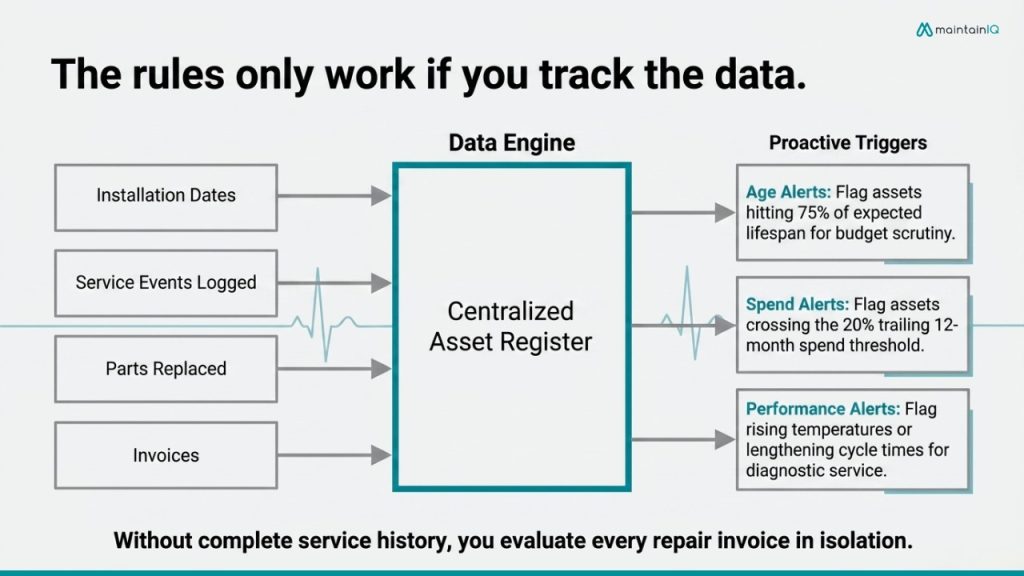
Equipment lifecycle management only works when you have data on every asset: what it is, when it was installed, what its expected life is, what service it’s received, and what it’s cost you.
Create an asset register
Every piece of equipment at every location needs a record that includes: make and model, serial number, installation date, purchase cost or estimated replacement cost, expected lifespan, warranty expiration date, and the vendor or service provider responsible for maintenance.
For multi-location operators, this register needs to be centralized — not stored in a binder at each store. A manager transfers to another location, and the institutional knowledge about that store’s equipment walks out the door with them. A centralized digital register keeps the information with the asset, not the person.
Log every service event
Every repair, every PM visit, every vendor service call should be logged against the specific asset. The record should include the date, the work performed, parts replaced, cost, technician or vendor name, and any notes about the equipment’s condition.
This history is what makes the 50% rule and the 20% threshold actionable. Without it, you’re making repair-or-replace decisions based on the current invoice alone — which is how operators end up spending $3,000 in cumulative repairs on a unit they should have replaced after the second call.
Work order management systems that link every completed work order to the corresponding asset build this history automatically. Over time, you can pull up any piece of equipment and see its complete service timeline, total spend to date, and remaining expected life.
Set replacement planning triggers
Don’t wait for equipment to fail to start planning its replacement. Set alerts based on:
Age thresholds. When an asset reaches 75% of its expected lifespan, flag it for review — not immediate replacement, but closer budget scrutiny and service monitoring.
Cumulative spend thresholds. When total repair costs in a rolling 12-month period exceed 20% of replacement cost, flag the asset for replacement evaluation.
Performance thresholds. When monitoring data shows declining performance — rising temperatures, longer cycle times, increasing energy draw — schedule a diagnostic service visit and evaluate whether the trend is correctable or signals end-of-life degradation.
These triggers turn replacement from a surprise expense into a planned capital decision. You can budget for it, schedule it during a slow period, and transition without the chaos of an emergency breakdown.
Multi-Location Lifecycle Management
For operators managing equipment across five, ten, or fifty-plus locations, the challenge compounds. You’re not tracking one walk-in cooler — you’re tracking dozens. And they’re all at different stages of their lifecycle.
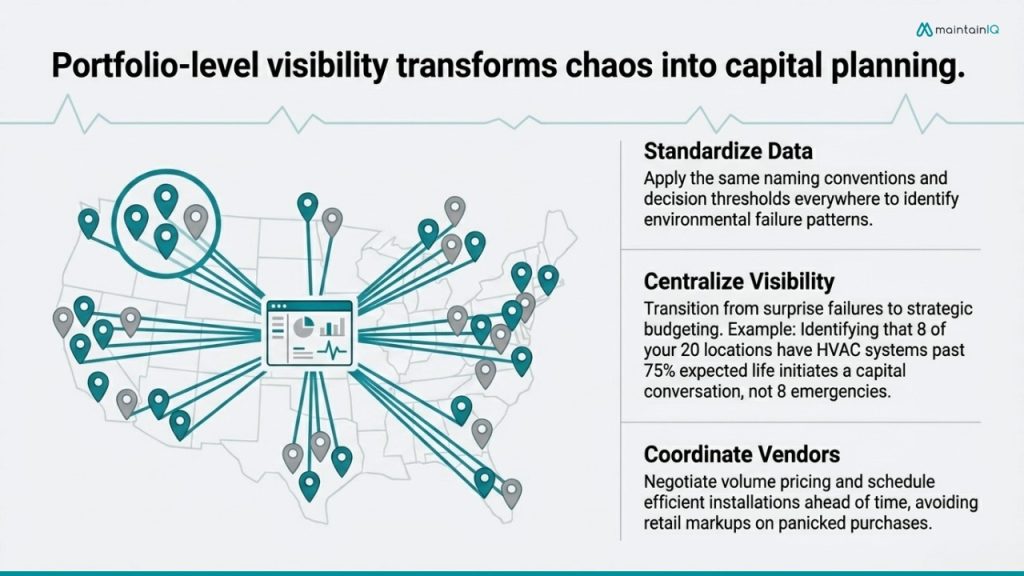
Standardize your asset data across all locations. Use the same naming conventions, the same expected lifespan benchmarks, and the same decision thresholds everywhere. This lets you compare locations and identify patterns — like one location whose refrigeration consistently fails earlier, which might indicate an environmental factor (poor ventilation, high ambient temperature) rather than an equipment problem.
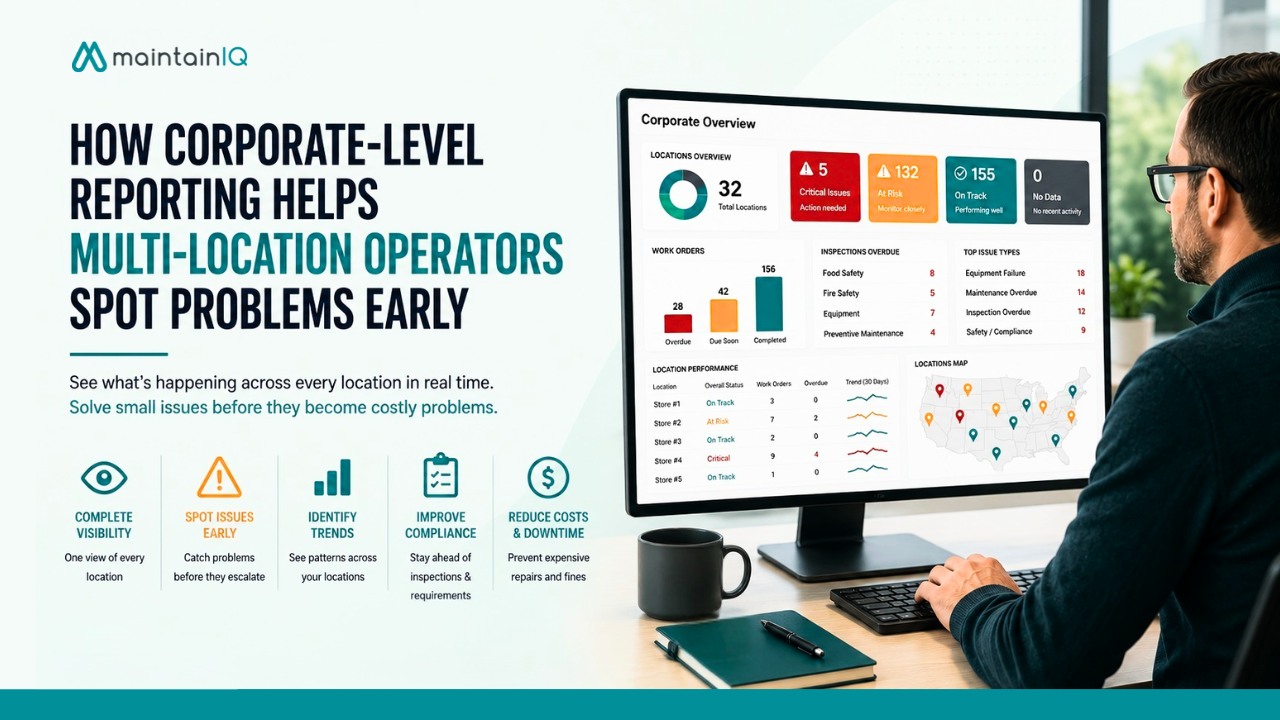
Centralize visibility. Corporate-level reporting that shows equipment age, service history, and upcoming replacement triggers across all locations lets operations leaders make portfolio-level decisions. If 8 of your 20 locations have HVAC systems past 75% of expected life, that’s a capital planning conversation — not 8 individual surprise failures waiting to happen.
Coordinate vendor relationships. When you know which assets are approaching replacement across multiple locations, you can negotiate volume pricing with equipment vendors and schedule installations across stores efficiently — rather than paying retail on emergency one-off purchases.
Connect lifecycle data to daily operations. When your digital checklists include equipment condition checks, and your PM program feeds completed work orders back to the asset register, your lifecycle data stays current without anyone having to maintain it separately. The system updates itself through normal daily operations.
Getting Started
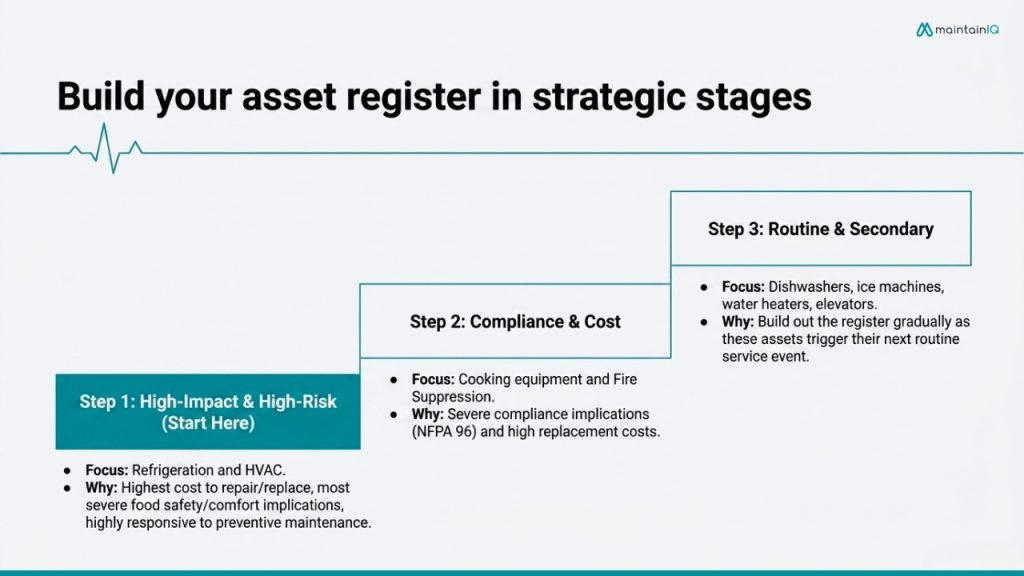
You don’t need a perfect asset register on day one. Start with the equipment that matters most — the assets where a failure causes the most disruption and the highest cost.
Start with refrigeration and HVAC. These are the highest-cost assets to repair and replace, the most likely to cause food safety or comfort issues when they fail, and the most responsive to preventive maintenance. Log their age, service history, and current condition. Set up automated work orders for their recurring PM tasks.
Add cooking equipment and fire suppression next. These carry compliance implications (NFPA 96 for hood systems, fire suppression inspection schedules) and high replacement costs.
Expand to all assets over time. Dishwashers, ice machines, water heaters, plumbing fixtures, elevators, exterior equipment — build the register gradually as each asset receives its next service event.
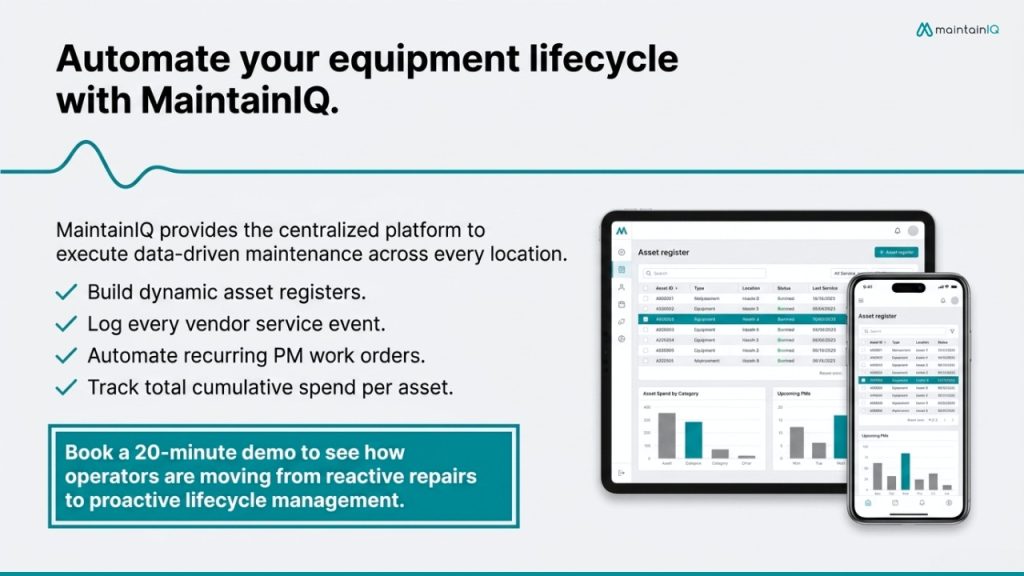
MaintainIQ’s equipment maintenance and preventive maintenance tools let you build an asset register, log every service event against specific equipment, automate recurring PM work orders, and track total spend per asset — across every location, from one platform.
Book a 20-minute demo to see how it works.
Conclusion
Equipment doesn’t fail without warning. It degrades — gradually, measurably, and predictably — over a lifecycle that you can track if you have the right system in place.
The operators who spend the least on maintenance aren’t the ones who avoid repairs. They’re the ones who know exactly where each asset sits in its lifecycle, who catch declining performance before it becomes a breakdown, who apply consistent decision rules to every repair-or-replace call, and who plan replacements as budgeted capital events instead of emergency expenses.
A walk-in cooler doesn’t care how busy your Friday night is. It will fail when the compressor gives out — whether that’s a predictable event you planned for or a surprise that costs you triple. The difference is whether you were tracking the data or hoping for the best.