The Untapped Potential of Restaurant Maintenance Scheduling
Restaurant maintenance scheduling made simple. Which tasks to do daily, weekly, monthly and yearly, what neglect really costs, and how to stay on track.
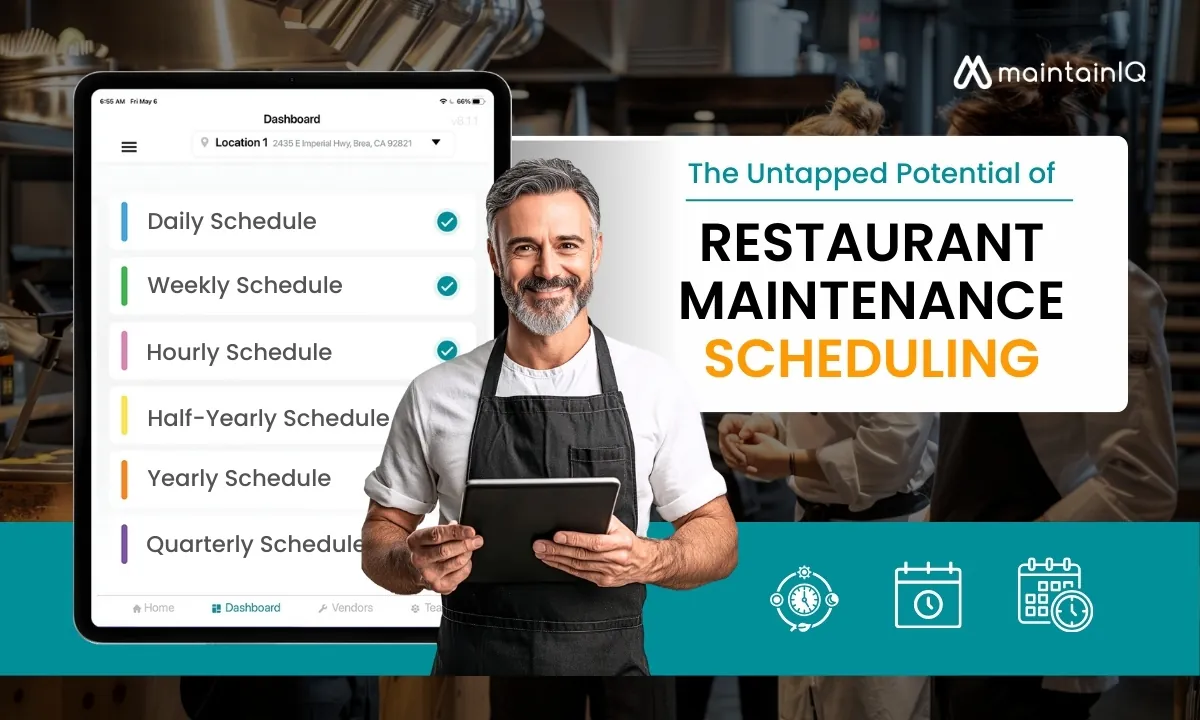
Key takeaways
- Planned maintenance costs less than emergency repairs in the middle of a rush, and it cuts downtime, energy waste and food safety risk.
- Split the work by frequency, from daily cleaning and checks to weekly inspections, monthly deep cleans and yearly professional service.
- Check refrigerator temperature controls often, because a cooler that drifts above 41°F is a repair and a food safety problem at once.
- Track what breaks and when, then service the equipment that fails most often on a shorter schedule.
On this page
Restaurant maintenance scheduling means deciding in advance which equipment and building tasks happen daily, weekly, monthly and yearly, and who does them. Done well, it stops most breakdowns before they happen, keeps your food safe and your energy bills in check, and saves you from paying rush rates for emergency repairs.
A well-run schedule turns your restaurant into a well-oiled machine. By taking control of maintenance tasks, you’ll cut down on equipment failures, reduce energy consumption, and stay on the right side of health regulations.
You’ll also create a more pleasant dining experience, which builds customer loyalty and improves profitability.
But just as a single cog can bring a machine to a grinding halt, a single oversight in your maintenance schedule can have far-reaching consequences.
What are the critical parts of a maintenance schedule that you can’t afford to overlook?
Highlights
- A proactive maintenance approach extends equipment life, improves day-to-day efficiency, and supports restaurant food safety.
- Setting daily, weekly, monthly, quarterly and annual tasks keeps upkeep consistent and prevents unexpected failures.
- Digital tools, such as maintenance software, handle scheduling, reminders of what is due, and a record of what was done.
- Identifying key maintenance tasks, setting frequencies, and tracking results are the building blocks of a reliable restaurant maintenance schedule.
- Training staff and keeping communication open make sure procedures are followed and improved over time.
The High Cost of Neglecting Restaurant Maintenance
You’re likely no stranger to the chaos that erupts when a crucial piece of equipment fails during a dinner rush, or the frustration of scrambling to find a last-minute repair.
Neglecting maintenance can quickly snowball into a costly, stressful mess that hurts customer satisfaction and your bottom line.
Common Maintenance Headaches in Restaurants
You know the sinking feeling when your restaurant’s refrigerator fails during a packed dinner service, or the health inspector shows up unannounced and finds a few “critical” issues.
Neglecting maintenance can snowball into equipment failures, food safety violations, higher energy bills, and bad reviews.
As you’ll soon see, a reactive approach can be a recipe for disaster.
Equipment failures during peak hours
Peak hours are the worst time for equipment failures to strike.
Imagine your fryer failing on a Friday night. Lost revenue, stressed staff, and unhappy customers are the immediate result.
You can limit the damage with a plan for peak hours and safety training for your staff, but the best fix is catching the problem before the rush.
Food safety and health code violations
Plenty of restaurant owners have learned the hard way that neglecting maintenance can lead to food safety and health code violations.
You’re putting customers at risk when malfunctioning equipment causes temperature issues, pest problems, and sanitation failures.
Regular temperature monitoring, pest control, and staff training prevent most of these issues and keep you ready for inspections, which protects your reputation.
Increased energy consumption and utility bills
How much is neglecting maintenance really costing your restaurant?
Skip regular tune-ups, and worn-out equipment uses more energy to do the same work. Dirty coils, clogged filters and leaky door seals all push your restaurant’s energy bills up month after month.
Ignoring energy efficiency undoes every other effort you make to manage utilities. When a unit does need replacing, the ENERGY STAR commercial food service equipment list is a good place to compare more efficient models.
Regular maintenance is the lifeblood of your business. Don’t let energy waste drain it.
Negative customer experiences & reviews
One negative review can damage your restaurant’s reputation, and neglecting maintenance invites more. Broken equipment and dirty restrooms leave a bad impression, resulting in poor reviews and lost business.
| Consequences of Neglecting Maintenance | Impact on Your Restaurant |
|---|---|
| Negative reviews | Harm to brand reputation |
| Lost business | Decreased customer loyalty |
| Poor guest perception | Difficulty in service recovery |
| Decreased online presence | Ineffective reputation management |
Unnecessary emergency repair costs
Emergency repairs usually cost far more than planned maintenance would have. You pay for the rush call-out, the part at short notice, the food you throw away, and the sales you lose while the equipment is down.
Neglecting maintenance puts a financial strain on your business, and you’re not alone.
Here’s what you’re up against:
- Unexpected expenses that blow your budget
- Equipment failures that halt service
- Last-minute repairs that compromise quality
- Lost revenue due to downtime
The Benefits of a Proactive Approach
As a restaurant owner, you know the chaos of equipment failure during a lunch rush. A proactive maintenance approach extends equipment life, improves efficiency, and brings plenty of other benefits.
From cost savings to better staff morale, staying on top of maintenance makes running your restaurant much easier.
Let’s look at these advantages in detail.
Extended equipment lifespan
Neglecting maintenance speeds up wear and tear, leading to costly replacements. Regular care extends equipment life and gives you:
- Lower replacement costs
- Less downtime
- More consistent food quality
- A reputation for reliable service
Improved operational efficiency
A proactive approach to restaurant maintenance makes the whole operation run better.
By using simple tools and doing regular maintenance walkthroughs, you’ll have fewer disruptions and a more productive team. Staff know what to do and when, shifts are easier to plan, and money goes where it is needed.
You’ll also hear better feedback from guests and build stronger relationships with your suppliers and service vendors.
With a record of what was serviced and what broke, you’ll prioritize repairs based on facts rather than guesswork, and guests get a smooth dining experience.
Enhanced food safety and compliance
Three of the most important areas in a restaurant, the kitchen, storage, and dining spaces, need regular maintenance to meet health codes and reduce the risk of foodborne illness.
Here’s what’s at stake:
- Food safety and customer well-being
- Compliance training for your staff
- Protection of your reputation
- Prevention of costly fines and shutdowns
Cost savings in the long run
Money spent on proactive restaurant maintenance usually comes back to you as fewer emergency repairs, longer-lasting equipment, and less wasted food and energy.
Run a simple cost analysis of what breakdowns cost you last year, and setting aside a maintenance budget quickly looks like the obvious choice.
It’s like paying a small insurance premium to avoid a massive bill.
Better staff productivity and morale
A well-maintained workplace lifts morale and teamwork, resulting in:
- Less stress and better morale
- Higher productivity
- Better communication and collaboration
- A positive work environment that encourages growth and job satisfaction
Building a Reliable Restaurant Maintenance Schedule
Creating a strong restaurant maintenance schedule begins with identifying the key tasks that keep operations smooth. For a step-by-step walkthrough, see our guide to developing a preventive maintenance schedule for restaurants.
You can make sure nothing is overlooked by setting daily, weekly, and monthly maintenance frequencies.
With the right tools for the job, you’ll build a maintenance routine as reliable as your favorite recipe.
Identifying Key Maintenance Tasks
Building your restaurant’s maintenance schedule starts with identifying the essential tasks that keep everything running.
From kitchen equipment to dining areas, each part of the building needs regular attention.
Kitchen Equipment (Ovens, Fryers, Refrigerators)
To last, commercial kitchen equipment such as ovens, fryers, and refrigerators needs frequent maintenance. Our commercial kitchen maintenance checklist covers each piece in detail.
Key tasks include:
- Cleaning and sanitizing equipment regularly
- Replacing worn-out parts and door seals
- Checking temperature controls, so coolers hold food at 41°F or below as the FDA Food Code requires
- Booking routine professional service
HVAC Systems
Next, focus on your HVAC system. A well-maintained HVAC system keeps energy use down, the air clean, and customers comfortable. Our HVAC preventive maintenance checklist for restaurants lists every task.
| Task | Frequency |
|---|---|
| Filter replacements | Monthly to quarterly, depending on use |
| Duct cleaning | Twice a year |
| Seasonal adjustments | Quarterly |
| Thermostat checks | Monthly |
Plan routine inspections and know who to call in an emergency to prevent costly repairs.
Plumbing and Electrical Systems
Pipes and wires are the backbone of your restaurant, working behind the scenes to keep your kitchen running and your customers comfortable.
To prevent costly failures, prioritize:
- Regular plumbing inspections to catch leaks and water damage
- Electrical upgrades for efficient lighting and equipment
- Checking commercial water heaters for temperature and pressure relief
- Inspecting circuit breakers for overload and wear
Dining Area Maintenance
Dining areas are the heart of any restaurant, and their upkeep shapes how customers see you.
Focus on keeping cleanliness standards high, making sure seating, lighting and temperature keep customers comfortable, and fixing worn or damaged decor before guests notice it.
Setting Frequencies for Maintenance Activities
Now that you’ve pinpointed the essential maintenance tasks, it’s time to create a schedule that brings your restaurant’s upkeep to life.
Build a routine that includes daily checklist items, like sanitizing equipment and restocking supplies, as well as weekly inspections to catch potential issues before they become major headaches.
| Frequency | Key Tasks | Objective |
|---|---|---|
| Daily | Clean equipment and high-touch areas, do routine checks, check thermometers and temperature readings, confirm tasks were completed | Keep daily sanitation and safety on track, prevent equipment problems, and make sure tasks get done |
| Weekly | Inspect systems and equipment more closely | Catch potential equipment issues before they turn into bigger problems |
| Monthly | Deep clean high-traffic areas and equipment, replace air filters, service refrigeration and HVAC systems | Handle the less frequent cleaning and preventive tasks that keep equipment working long term |
| Quarterly and annual | Major inspections and repairs, seasonal adjustments, budgeting, compliance updates, vendor coordination and training | Cover major servicing and compliance, and prepare for seasonal changes and upgrades |
Choosing the Right Tools for the Job
You’re probably used to scribbling maintenance reminders on a sticky note or relying on a dusty old calendar.
But as you start building your restaurant maintenance schedule, consider whether it’s time to move to digital restaurant maintenance software.
Can restaurant maintenance software really be the game-changer everyone claims it is, or is it just another expensive tool to gather dust?
Pen and Paper vs. Digital Solutions
Scribbled notes, lost reminders, and frantic schedules show where pen-and-paper methods fall short for modern restaurant maintenance.
You’re likely no stranger to these problems.
Consider what a digital system adds:
- Time saved because due dates are worked out for you
- Fewer mistakes with digital records
- Clearer communication about who does what
- One place to see every task, instead of notes spread across the kitchen
Benefits of Restaurant Maintenance Software
The right restaurant maintenance software can be a game-changer for your business.
A cloud-based system with a simple interface lets your team work from the same list as things happen, and it shows who is responsible for each task.
Reminders of what is due, mobile access, and a service history for each piece of equipment make the team more efficient. The records also help you decide where to spend money, which vendors to keep, and which numbers matter most.
Implementing and Optimizing Your Maintenance Strategy
You’ve created a solid maintenance schedule. Now it’s time to put it into practice.
Train your staff on the new procedures and explain why careful maintenance matters. A team that agrees on the plan is the key to success.
Staff Training & Communication
Effective maintenance scheduling relies heavily on staff training and communication. You can’t just hand your team a schedule and expect them to follow it. They need to understand why maintenance matters and how to do each task correctly.
Proper training makes sure they grasp the why behind the tasks, and clear communication keeps everyone informed and accountable.
To get started, focus on:
- Running regular training sessions to refresh staff on maintenance procedures
- Ranking tasks by importance to identify the critical ones that need special attention
- Keeping communication open, for example with daily or weekly meetings to discuss ongoing work
- Setting clear expectations and consequences for not following the maintenance schedule
Tracking and Analyzing Maintenance Data
As you track and analyze maintenance data, you’ll start to see trends and potential issues before they become major headaches.
You’ll begin to notice patterns in equipment failures, which lets you adjust your maintenance schedule and prevent costly repairs.
Identifying trends and potential issues
Regularly reviewing your maintenance records helps you spot trends and potential issues in your restaurant’s equipment and systems, so you can prevent major problems.
Here’s what you can uncover:
- Patterns of equipment failure
- Energy consumption trends
- Potential health hazards
- Gaps in your maintenance schedule
Large operations sometimes go a step further with sensors and data that forecast failures, known as predictive maintenance. For most restaurants, a good service history and a schedule you actually follow catch the same problems early.
Adapting Your Schedule Based on Performance
Improving your maintenance schedule is an ongoing process. As you track and review your records, patterns will emerge that show where to make changes.
To cut downtime and keep things efficient, focus on continuous improvement by:
- Reviewing results to spot areas that need adjusting
- Using maintenance software to see service history and overdue tasks at a glance
- Servicing problem equipment more often to prevent repeat failures
- Reviewing and refining your plan on a regular basis
With these habits and the right tools, you can improve your maintenance process and keep your restaurant running at its best.
MaintainIQ: Simplifying Restaurant Maintenance Management
Managing restaurant maintenance can be overwhelming, often bogged down by paperwork and missed appointments.
MaintainIQ is a simple app built for restaurants and other multi-location operators that puts preventive maintenance, work orders and daily checklists in one place.
Key Features and Benefits for Restaurants
Equipment breakdowns can be disastrous in a busy restaurant, especially during peak hours.
Preventive maintenance scheduling is essential to staying ahead of equipment failures, minimizing downtime, and controlling costs.
Preventative maintenance scheduling
By scheduling preventive maintenance, you’ll reduce downtime and save money.
With MaintainIQ, you can:
- Set a service frequency for each piece of equipment and assign it to a person or a role
- See the last service, next due date and how many days a task is overdue
- Track warranty expiry dates so you use a warranty before it runs out
- Keep the preferred vendor and service history with each piece of equipment
Getting Started with MaintainIQ
MaintainIQ’s preventive maintenance app runs on iPhone, iPad and Android, so your team can record a service right at the equipment. Failed checks turn into follow-up tasks, and problems can become work orders with a priority, a due date and a clear owner. It is priced per location with unlimited users; see pricing for details.
Conclusion
As you reach the end, don’t overlook the value of a well-structured maintenance schedule for your restaurant.
Don’t be like me. I once let a leaky faucet turn into a mini-geyser that flooded the kitchen and cost a small fortune. Trust me, it’s not worth the stress (or the embarrassment).
By now, you understand the value of a solid maintenance plan. Take action, put your schedule in place, and watch your restaurant thrive. Your future self, and your business, will thank you.
Frequently Asked Questions
What Types of Equipment Should Be Prioritized in a Maintenance Schedule?
Start with the high-use equipment your menu depends on, like refrigerators, freezers, ovens and fryers. A breakdown there stops service and can put food at risk, so they need the most frequent checks.
How Often Should Restaurant Equipment Be Inspected for Maintenance Needs?
Do quick visual and temperature checks every day, a closer inspection every week, deep cleaning and filter changes every month, and professional service on the schedule the manufacturer recommends. Regular inspections catch issues early, extend equipment life and prevent expensive repairs.
Can Maintenance Scheduling Reduce Energy Consumption in Restaurants?
Yes. Clean coils, fresh filters and tight door seals let equipment run less hard, which lowers energy use and utility bills.
What Role Do Employees Play in Reporting Maintenance Issues in Restaurants?
Your team sees problems first. Give them a clear, simple way to report an issue, such as a work order they can submit from a phone, and make sure someone follows up so they keep reporting.
Are There Any Industry Standards for Restaurant Maintenance Scheduling Best Practices?
There is no single standard for the whole schedule, but some parts are set by codes. Your local health code sets food temperature rules, and fire codes such as NFPA 96 set how often kitchen exhaust systems are inspected. Manufacturer manuals cover the rest. See how maintenance supports food safety for more.