Vendor Maintenance Tracking for Restaurants, How to Stay on Top of Every Service Contract
Vendor maintenance tracking for restaurants keeps every service contract, visit and report in one place, so hood cleaning, pest control and HVAC stay on time.
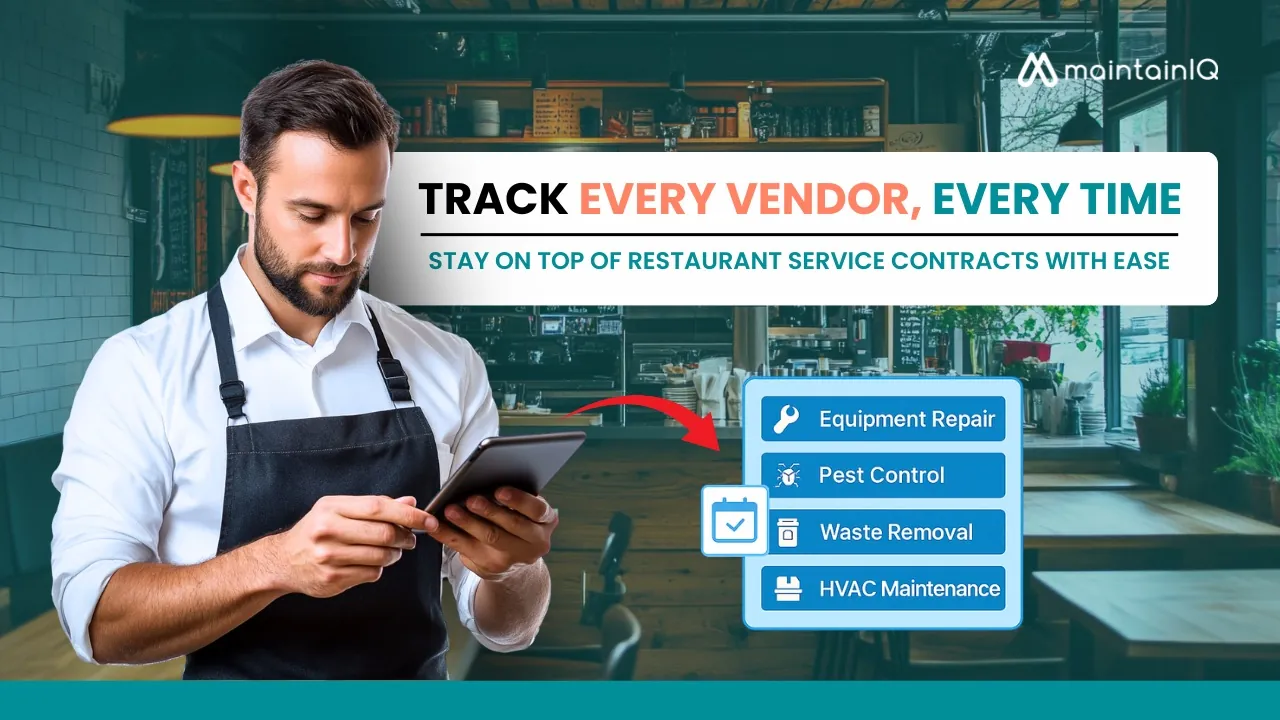
Key takeaways
- Keep every vendor's contract, contact details, service dates and reports in one place instead of scattered emails and binders.
- Give each vendor service a recurring schedule, so the next due date is always set and overdue visits stand out right away.
- NFPA 96 sets hood and exhaust inspections from monthly for solid-fuel cooking to annually for low-volume kitchens.
- Keep proof of every visit, such as the dated service report, so you can show inspectors and insurers the work was done.
On this page
Vendor maintenance tracking for restaurants means keeping every service contract, visit date and service report in one system, with a recurring schedule that flags the next visit and any overdue work. It replaces sticky notes, inboxes and memory, so hood cleaning, pest control, refrigeration and HVAC service happen on time at every location. It also gives you proof of service when an inspector, insurer or landlord asks for it.
If you run a restaurant, chances are you juggle a dozen or more vendors just to keep things running.
Keeping tabs on all those service contracts and maintenance schedules isn’t easy. It’s easy for something to slip, and a missed visit can lead to costly disruptions or safety issues. Here’s why that happens and what a better system looks like.
The Hidden Risk in Vendor-Dependent Maintenance
Relying on vendors to handle restaurant maintenance can feel convenient, but it often brings risks you might not notice right away.
When you hand the work to outside companies, you open yourself up to gaps: vendors who delay, cut corners or overlook issues.
Without your direct oversight, unmanaged vendor relationships can spiral, letting small problems become major setbacks.
To avoid constant surprises and slipping timelines, take ownership, understand the risks and build a system that puts you in charge.
Why Vendor Maintenance Slips Through the Cracks
Vendor details are spread across emails, notebooks or outdated spreadsheets, so it’s easy to lose track of key information. Without reminders, service dates slip by, and maintenance ends up forgotten or overdue.
When audit time comes, incomplete records turn into a major headache for your team.
No Centralized System for Vendor Info
When contracts are scattered across emails, binders and desktops, it’s easy to lose track of important details. You may also find that no one is really sure who handles each vendor.
Without a clear system, vendor maintenance can quickly slip through the cracks.
Contracts scattered, responsibilities unclear
In many restaurants, important vendor contracts are tucked away in file cabinets, scattered across email inboxes or saved to individual computers.
With several versions of a contract floating around and nobody clearly responsible, it’s all too easy for vendor maintenance to slip.
You’re left tracking down overdue service and paying for it. Centralizing these records clears up the confusion and prevents costly mistakes.
Forgotten or Overdue Service Dates
When you rely on sticky notes or calendar alerts, it’s easy for maintenance dates to slip your mind.
Without an automated system, locations often end up guessing when vendors are supposed to show up. That leads to overdue service and costly surprises.
Manual reminders fail; locations operate on guesswork
You might jot down service dates or set calendar reminders, but manual tracking is easy to overlook. When every location coordinates maintenance by hand, each one runs on guesswork, and that’s a recipe for missed details and stress.
Vendors’ own shifting schedules add to the chaos. The result is often:
- Missed service appointments
- Delayed repairs
- Overlapping vendor visits
- Untracked compliance deadlines
- Unexpected downtime
Incomplete Records During Audits
When your maintenance records are incomplete during an audit, you have no proof that critical services were performed.
Missing details also slow down escalation and leave your restaurant at risk.
No proof of service, delayed issue escalation
Without solid documentation, vendors who don’t deliver and contractors who don’t respond can slip by unnoticed. You’re left struggling to escalate issues or defend your business during audits.
Get ahead of this by keeping:
- Digital service reports
- Time-stamped photos
- Vendor signatures
- Maintenance logs
- Automated reminders
What a Proper Vendor Maintenance System Looks Like
A good system puts everything in one place: a dashboard that shows each vendor’s details and service history. Recurring schedules with alerts keep you on track, while digital logs and file storage make record-keeping simple.
Audit-ready reports and a full service history mean you’re prepared, not scrambling for information.
Centralized Vendor and Service History Dashboard
A proper vendor maintenance system relies on a central dashboard that puts all vendor relationships and service histories at your fingertips. No more scattered emails and paper trails: everything sits in one consolidated record.
With one dashboard, you can manage every detail with ease. Look for:
- Complete profiles for every vendor
- Quick access to past service records
- Digital storage for contracts and notes
- Views that show trends and gaps
- Simple updates that keep information current
Recurring Schedule with Custom Alerts
Your vendors play an essential role in daily operations, so their visits shouldn’t depend on memory or scattered reminders. Let the system handle it.
Set recurring schedules for vendor tasks so there are no more last-minute fixes. Reminders and alerts keep you ahead without the mental load, so each contract is honored and every service happens on time.
| What You Gain | What It Does for You |
|---|---|
| Recurring schedules | No missed services |
| Custom notifications | Peace of mind |
| Automated reminders | Fewer emergencies |
| Central control | Less chaos |
How Often Vendors Should Service Key Equipment
A recurring schedule is only as good as the intervals you put in it. Some come from fire codes; the rest come from the manufacturer, your local rules or your contract. Here is a starting point:
| Service | Usual vendor | How often |
|---|---|---|
| Hood and exhaust inspection and cleaning | Hood cleaning contractor | Monthly for solid-fuel cooking, quarterly for high-volume cooking (24-hour, charbroiling, wok), semiannually for moderate volume, annually for low volume |
| Portable fire extinguishers | Fire protection company | Monthly visual inspection, annual maintenance |
| Refrigeration and ice machines | Refrigeration contractor | As the manufacturer recommends |
| HVAC | HVAC contractor | As the manufacturer or your contractor recommends |
| Grease trap pumping | Grease hauler | As your local rules or permit require |
| Pest control | Pest control company | As your contract and local rules require |
The hood intervals come from NFPA 96, and the extinguisher schedule comes from NFPA 10. When you hire a refrigeration contractor, check that the technicians who handle refrigerant are certified under EPA Section 608.
For the hood itself, a commercial kitchen hood and exhaust cleaning checklist helps your team check the vendor’s work before they sign off.
Assign and Track Vendor Work Across Locations
As you add locations, vendor work shouldn’t get more complicated. A good system lets you assign each vendor service to a manager or role at each site, see which locations are on schedule and which are behind, and stop chasing updates by phone.
Every manager works from the same list, so you spend less time on repetitive check-ins and more time on the locations that need help.
Digital Completion Logs with File Uploads
One key marker of an effective vendor maintenance system is that it captures digital completion logs with supporting files. You’re no longer tied to paperwork or scattered emails. Each visit is documented, verified and easy to find later.
- Before and after service photos
- Invoices, compliance forms and receipts
- The date and the person who recorded each entry
- Secure, central document storage
- Quick search and retrieval when someone asks for proof
Audit-Ready Reporting and Historical Views
With every service documented and every file stored, you get the real payoff of a modern vendor maintenance system: audit-ready reporting and a clear service history.
No more scrambling before inspections. Reports you can export show which services were done and when, and that the facility is well kept.
When a vendor keeps missing dates or a repair keeps coming back, that history also helps you track vendor performance and warranty claims and decide who to keep.
This is what vendor management should feel like.
How MaintainIQ Makes Vendor Oversight Effortless
MaintainIQ gives you vendor and warranty management for every piece of equipment. Each piece of equipment can have a preferred vendor, a service frequency, service instructions and warranty dates, and the list shows the next due date and how many days a service is overdue.
- Tick a box to confirm a service visit is booked, then record the service when it’s done
- Assign each service to a person or a role, like the general manager, at each location
- Keep contracts, certificates and PDF service reports in document library folders
- See each location’s preventive maintenance and work order status on one dashboard
- Export vendor and service lists to Excel when you need a report
Your team can use it on phones and tablets, and it’s priced per location with unlimited users.
Conclusion, Don’t Let Vendor Neglect Cost You
It’s easy to focus on daily operations, but overlooking vendor maintenance can quietly eat into your restaurant’s efficiency and profits. Proactive management beats the frustration of surprise breakdowns and services that never happened.
By closely tracking vendor performance and keeping clear records, you can head off vendor disputes before they start. Good tracking helps you make confident decisions, negotiate better terms and protect your bottom line.
Build your vendor services into your day-to-day operating routines, and don’t let neglect trap you in costly cycles. Take control, and keep every contract, every vendor and every promise working for you.