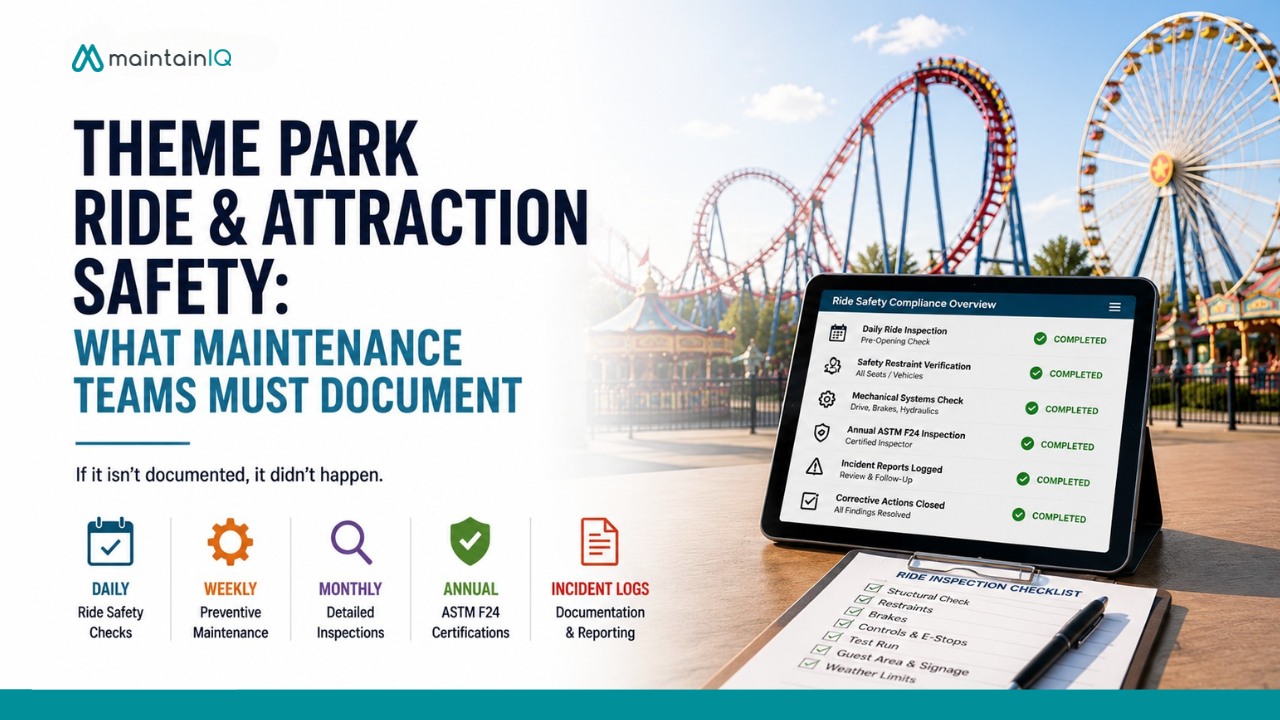
Every ride in your park — from a family carousel to a high-speed coaster — carries a documentation requirement that goes far beyond “it’s working.” State regulators, insurance underwriters, and the ASTM F24 standards that govern the U.S. amusement industry all expect the same thing: documented proof that every ride has been inspected, tested, and maintained on the correct schedule, with every deficiency recorded and every corrective action completed.
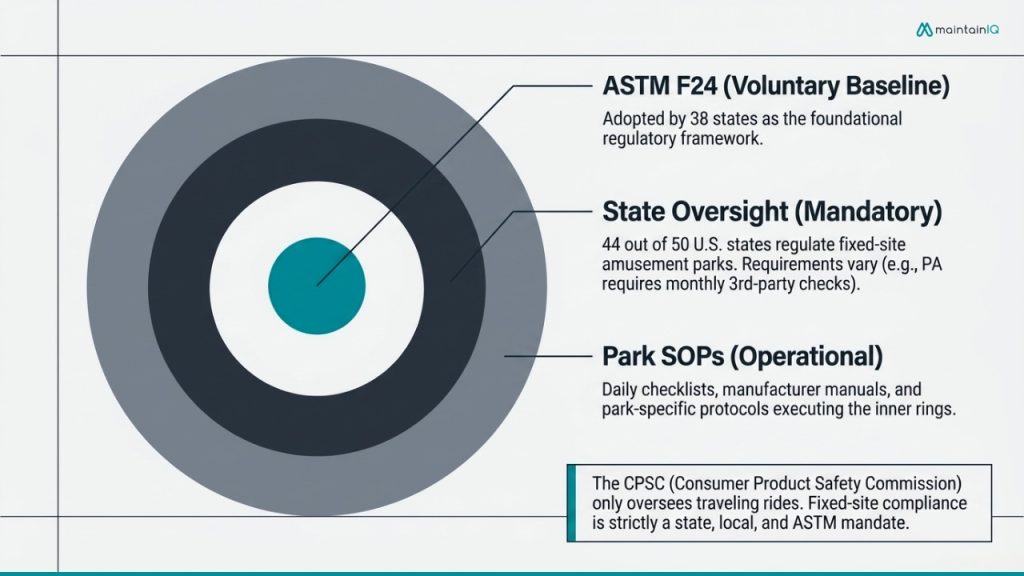
Currently, 44 of 50 U.S. states regulate amusement parks, each with its own inspection requirements, reporting mandates, and enforcement mechanisms. Fixed-site parks are regulated at the state and local level — not by the federal Consumer Product Safety Commission, which only oversees traveling rides. That means your documentation requirements depend on your jurisdiction, but the ASTM F24 framework adopted by 38 states provides the baseline standard most regulators reference.
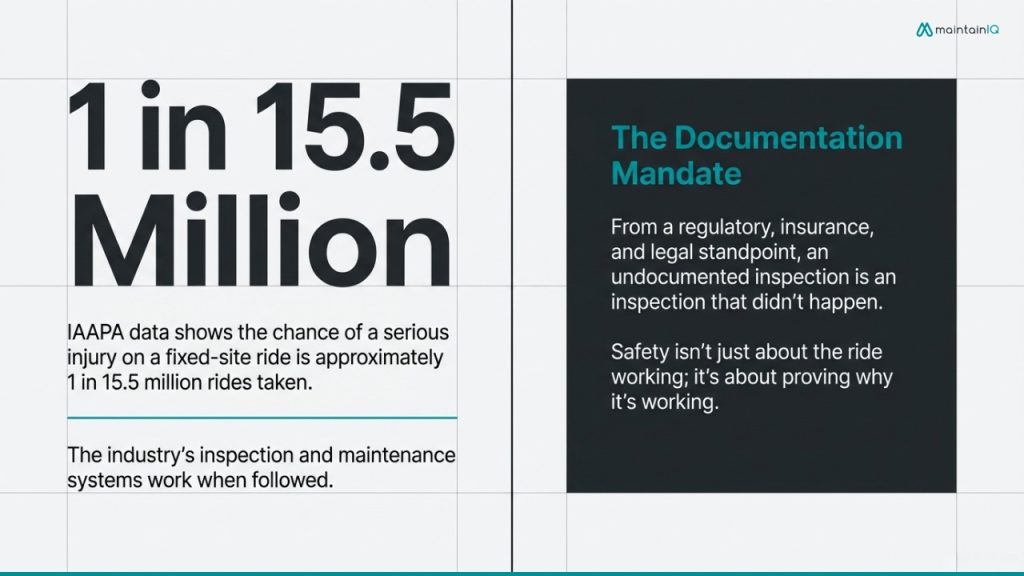
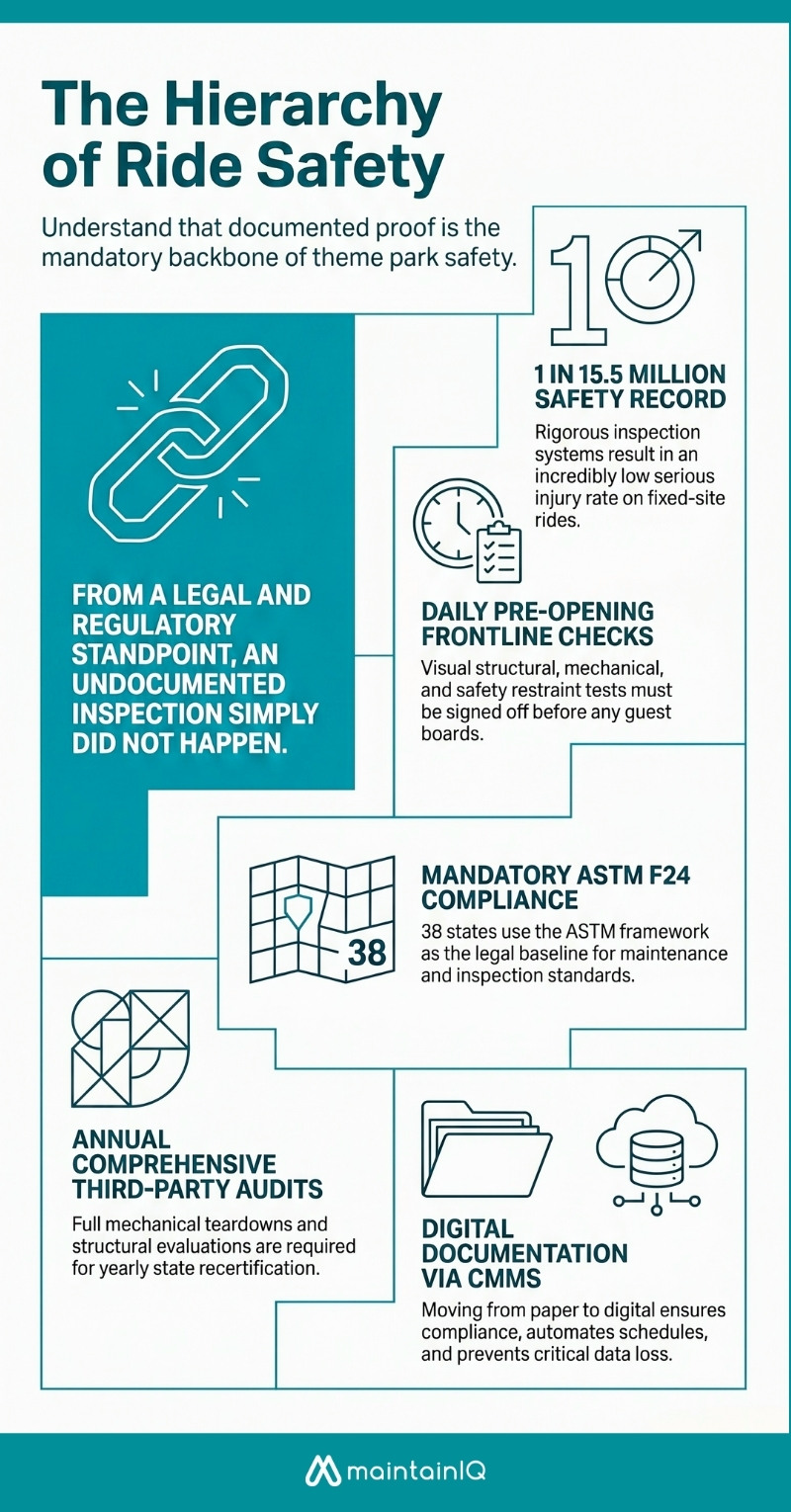
IAAPA data shows that the chance of a serious injury on a fixed-site ride is approximately 1 in 15.5 million rides taken — a testament to how well the industry’s inspection and maintenance systems work when they’re followed. But those systems only protect the park when they’re documented. From a regulatory and legal standpoint, an undocumented inspection is an inspection that didn’t happen.
This guide covers what Theme Park ride & attraction safety maintenance teams must document, organized by inspection frequency and system type — so your team knows exactly what to record, how often, and why it matters.
Table of Contents
The Regulatory Framework: ASTM F24 and State Oversight
ASTM International’s F24 Committee on Amusement Rides and Devices publishes the standards that define how rides are designed, manufactured, tested, inspected, operated, and maintained in the United States. These are voluntary standards, but 38 states have incorporated them into their regulatory codes, making them effectively mandatory for parks operating in those jurisdictions.
The key ASTM F24 standards maintenance teams need to know:
| Standard | Title | Scope & maintenance relevance |
| ASTM F770 | Ownership, Operation, Maintenance, and Inspection | Core operational standard. Establishes frameworks for daily, periodic, and annual inspections; maintenance programs; operator training; and incident reporting. If your state references ASTM F24, your inspection program must align with this standard. |
| ASTM F1193 | Quality, Manufacture, and Construction | Primarily a manufacturing standard, but relevant to maintenance teams when evaluating whether replacement parts, modifications, or refurbishments meet the original design criteria. |
| ASTM F2291 | Design of Amusement Rides and Devices | Defines engineering requirements referenced when assessing structural integrity, load capacity, and fatigue life during periodic inspections. |
| ASTM F2974 | Auditing Amusement Rides and Devices | Guidelines for formal audits of ride safety programs, including inspections, evaluations, and conformity assessments. |
State regulations layer on top of ASTM. Some states (like Pennsylvania) require monthly third-party inspections. Others require annual state inspections with daily checks handled by park staff. Your park’s compliance program must satisfy both the ASTM framework and your specific state requirements.
Daily Pre-Opening Inspections
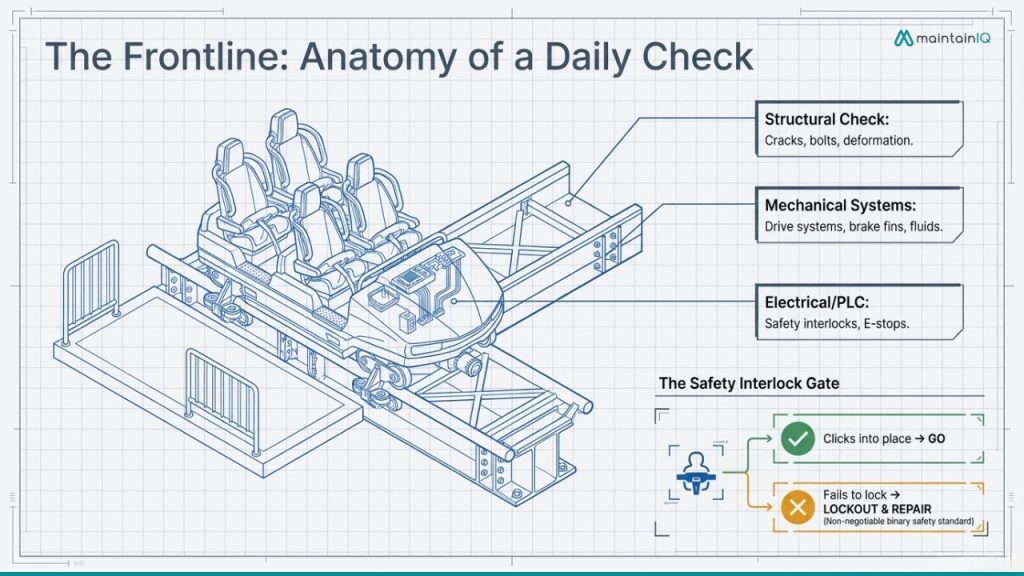
Daily inspections are the frontline of ride safety. Most states require documented daily inspections before any ride can open to the public, confirming safe operating conditions after overnight shutdown and before guests board.
What to Document for Every Ride, Every Day
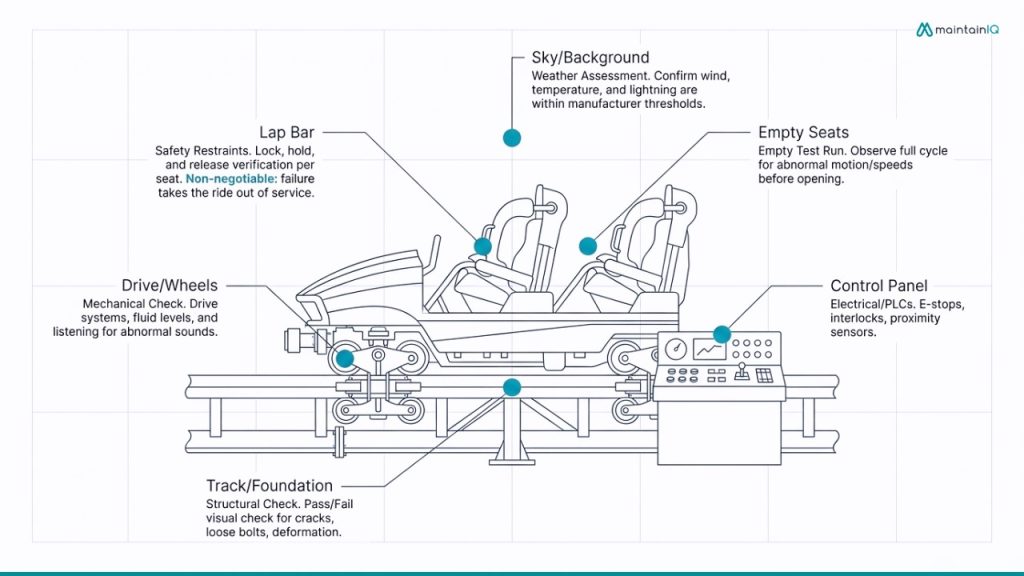
Visual structural inspection. Walk the entire ride structure — track, supports, foundations, platforms, queue fencing. Look for visible cracks, corrosion, loose bolts, missing hardware, deformation, or any structural change from the previous day. Document: ride name, inspector name, date, time, and a pass/fail for structural condition.
Mechanical systems check. Inspect drive systems (chains, cables, motors, gearboxes, hydraulics, pneumatics), braking systems (primary and emergency), and lift mechanisms. Listen for unusual sounds during test cycles. Check fluid levels on hydraulic systems. Document: mechanical systems condition, any abnormalities noted.
Safety restraint verification. Test every restraint — lap bars, over-the-shoulder harnesses, seat belts, and locking mechanisms — on every seat/vehicle. Verify that restraints lock, hold, and release properly. This is non-negotiable. A restraint that doesn’t lock correctly takes the ride out of service until repaired. Document: restraint test results per vehicle/seat, any units locked out.
Electrical and control systems. Verify that all safety interlocks, emergency stop circuits (E-stops), proximity sensors, and programmable logic controllers (PLCs) are functioning. Test E-stop buttons at operator stations and along the ride path. Verify that dispatch and block zone controls prevent vehicle collisions. Document: control system test results, E-stop functionality confirmed.
Test run(s) without passengers. Run the ride through at least one full cycle empty before opening to guests. Observe the entire cycle for abnormal motion, sounds, speeds, or stops. For rides with multiple operating modes, test each mode. Document: number of test cycles completed, observations, pass/fail for operations.
Ride area and guest environment. Check platform surfaces for damage or slip hazards. Verify that queue line barriers and gates are secure. Confirm that height measurement devices are in place and accurate. Check that ride signage (safety rules, restrictions, warnings) is visible and intact.
Weather assessment. Document wind speed, temperature, and precipitation conditions. Many rides have manufacturer-specified weather limits — wind speed thresholds for tall structures, temperature minimums for hydraulic systems, and restrictions during lightning. Document that conditions are within operating parameters.
The completed inspection report must be signed by the inspector and reviewed by a supervisor before the ride opens. Retain all reports per your state’s requirements — industry best practice is a minimum of one year, with many parks keeping them for the life of the ride.
Weekly and Monthly Inspections
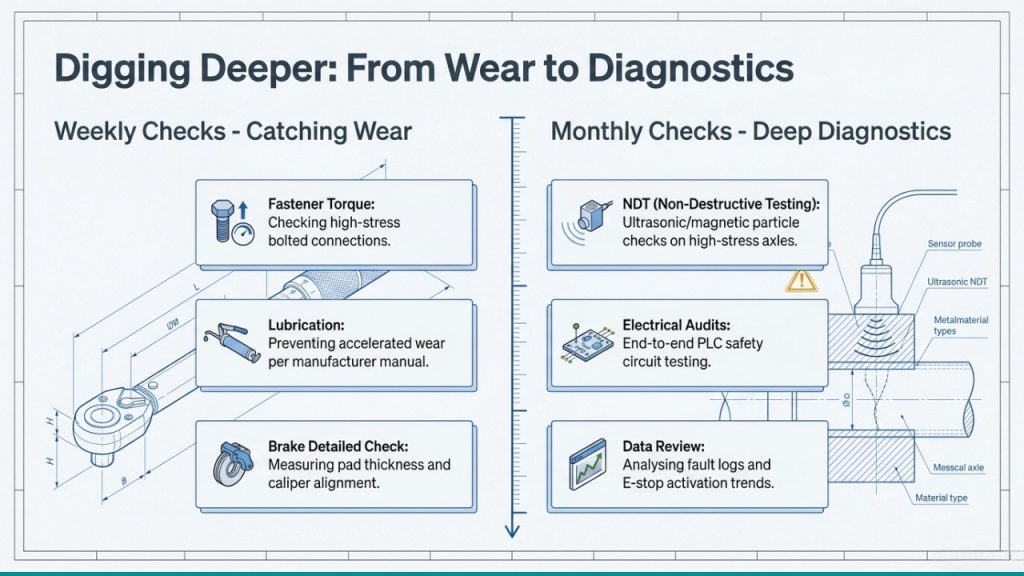
Weekly and monthly inspections go deeper than daily checks, catching wear patterns, gradual degradation, and component aging that daily inspections may not reveal.
Weekly Inspections
Fastener torque checks. Critical bolted connections should be checked weekly on high-stress rides. Vibration from normal operation can loosen fasteners over time. Document each connection checked and the torque reading.
Lubrication. Inspect and lubricate all specified points per the manufacturer’s maintenance manual. Under-lubrication causes accelerated wear; over-lubrication attracts debris. Document: lubrication points serviced, lubricant type used.
Brake system detailed inspection. Beyond the daily function test, weekly inspections should measure brake pad thickness, verify caliper alignment, and check hydraulic brake line condition. Document: brake measurements, comparison to minimum thresholds.
Safety restraint detailed inspection. Beyond the daily lock/release test, inspect restraint pivot points, spring mechanisms, latch wear, and webbing condition on seat belts. Document: restraint condition per vehicle, any components approaching replacement thresholds.
Monthly Inspections
Non-destructive testing (NDT) on critical components. Depending on the ride type and manufacturer requirements, monthly NDT may include visual, ultrasonic, magnetic particle, or dye penetrant inspection of high-stress structural connections, axles, wheel assemblies, and drive components. Document: NDT method used, components inspected, findings, and disposition of any indications found.
Electrical system comprehensive check. Inspect wiring, connectors, junction boxes, and control cabinets for corrosion, wear, or damage. Verify PLC software version matches the approved revision. Test all safety circuits end-to-end. Document: electrical system condition, any repairs or replacements.
Guest-facing safety features. Inspect height check devices, ride signage, safety announcements/recordings, and operator communication systems. Verify emergency lighting, public address systems, and evacuation equipment. Document: condition and functionality of each safety feature.
Ride operating data review. Review cycle counters, fault logs, and any ride monitoring system data. Identify patterns — increasing fault frequency, recurring E-stop activations, or cycle time variations that may indicate developing issues. Document: data reviewed, trends identified, actions taken.
Annual Comprehensive Inspections
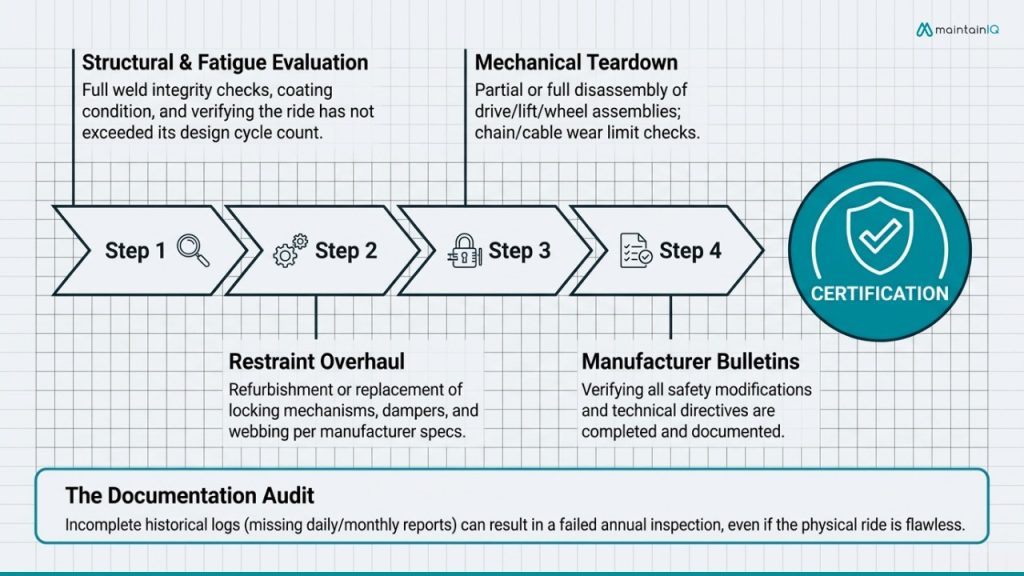
The annual inspection is the most thorough evaluation a ride receives. In most states, this inspection must be performed by a certified third-party inspector or a state inspector, and the resulting certification is required before the ride can operate for the season.
What Annual Inspections Cover
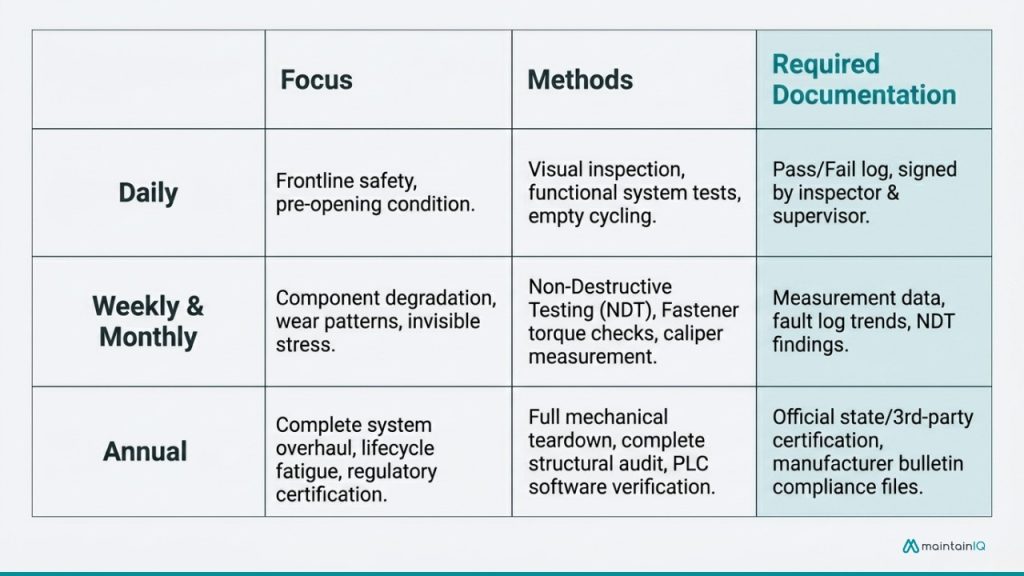
Full structural evaluation. Every structural member, connection, foundation, and support is inspected. For steel structures, this includes checking for corrosion, fatigue cracking, weld integrity, and coating condition. NDT methods (ultrasonic, magnetic particle, dye penetrant) are applied to critical joints and high-stress areas. For rides with structural fatigue life calculations, verify that the ride has not exceeded its design cycle count.
Complete mechanical teardown inspection. Drive systems, braking systems, lift mechanisms, and wheel assemblies are inspected in detail — often with partial or full disassembly. Bearings are checked for wear. Chains and cables are measured against wear limits. Hydraulic systems are checked for leaks, contamination, and pressure performance.
Full electrical and control system audit. Every safety circuit is tested. PLC programming is verified against the approved software version. Redundant safety systems are tested independently. Wiring and connectors are inspected throughout.
Restraint system overhaul. All restraints are inspected, tested, and refurbished or replaced as needed. Locking mechanisms, springs, dampers, and webbing are evaluated against manufacturer specifications.
Manufacturer bulletin compliance. Verify that all manufacturer service bulletins, technical directives, and safety modifications have been completed. Document the bulletin number, date of compliance, and work performed. Outstanding bulletins can result in a ride failing its annual inspection.
Documentation review. The annual inspector will review the park’s maintenance records — daily inspection logs, weekly and monthly reports, work orders, parts replacement history, incident reports, and training records. Incomplete or missing documentation can result in a failed inspection even if the ride itself is in good condition.
The annual inspection produces a certification document that most states require to be posted at or near the ride. This certification must include the inspector’s credentials, inspection date, standards referenced, and any conditions or restrictions.
Water Attractions and Aquatic Rides
Water slides, wave pools, lazy rivers, and splash pads have their own maintenance documentation requirements that layer on top of standard ride inspections.
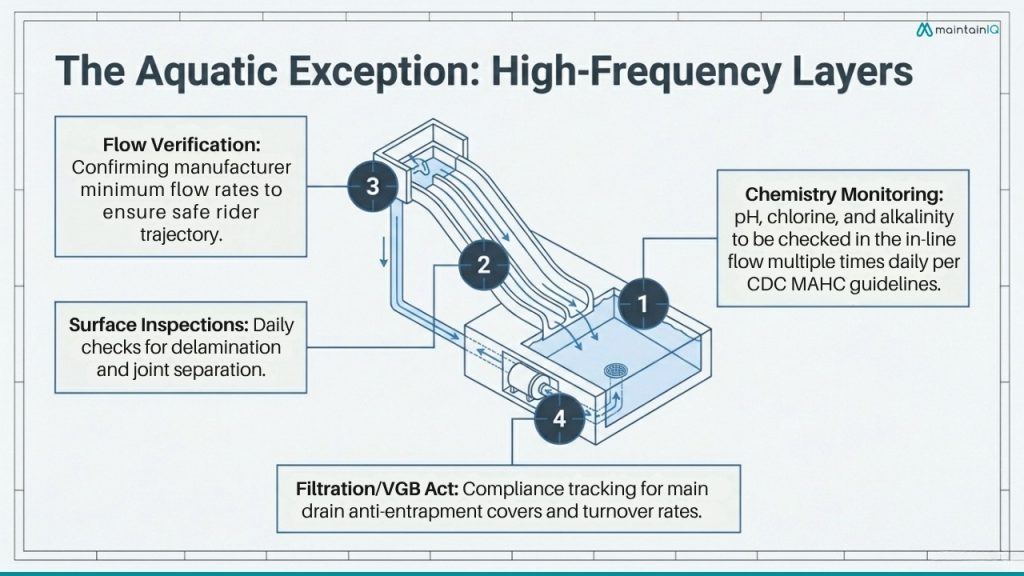
Water chemistry monitoring. Test pH, free chlorine (or alternative sanitizer), total alkalinity, and cyanuric acid levels multiple times per day per state health department requirements and CDC Model Aquatic Health Code (MAHC) guidelines. Document every reading with time, location, result, and any chemical adjustments made.
Slide surface and structural inspection. Daily visual inspection of flume surfaces for cracks, delamination, rough spots, or joint separation. Weekly detailed inspection of support structures, catch pools, and runout areas. Document condition and any repairs.
Water flow verification. Verify flow rates per slide against manufacturer specifications before opening — inadequate flow alters rider speed and trajectory, creating safety risks the slide wasn’t designed for. Document: flow rate readings per slide and comparison to manufacturer minimums.
Filtration and circulation. Inspect and document filter pressure differentials, pump operation, and turnover rates. Backwash filters on the schedule specified by your aquatics plan. Verify that main drains comply with the Virginia Graeme Baker Pool and Spa Safety Act (VGB Act) — anti-entrapment covers must be compliant, in good condition, and not expired.
Incident Documentation and Reporting
When an incident occurs — whether it’s a guest injury, a ride malfunction, a near-miss, or an emergency stop activation — the documentation requirements are immediate and specific.
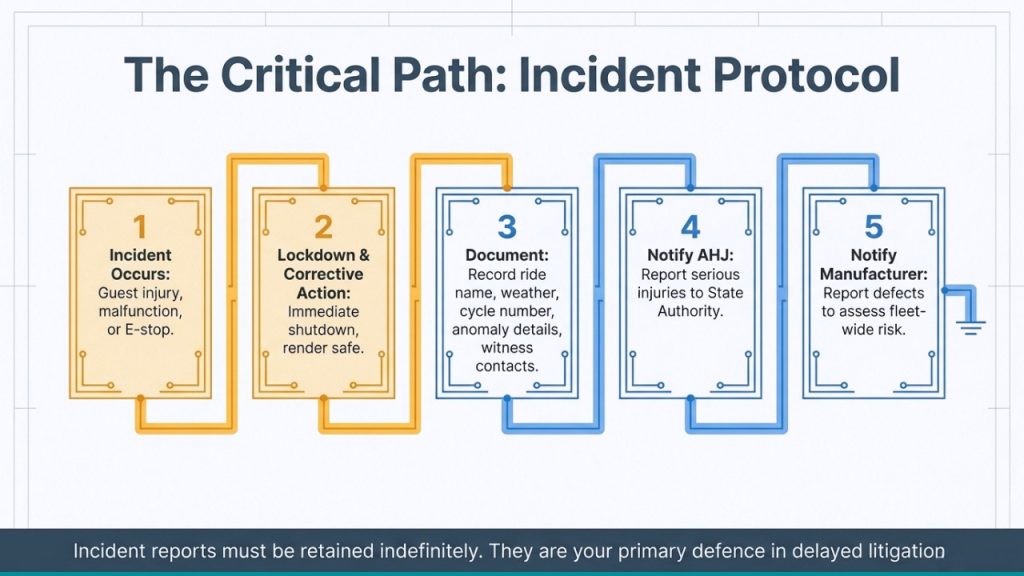
ASTM F770 requires operators to report incidents resulting in serious injury to the Authority Having Jurisdiction (AHJ) — typically your state’s ride safety division. “Serious injury” definitions vary by state but generally include any injury requiring overnight hospitalization.
What to document for every incident:
- Ride name, date, time, weather conditions, and cycle number
- Description of what happened, written by the ride operator and responding supervisor
- Names and contact information for the injured party and any witnesses
- Any mechanical or operational anomaly observed
- Immediate corrective actions taken
- Whether the ride was shut down, when it was returned to service, and what inspection or repair was performed before reopening.
Manufacturer notification. ASTM standards require operators to report ride-related defects to the manufacturer so they can assess whether other installations of the same ride are affected.
Incident reports must be retained according to your state’s requirements — but practically, they should be retained indefinitely. Litigation related to ride incidents can surface years after the event, and your documentation is your primary defense.
Building the Documentation System
The volume of documentation a theme park maintenance team must produce is substantial. A mid-sized park with 25 rides generates 25 daily inspection reports, plus weekly and monthly reports, plus water attraction logs, plus incident reports, plus annual inspection files — amounting to thousands of documented inspections per year.
Paper systems buckle under this volume. Binders get disorganized. Reports get misfiled, and when a state inspector asks for 12 months of brake records for a specific ride like Ride #14, finding them takes hours instead of seconds.
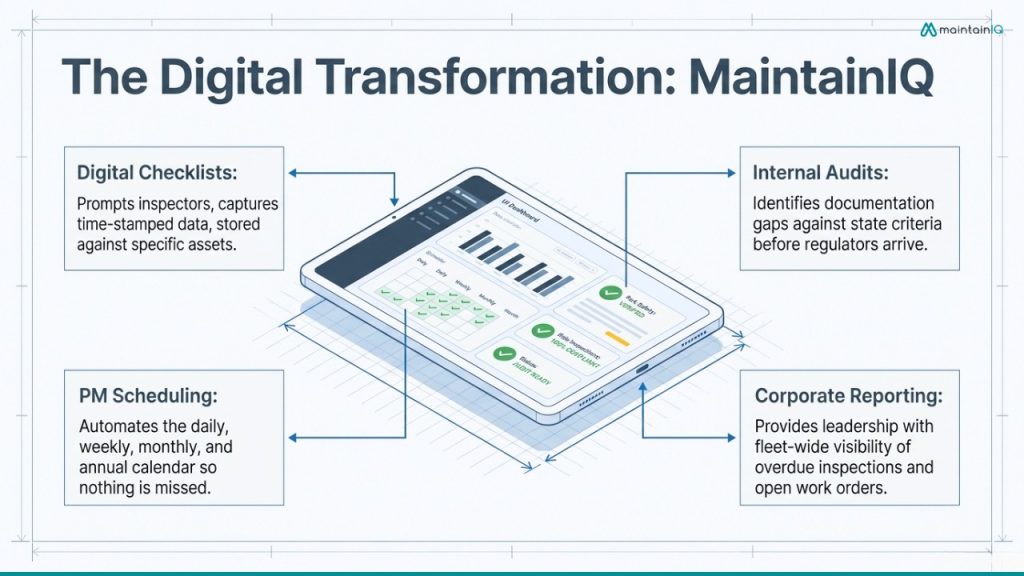
A CMMS (computerized maintenance management system) built for attractions solves this. Digital checklists built for each ride type prompt inspectors through every required check, capture time-stamped completion data, and store results against the specific ride asset. Deficiencies found during inspections automatically generate work orders assigned to the right technician with the right priority.
Preventive maintenance scheduling automates the recurring inspection calendar — daily, weekly, monthly, and annual — so nothing falls through the cracks. When a quarterly NDT inspection is due, the system generates the work order. When a manufacturer bulletin is issued, it can be tracked against every affected ride in your fleet.
Internal audits using your state’s inspection criteria — or the ASTM F2974 audit framework — identify documentation gaps before the state inspector does. With built-in compliance tracking, every bulletin, certification deadline, and overdue inspection stays visible in one place.
Corporate-level reporting gives leadership visibility across the entire park — or multiple properties — flagging overdue inspections, open work orders, and upcoming certification deadlines.
Multi-Park Operators: Scaling Safety Documentation
For operators managing multiple theme parks or amusement properties, the documentation challenge scales with every additional location.
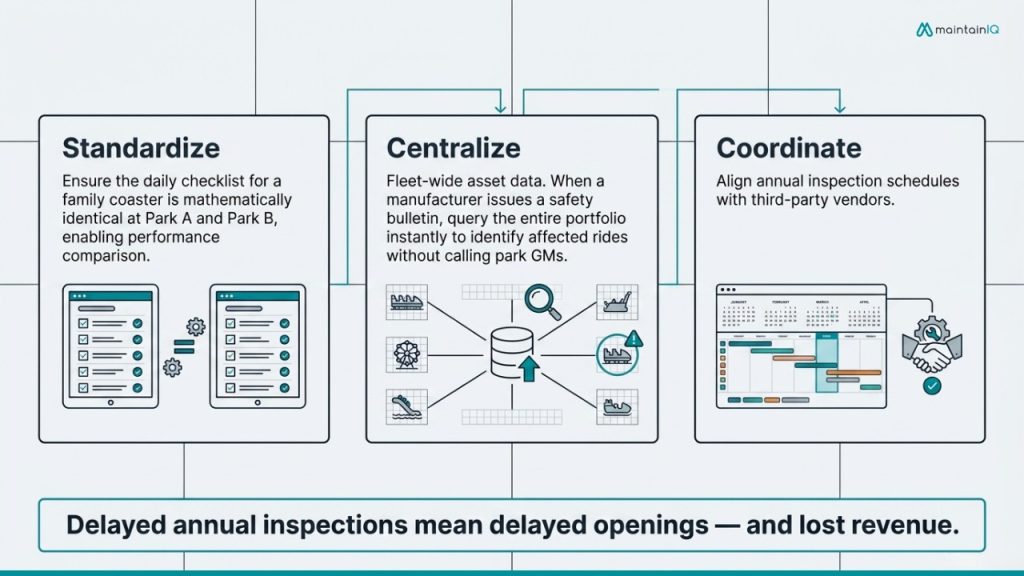
Standardize inspection protocols across all parks. The daily inspection checklist for a family coaster should be the same at Park A as it is at Park B. Standardization ensures consistent safety standards and enables performance across properties.
Centralize ride asset data. Know the age, cycle count, service history, manufacturer bulletin compliance status, and annual certification date for every ride across every park. When a manufacturer issues a safety bulletin, you need to identify every affected ride across your entire portfolio immediately — not call each park and ask.
Coordinate annual inspection scheduling. If multiple parks have rides approaching annual certification at the same time, coordinate with third-party inspectors early. Delayed annual inspections mean delayed openings — and lost revenue.
Getting Started
Start with your daily inspection program. If your daily checks are on paper — or inconsistent across rides — move them to digital checklists first. This is the foundation everything else builds on.
Then build your recurring inspection calendar. Map every weekly, monthly, quarterly, and annual inspection for every ride and attraction. Set up automated work orders so each inspection is generated on schedule.
Finally, connect inspections to maintenance. A worn brake pad found during a daily check should flow directly into a work order, get assigned to a technician, and be tracked to completion — with the entire chain documented and searchable.
MaintainIQ is a maintenance management software platform that brings digital checklists, preventive maintenance scheduling, work order management, internal audits, and corporate reporting into one platform — built for operators who need every ride inspected, every finding documented, and every corrective action tracked across every location.
Book a 20-minute demo to see how it works for theme park operations.
Conclusion
Theme park ride safety isn’t built on good intentions. It’s built on documentation — daily inspection reports, weekly maintenance logs, monthly NDT records, annual certifications, incident reports, and manufacturer bulletin compliance files that prove every ride has been maintained to the standard it was designed for.
State regulators check this documentation. Insurance auditors check it. And if an incident ever reaches a courtroom, it’s the first thing plaintiff’s counsel asks for.
The parks with the strongest safety records aren’t the ones with the newest rides. They’re the ones with the most complete documentation — because complete records mean complete maintenance, and complete maintenance means rides that operate the way they were engineered to operate, every cycle, every day.
The standard your rides were built to is only as good as your ability to prove you’ve maintained them to it.