Just as a single loose bolt can ground an airplane, one malfunctioning trampoline can shut down your entire park. You’re losing roughly $1,500 for every hour of unplanned downtime, not counting the damage to your reputation.
With a systematic preventive maintenance schedule, you’ll catch wear patterns before they become safety hazards or operational nightmares.
What if you could reduce unexpected equipment failures by 70% while extending the lifespan of your most expensive assets?
Table of Contents
The Impact of Downtime on Trampoline Park Operations
When your trampoline park experiences unexpected downtime, you’ll face financial losses beyond just missed ticket sales, including staff wages, refunds, and potential reputation damage.

Customer satisfaction plummets with each closure, as families who’ve travelled for the experience may not return after a disappointing visit.
Regular maintenance is essential—not just for operations but as a safety measure, preventing equipment failures, injuries, and liability.
Understanding the True Costs of Unexpected Closures
Although many trampoline park owners focus primarily on equipment costs, the financial impact of unexpected closures often dwarfs routine maintenance expenses.
When your facility shuts down unplanned, you’re not just losing ticket sales—you’re facing cancelled parties, refunds, staff wages without revenue, and potential reputation damage.
Operational disruptions affect inventory, staffing, and customer trust—amplified by negative social media.
Break free from reactive maintenance cycles by accurately calculating these hidden costs.
When you understand what closures truly cost, investing in prevention becomes the obvious financial choice.
Customer Satisfaction and Safety Risks
The most concerning aspect of trampoline park downtime extends beyond financial losses to directly impact customer safety and satisfaction.
When equipment fails unexpectedly, you face disappointed customers and potential safety hazards that could lead to injuries and liability issues.
Your insurance compliance depends on maintaining operational equipment. Properly functioning trampolines and safety systems protect visitors and businesses from preventable incidents.
Additionally, downtime disrupts staff productivity and halts revenue generation. Your team stands idle while costs continue. Customers looking for physical activity leave disappointed—some never return.
Key Elements of an Effective Preventive Maintenance Schedule
Your preventive maintenance schedule must include three critical components to guarantee trampoline park safety and durability.
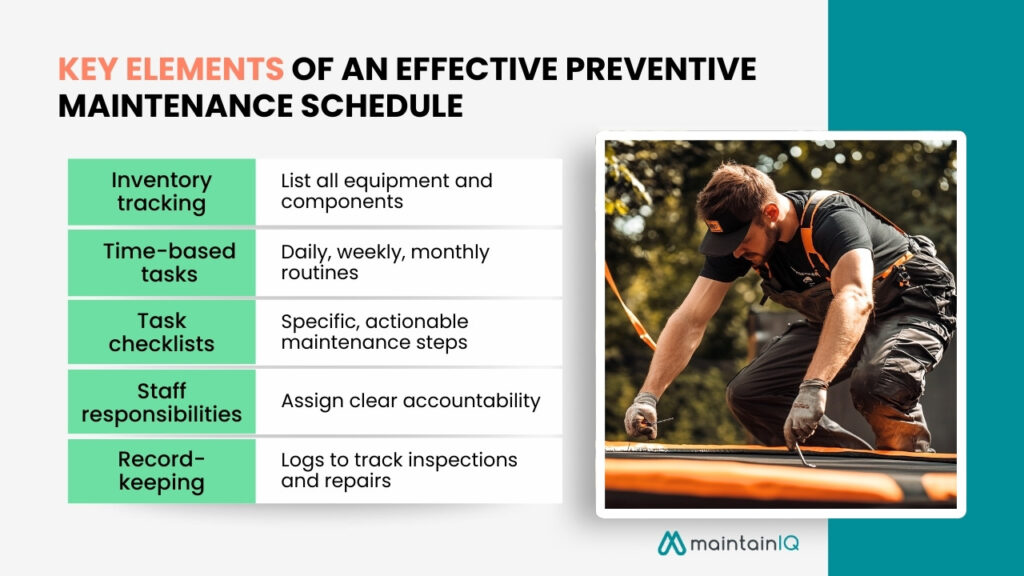
Regular equipment inspections enable early detection of wear patterns, predetermined replacement cycles prevent catastrophic failures, and staff training with accountability through documentation creates a complete safety system protecting both your business and customers.
Routine Equipment Inspections and Monitoring
Daily visual inspections must be conducted before opening your facility to identify any visible damage or safety hazards promptly.
Establish a weekly, detailed component check system that methodically examines all springs, mats, and padding for signs of wear or structural weakness.
These scheduled inspections are essential safeguards that protect your patrons and prevent costly equipment failures.
Daily Visual Inspections
Before customers enter your facility, performing thorough visual inspections serves as your first line of defense against potential safety hazards.
Train your staff to recognize torn padding, loose springs, or frame damage through detailed employee training.
Incorporate these checks into your maintenance protocols and operational procedures, empowering your team to identify issues before they escalate into costly shutdowns confidently.
Weekly Detailed Component Checks (Springs, Mats, Padding)
A thorough weekly inspection protocol moves beyond daily visual checks to examine critical trampoline components in greater detail.
Focus on spring tension, mat integrity, and padding security—areas where wear typically begins.
Document findings in your maintenance system to track degradation patterns, preventing unexpected failures and allowing proactive replacements.
Scheduled Replacement and Repairs
Recognizing wear patterns in high-traffic areas allows you to predict equipment failure before accidents occur.
Establish a data-driven replacement schedule for springs, padding, and jump surfaces based on manufacturer recommendations and your park’s specific usage patterns.
Replace springs showing metal fatigue immediately, while padding should be swapped out at first signs of compression loss or tearing, not when completely deteriorated.
Identifying Wear Patterns and Predicting Equipment Failure
While conducting routine inspections, skilled maintenance technicians must develop the ability to identify specific wear patterns that indicate potential equipment failure. Recognizing these signs reduces costs and predicts when components need replacement.
| Wear Pattern | Potential Failure Risk |
| Frayed springs | Spring breakage |
| Padding compression | Impact protection loss |
| Frame discoloration | Structural weakness |
| Mat thinning | Tear/puncture hazard |
| Connection loosening | Component separation |
Best Practices for Timely Spring and Padding Replacements
Effective spring and padding replacement schedules form the cornerstone of any extensive trampoline park maintenance program.
Replace springs at 70% tension loss and padding when compression drops below standards.
Document spring wear patterns and padding deterioration systematically, incorporating both into your maintenance workflow.
This proactive approach prevents accidents while reducing unexpected equipment downtime.
Staff Training and Accountability
Maintenance staff must have clearly defined responsibilities documented in writing, with each team member understanding exactly which equipment they’re accountable for inspecting and maintaining.
Implement regular training sessions that cover current preventive maintenance procedures, proper documentation protocols, and any updates to manufacturer guidelines.
Always maintain detailed records of all staff training activities, including dates, topics covered, and participant verification, as these will prove invaluable during safety audits or incident investigations.
Clearly Defined Maintenance Responsibilities
Accountability forms the cornerstone of trampoline park safety maintenance. Clearly defined employee roles that specify who handles inspections, repairs, and record-keeping.
Establish maintenance priority setting protocols to address critical safety issues first.
Proper maintenance budget allocation guarantees resources are available when needed, preventing dangerous equipment neglect.
When everyone knows their responsibilities, your preventive maintenance system remains effective and consistent.
Regular Staff Training on Preventive Maintenance Procedures
With well-defined responsibilities established, staff training becomes the essential execution component of your maintenance strategy.
You’ll need ongoing, continuous training programs that reinforce proper inspection techniques and immediate reporting protocols.
Guarantee staff accountability through maintenance oversight systems that track completion of preventive tasks.
Your team’s ability to identify early warning signs prevents costly repairs and enhances visitor safety.
Optimizing Your Maintenance Schedule for Minimal Downtime
Scheduling your trampoline park’s maintenance during off-peak hours guarantees critical safety inspections don’t interfere with customer flow or revenue generation.

Maximize efficiency with a prioritized task list addressing high-impact safety issues first and combining related activities.
This strategy keeps downtime minimal while maintaining safety standards.
Performing Maintenance During Off-Peak Hours
Analyzing your facility’s visitor traffic patterns through attendance data will help you identify consistent low-volume periods ideal for maintenance activities.
Minimize revenue loss and customer disappointment by scheduling essential equipment inspections and repairs during these naturally quieter times.
Clearly communicate any planned maintenance windows through your website, social media channels, and on-site signage at least one week in advance, providing customers with alternative visiting options.
Analyzing Visitor Patterns to Identify Ideal Maintenance Times
Schedule maintenance by analyzing foot traffic to identify natural lulls.
Holiday season trends reveal predictable patterns—schedule thorough inspections before peak rushes.
Staff scheduling optimization guarantees qualified personnel can perform maintenance during slower periods.
Review customer engagement strategies to temporarily redirect visitors when maintenance can’t wait, preserving both safety and guest satisfaction.
Communicating Scheduled Downtime Clearly to Customers
Once an ideal maintenance schedule is established, transparent customer communication becomes your next critical responsibility.
Optimize downtime notifications through multiple channels—social media, email alerts, and on-site signage—at least one week before scheduled maintenance.
Your customer communication strategies should include precise timing details and alternative options.
Streamlining downtime messaging builds trust while ensuring visitors feel respected, not inconvenienced.
Prioritizing Maintenance Tasks for Maximum Efficiency
To maximize your maintenance efficiency, establish a clear system for categorizing repairs as either critical (requiring immediate attention) or non-critical (which can be scheduled during planned downtime).
Critical tasks address safety concerns that could potentially harm guests, such as torn trampoline beds, damaged springs, or compromised padding.
Developing an exhaustive preventive maintenance calendar will help you track recurring tasks, equipment inspections, and replacement schedules, ensuring you’re addressing potential issues before they develop into costly emergency repairs.
Categorizing Repairs: Critical vs. Non-critical Tasks
Effective maintenance prioritization forms the foundation of a successful trampoline park operation.
Maximize uptime by categorizing repair costs as either critical (safety systems, main jumping surfaces) or non-critical (cosmetic issues, secondary amenities).
This distinction drives repair scheduling optimization and proper labor resource allocation, ensuring your team addresses potential dangers first while keeping your park operational and guests safe.
Creating a Long-term Preventive Maintenance Calendar
Beyond categorizing immediate repairs, a strategic preventive maintenance calendar forms the bedrock of operational excellence at your trampoline park.
Integrate seasonal maintenance calendar planning with equipment life cycle management to anticipate needs before failures occur.
Track ongoing cost analysis to identify when replacement becomes more economical than repair.
Move from reactive maintenance cycles while maximizing both safety and operational uptime.
Using Maintenance Scheduling Software to Reduce Downtime
Switching to digital maintenance scheduling can transform your trampoline park’s safety protocol from reactive to proactive, allowing you to track inspection history and receive automatic maintenance alerts.

MaintainIQ’s specialized software enables you to schedule preventive maintenance tasks based on equipment usage statistics rather than arbitrary timeframes, resulting in fewer equipment failures.
Your staff can quickly document completed inspections with mobile-friendly digital checklists, creating verifiable safety records that protect both your customers and business.
Benefits of Switching to Digital Maintenance Scheduling
Digital maintenance software transforms your trampoline park operations by automating work orders and sending timely reminders when equipment requires attention.
Eliminate the guesswork from maintenance scheduling while ensuring critical safety inspections are never missed.
The system’s ability to track performance metrics across all equipment allows you to identify patterns of wear, anticipate potential failures, and address issues before they lead to costly downtime or safety risks.
Automating Work Orders and Reminders
As trampoline parks endeavor for operational excellence, automating work orders and reminders through maintenance scheduling software represents a critical step toward minimizing downtime.
Receive alerts when inspections are due, use mobile workflows to eliminate paperwork, and apply predictive analytics to detect failures before they cause injuries or closures.
Tracking Equipment Performance to Anticipate Failures
Beyond automating work orders, maintenance scheduling software empowers trampoline park operators to track equipment performance metrics with unprecedented accuracy.
Gain freedom from unexpected failures by implementing equipment health monitoring systems that collect real-time data on spring tension, frame stability, and padding integrity.
Sensor-based diagnostics and fault prediction models identify warning signs before catastrophic breakdowns occur, liberating you from costly emergency repairs.
How MaintainIQ Enhances Preventive Maintenance Scheduling
MaintainIQ streamlines your trampoline park maintenance by centralizing digital logs, equipment records, and scheduling tasks in one accessible platform.
Automated asset tracking predicts maintenance needs, preventing failures and reducing emergency repairs and downtime.
Your facility’s compliance requirements become easier to manage with MaintainIQ’s systematic record-keeping capabilities, ensuring you maintain consistent documentation for inspections and safety certifications.
Centralized Maintenance Management and Digital Logs
While traditional paper-based maintenance systems often lead to communication gaps and missed tasks, a centralized digital maintenance system like MaintainIQ transforms how trampoline park operations manage their preventive maintenance schedules.
Access diagnostics and training data from anywhere. Make data-driven decisions, eliminate paperwork, and strengthen safety protocols.
Asset Tracking and Predictive Maintenance Capabilities
Effective asset tracking serves as the foundation for implementing predictive maintenance strategies that can dramatically reduce equipment downtime in your trampoline park.
| Feature | Benefit |
| Inventory optimization | Eliminates wasteful spare parts spending |
| Equipment diagnostics | Detects issues before catastrophic failure |
| Failure mode analysis | Identifies root causes of recurring problems |
| Condition monitoring | Tracks performance degradation patterns |
| Maintenance forecasting | Schedules interventions during low-traffic periods |
Ensuring Consistent Compliance and Record-Keeping
When regulatory compliance becomes a moving target, maintenance scheduling software transforms your record-keeping from a liability into a strategic advantage.
Establish robust record retention policies that satisfy inspectors while implementing staff accountability measures that verify completed tasks.
MaintainIQ’s documentation best practices guarantee you’re never caught unprepared during audits—freeing you from paperwork anxiety and giving you confidence that your facility consistently meets safety standards.
Common Mistakes in Preventive Maintenance Scheduling (and How to Avoid Them)
Preventive maintenance programs often fail when you neglect regular inspections that should follow manufacturer-specified intervals for every piece of equipment in your facility.

Poorly documented records prevent issue tracking and safety compliance verification.
Clear communication channels between your operations, maintenance, and management teams are essential to guarantee that identified issues aren’t overlooked and safety concerns receive immediate attention.
Neglecting Regular Inspections and Updates
One of the most critical errors in trampoline park maintenance is neglecting regular inspections and updates. When you skip these essential checkpoints due to budget constraints, you’re gambling with both safety and future expenses.
Equipment deterioration accelerates silently between inspections, transforming minor fixes into major overhauls.
Staff expertise gaps often contribute to this neglect—team members mightn’t recognize early warning signs of wear.
Break free from this dangerous cycle by implementing non-negotiable inspection schedules.
Document everything meticulously, even when it seems redundant.
Consistent inspections prevent accidents and free your business from unexpected downtime.
Poorly Documented Maintenance Records
Poorly documented maintenance records represent a significant liability that parallels the dangers of skipped inspections. When you fail to maintain detailed logs, troubleshooting becomes needlessly complex, and problems recur without resolution.
Your freedom to operate safely depends on thorough documentation. Address expertise gaps with standardized record-keeping anyone can follow.
Replace outdated maintenance manuals with digital systems that track component lifespans and maintenance histories.
Establish an adequate part inventory through documented usage patterns rather than guesswork.
Remember, proper documentation protects against preventable downtime and pathway to operational independence.
Lack of Communication Among Staff
When maintenance staff operate in communication silos, even the most meticulously designed preventive maintenance schedule will fail.
Poor employee communication creates safety risks, extends equipment downtime, and damages team morale.
- Establish clear internal processes that connect all stakeholders in your maintenance operations.
- Implement daily maintenance briefings before shift changes.
- Create a digital communication hub for real-time equipment updates.
- Establish standardized terminology for describing trampoline issues.
- Schedule monthly cross-training sessions between departments.
- Develop escalation protocols for critical maintenance concerns.
Breaking down communication barriers empowers your team to take ownership of park safety and maintenance protocols, ultimately reducing costly downtime and fostering a culture of shared responsibility.
Conclusion: Take Control of Downtime with Proactive Maintenance Scheduling
The proactive management of maintenance schedules represents your most powerful tool in minimizing trampoline park downtime. By implementing structured preventive protocols, you’ll boost employee morale while creating operational flexibility that serves both your business and customers.
Your commitment to systematic risk assessment transforms maintenance from reactive emergency responses to strategic advantage. Don’t let equipment failures dictate your operational rhythm.
Take control by documenting maintenance history, establishing clear inspection schedules, and empowering staff with proper training. This liberation from unpredictable breakdowns creates financial stability and enhances your reputation for safety excellence.
The path to operational freedom starts with maintenance discipline.