You might not realize that most fire codes require detailed documentation for every fire suppression maintenance task in your commercial kitchen. Even small lapses can lead to non-compliance, system failures, or insurance claim rejections.
Routine inspections and scheduled servicing aren’t just best practices—they’re regulatory mandates that keep your kitchen operational and protected.
Understanding how these systems work and why their upkeep directly impacts your business is essential if you want to avoid costly setbacks.
Table of Contents
Why Fire Suppression Maintenance Isn’t Optional
Although some may underestimate its significance, fire suppression system maintenance isn’t a discretionary task—it’s a mandatory requirement dictated by national fire codes like NFPA 96 and enforced by local authorities.
You’re responsible for combating fire hazards and preventing unsafe operations in your commercial kitchen.
Ignoring regular inspections or maintenance jeopardizes compliance and heightens risk for staff and property.
Scheduled servicing detects malfunction, wear, or obstructions before they undermine system effectiveness.
What Is a Fire Suppression System and How It Works
A commercial kitchen fire suppression system consists of interconnected nozzles, sensors, and a control panel engineered for rapid response.

When heat or flames trigger the detection mechanism, the system immediately discharges extinguishing agents tailored to the hazard—most often a wet chemical or, in some cases, a dry chemical solution.
Understanding these components and activation methods is essential for ensuring compliance and effective risk mitigation.
Core Components in a Commercial Kitchen Setup
A commercial kitchen’s safety infrastructure depends on several integrated components, with the fire suppression system serving as a critical safeguard against cooking-related fires.
You’ll find this system seamlessly incorporated into your kitchen ventilation design, especially within exhaust hoods, managing combustible vapors effectively.
Key elements include agent storage cylinders, heat detection lines, discharge nozzles, and manual pull stations—all arranged to maximize response speed and coverage.
Precise nozzle placement targets high-risk areas like fryer banks, aligning with fire code regulations.
These components operate as a unified network, ensuring compliance while empowering your kitchen crew to focus confidently on culinary innovation.
How It Activates During a Fire Event
When a fire breaks out on the cooking line, the fire suppression system springs into action through a sequence that prioritizes immediate threat reduction. You’ll notice activation triggers—thermal links or fusible links—reach a preset temperature, releasing the suppression agent.
The system simultaneously shuts off gas or electric power, halting fuel flow to the fire’s origin. Alarm notifications signal staff and alert emergency response. Every element works swiftly, in compliance with fire code regulations, minimizing downtime and risk.
Common Types: Wet Chemical vs. Dry Chemical Systems
Understanding the activation process sets the stage for evaluating fire suppression system types suited to commercial kitchens. You’ll typically encounter wet chemical and dry chemical systems—each with unique code-driven benefits. Wet chemical systems excel at grease-laden fires with effective discharge patterns, deploying saponification for rapid knockdown. Dry chemical systems, on the other hand, disperse powders to interrupt combustion but may leave residue.
| System Type | Effective Discharge Patterns | Automated Maintenance Scheduling |
| Wet Chemical | Directed nozzle coverage | Integrated diagnostic alerts |
| Dry Chemical | Wide, rapid aerosol spread | Manual inspection prompt |
| Compliance | NFPA 17A | Industry-standard protocols |
| Cleanup | Minimal chemical residue | Major kitchen clean-up |
| Cost | Moderate w/long-term savings | Lower initial, higher upkeep |
Key Maintenance Tasks and Their Recommended Frequency
To maintain code compliance and system reliability, you must follow a scheduled maintenance program.

Conduct daily or weekly visual checks, complete monthly pressure and control tests, and arrange semi-annual NFPA 96 inspections.
After any system activation, promptly reset, recharge, and document the maintenance to guarantee operational readiness.
Daily/Weekly Visual Checks (e.g., nozzles, hoods, manual pull stations)
Even though automatic fire suppression systems are designed for reliability, commercial kitchens must complete daily and weekly visual checks to ascertain all components remain ready for immediate operation.
Visually monitor nozzles for obstructions, verify hoods are clean and intact, and confirm manual pull stations are accessible and clearly marked. This routine visual monitoring aligns with NFPA 96 code, forming a foundation for preventive maintenance.
Don’t ignore misplaced parts, grease buildup, or blocked access points.
With this discipline, your staff stays ready, risk is minimized, and operational freedom is sustained.
Monthly System Pressure and Control Checks
Every month, conduct thorough checks of your fire suppression system’s pressure gauges, detection controls, and system cartridges to guarantee operational integrity.
Verify gauge readings align with manufacturer specifications; inaccuracies signal the need for system calibration.
Inspect all control panels for status indicators or faults—immediate troubleshooting keeps you in compliance.
Execute valve condition checks, ensuring every valve moves freely and displays no corrosion or leakage.
Assess cartridge weight and expiration dates, replacing components as needed to eliminate preventable risks from your operation.
Meticulous monthly reviews mean your kitchen stays protected and ready, empowering you to focus on culinary innovation.
Semi-Annual Professional Inspection (NFPA 96 Compliant)
While your monthly inspections play an essential role, semi-annual professional servicing is mandated by NFPA 96 and addresses critical aspects beyond routine checks. An authorized technician guarantees your system’s integrity by verifying it aligns with the original commissioning process and supports your quarterly cleaning routines.
This inspection removes hidden liabilities and strengthens compliance. A typical service includes:
- Inspecting nozzle alignment and unobstructed discharge pathways.
- Testing manual pull stations and automatic actuation mechanisms.
- Verifying cylinder hydrostatic test dates and agent levels.
- Confirming system interlocks with fuel sources and exhaust fans.
Stay empowered—make these reviews non-negotiable.
Post-Activation Reset & Recharge Requirements
After any fire suppression system discharge, shift immediately from prevention to restoration. Evacuate the area and coordinate with professionals to assess system integrity.
Next, initiate mandated post-activation testing to verify that all detection circuits, release mechanisms, and alarms are operational.
According to NFPA 96, you must follow manufacturer-approved system recharging protocols, ensuring all suppressant agents are properly replaced and cylinders pressured to specification.
Document every reset and recharge event meticulously.
Don’t restore kitchen operations until the contractor certifies full system restoration. With prompt, code-compliant actions, you guarantee safety and regain your autonomy in the kitchen.
What Happens If You Skip Maintenance
If you skip scheduled maintenance, you’re increasing your risk of fire-related shutdowns and code violations, which can lead to costly insurance denials.

Local regulations require regular inspections and functional systems, so non-compliance exposes you to legal and financial penalties. Neglected equipment also wears out faster, reducing system reliability and lifespan.
Risk of Fire-Related Shutdowns
Neglecting routine fire suppression maintenance exposes commercial kitchens to major operational risk. Even a minor fault can result in an unchecked fire and forced shutdown. You’ll face more than property damage—your restaurant downtime can quickly snowball into costly business interruption.
To achieve operational freedom and minimize risk, consider these consequences:
- Uncontrolled fires escalating before manual intervention.
- Forced shutdowns resulting in lost revenue and workflow disruption.
- Critical assets, including appliances and inventory, damaged beyond repair.
- Extended recovery time, hindering your ability to resume service swiftly.
A proactive, code-compliant approach gives you control and protects both people and profits.
Violation of Local Fire Codes and Insurance Denials
Noncompliance with local fire codes presents immediate legal and financial consequences for commercial kitchens. If you neglect scheduled inspections or display a lack of maintenance, you risk costly fines from regulatory authorities.
Your insurance provider may also deny claims if you’re found operating out of compliance, forcing you to absorb the full cost of fire damages. Such oversight restricts your operational freedom, compelling you to comply or face closures.
Meeting inspection schedules and documenting maintenance transforms compliance into a business advantage—protecting your kitchen, investments, and reputation.
Reduced Lifespan of Suppression Equipment
Each skipped maintenance cycle accelerates wear on your fire suppression equipment and undermines its reliability.
Neglected systems become vulnerable to premature failure, leading to these consequences:
- Corrosion concerns—without regular inspection, pipes and nozzles corrode, degrading performance.
- Reduced operational life—components wear out faster, demanding early replacement.
- Increased impact on insurance premiums—insurers may penalize your business for heightened risk.
- Unplanned downtime—system failure during an event can halt your kitchen operations.
Stay code-compliant and safeguard your investment by maintaining your system consistently.
How MaintainIQ Helps You Stay Fire-Safe and Compliant
With MaintainIQ, you centralize digital fire suppression maintenance logs and automate recurring task reminders for full staff accountability. You’ll generate professional inspection records and audit-ready reports that align with code requirements.
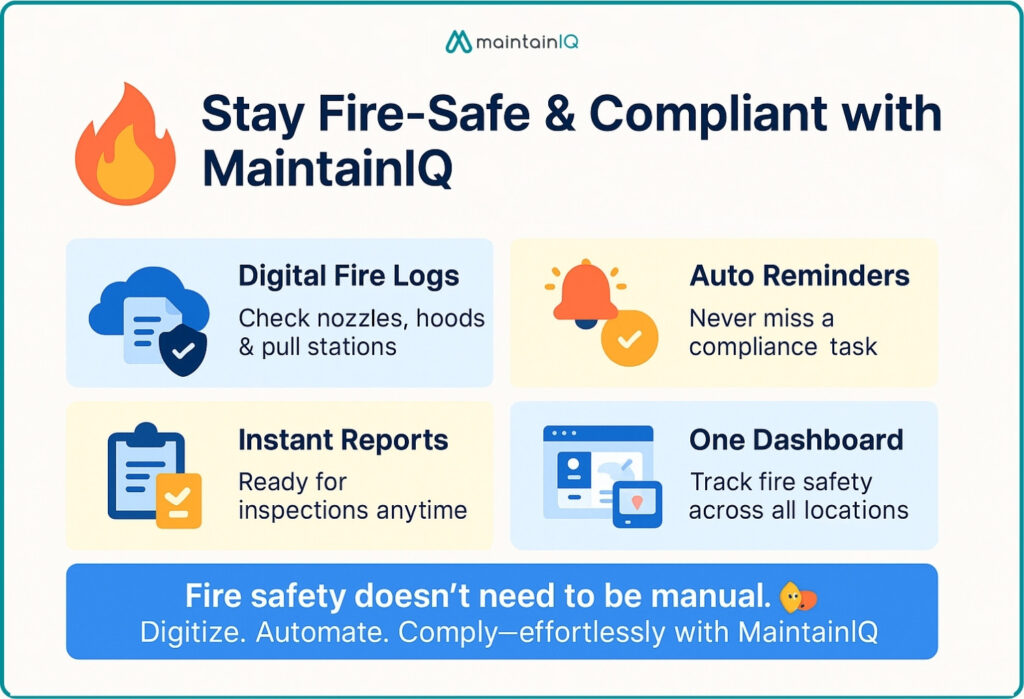
Manage multiple locations efficiently from one dashboard, minimizing compliance risks across your operations.
Digital Fire Suppression Maintenance Logs
Switching to digital fire suppression maintenance logs streamlines your compliance process and instantly improves traceability. You gain tighter control and visibility over critical safety documentation, freeing yourself from bulky paper binders and data silos.
MaintainIQ empowers you through advanced features that keep your kitchen both fire-safe and code-compliant:
- Secure digital fire log backup guarantees your records are never lost or misplaced.
- Automated maintenance alerts proactively notify you before deadlines are missed.
- Instant report generation simplifies inspections and audits.
- Timestamped log entries safeguard a complete, trustworthy maintenance history.
Leverage digital logs to attain true operational freedom and defensible compliance.
Recurring Task Reminders and Staff Accountability
A single missed maintenance task in your kitchen’s fire suppression system can compromise safety and violate code compliance. With MaintainIQ, you’ll never miss critical actions—automated recurring task reminders keep your team on schedule and aligned with regulatory demands.
Real-time staff communication guarantees everyone is clear on responsibilities, eliminating confusion.
Built-in accountability protocols require digital sign-offs, providing verifiable proof of task completion.
This precise system of reminders, transparent scheduling, and documented staff engagement liberates you from outdated paper checklists and uncertainty.
Professional Inspection Records and Audit-Ready Reports
Because regulatory compliance demands precise documentation, MaintainIQ equips you to log every professional inspection and maintenance event in an organized, tamper-proof digital format.
MaintainIQ empowers you with:
- Timestamped digital logs for all inspections and corrections.
- Automatic report generation that meets code requirements.
- Secure record storage, preserving integrity for audits or claims.
- Instant sharing capabilities to satisfy inspectors and insurance reviewers.
Stay liberated—compliance never felt so seamless.
Multi-Location Oversight from One Dashboard
Robust inspection records form the foundation for efficient oversight, especially when managing multiple commercial kitchen locations. With MaintainIQ, you gain centralized system monitoring, allowing you to track fire suppression system status and compliance at every site in real time.
You’ll access a unified dashboard, analyze inspection data, and identify code compliance gaps instantly.
When issues arise, remote troubleshooting empowers you to diagnose and coordinate corrective actions promptly—no on-site visit required. This minimizes downtime and penalties—keeping every location operational and compliant.
MaintainIQ directly supports your drive for autonomy, giving you clear, actionable oversight from anywhere.
Fire Safety Starts with Consistency
Set aside any uncertainty—fire safety in commercial kitchens hinges on maintaining consistent protocols and practices. You drive fire risk reduction by integrating routine checks and emphasizing employee training.
Reliable systems demand repeatable actions, not improvisation.
Empower your staff with clear responsibilities, accurate information, and responsive escalation paths. For freedom from avoidable hazards, implement a code-compliant approach every shift:
- Inspect suppression equipment weekly for operational integrity.
- Schedule professional maintenance every six months.
- Conduct quarterly employee training focused on real-world scenarios.
- Log all activity and incidents for compliance and review.
Precision and reliability liberate your kitchen from fire-related interruptions.